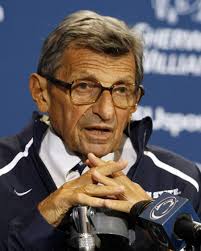
Just like Joe Paterno’s last day as a football coach, comes the last day of his life.
The first came like a thief in the night. The second came without as much surprise and shock but with similar dismay.
Penn State won’t be the same in many ways. Neither will college sports.
Here are five of my memories of the man called Joe Pa, who died of all things – lung cancer – at the age of 85 on Jan. 22, 2012:
1. I met Joe Paterno in the summer of 1995. Paterno came to Waynesboro to help dedicate the Charles A. “Rip” Engle Sports Complex. Afterwards, Paterno joined many involved in the Rip Engle project as well as well-wishers in downtown Waynesboro. He was kind and approachable. I shook his hand and told him he recruited my father, Edward D. Goodwin, back in the late 1950s. I don’t know if he remembered. But, just knowing that, in some small way, I was linked to Paterno made me feel special. My father never went to Penn State. Instead, after a year at West Point and then back home to take care of his family after his father died, Dad went to the University of Pennsylvania. My father died in 1999, but, during his life, he admired all that Paterno stood for as a coach, an educator and an ambassador for higher education and amateur sports.
2. The year was 1973. Joe Paterno was being lured away from college football by the New England Patriots. Paterno declined, and former University of Oklahoma football coach Chuck Fairbanks took the head coaching job of the Patriots. It didn’t sink in until later in my life that Paterno was a wise man. Ego is a pretty big thing in successful coaches, and Paterno was successful. In just seven years as the head coach of Penn State, he already had three undefeated seasons and a memorable disagreement with President Nixon in 1969 after Nixon awarded Texas the national championship. Paterno could have become another statistic: a college coach falling flat in the NFL. Instead, Paterno stayed in Happy Valley and continued to build winning teams and college graduates.
3. By the numbers. Paterno was never fond of polls. He shrugged at winning national championships. He was “just a football coach who’s won a few games.” His simple approach ensured his longevity. He never became embroiled in the controversies about who should be number one, who should be playing for the national championship, and how someone should vote. When the Nittany Lions finished behind Nebraska in the Associated Press and Coaches Poll after the 1994 season, Paterno didn’t seem to think it was the end of the world. Because, to him, it wasn’t about who wins the national championship. It was about molding student-athletes into being good competitors, good students, and, ultimately, good citizens.
4. The ripple effect. Here is where the story ends – like a Greek tragedy, or, perhaps, an American tragedy. Like many, I was blindsided by the events of early November 2011. Paterno didn’t have a chance. He was buried in an avalanche of criticism, condemnation, and angst. Were they mad at him for turning them away in 2004? Were they mad at him for “not doing more?” But that’s not how I remember Paterno. I remember him through the kind words of his former players, who knew Paterno, who played for him, who listened to him.
5. The games. Penn State’s last-second win over Notre Dame in 1990. . . The 1989 Holiday Bowl against Brigham Young. . . Beating Florida State in the 2006 Orange Bowl. . . Beating Oregon in the 1995 Rose Bowl. . . Losing to Minnesota 24-23 in 1999 and going on to lose the final three games of the season before beating Texas A&M in the Alamo Bowl (Jerry Sandusky’s last game with Penn State).