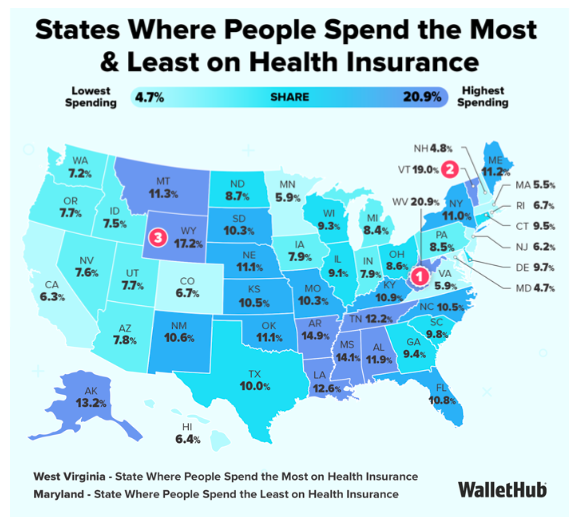
Residents of Maryland pay the least in the U.S. for their health insurance at 4.66 percent of that insurance, while Pennsylvania ranks 31st, with residents paying 8.54 percent.
The financial services firm WalletHub conducted this study by comparing a “silver-level” insurance plan against residents’ median income state by state.
Chris Lupo, WalletHub analyst, noted, “Inflation has driven up health insurance premiums significantly in recent years, making it harder and harder for Americans to afford proper health care. Being without insurance is even more dangerous, though, as medical debt is one of the most common reasons people file for bankruptcy.
“People in certain states feel the pressure of high premiums more than others, as they can cost as much as 21% of the median income in some states and less than 5% in others.”
WalletHub offered the following tips for coping with the rising costs, noting insurance costs climbed 6 percent in 2025 alone:
- Make sure you have at least some coverage. As expensive as health insurance premiums can be, not having coverage can be far more costly if you experience a major medical emergency. Insurance plans have out-of-pocket maximums that put a hard limit on how much you can owe.
- Budget well. Always include health insurance costs among the first things that you put into your budget, as coverage is essential. Then, set aside additional money each month until you have an emergency fund built that can cover 3-6 months’ worth of expenses. You can dip into your emergency fund when you have big medical expenses and need to pay money toward your deductible.
- Consider high-deductible plans if you’re healthy. Plans with high deductibles tend to have lower monthly premiums. They essentially bank on you not needing much care during an average year. If you don’t have any big medical expenses, they can save you a lot of money. The tradeoff is that if you do have a medical emergency, you’ll have higher out-of-pocket costs than with lower-deductible plans.
- Work at a job that covers your health insurance. Many Americans get their health insurance premiums covered through their employer. If yours doesn’t offer this benefit, you may want to consider switching jobs.
- Stay on your parents’ insurance. Under the Affordable Care Act, young people can stay on their parents’ insurance policies until they’re at least 26 years old.
- Use preventative care. Many insurance plans provide at least some types of preventative care, such as an annual physical exam and certain immunizations and screenings at no additional cost. Taking advantage of these free benefits can also help prevent future medical problems, which is good for both your health and your wallet.
- Opt for in-network providers. Going to an in-network doctor will be much cheaper than one that’s outside your network. Plus, health care plans often have separate out-of-pocket maximums for in-network and out-of-network care.
To read the full report, readers can go to https://wallethub.com/edu/states-where-people-spend-the-most-least-on-health-insurance/145713.