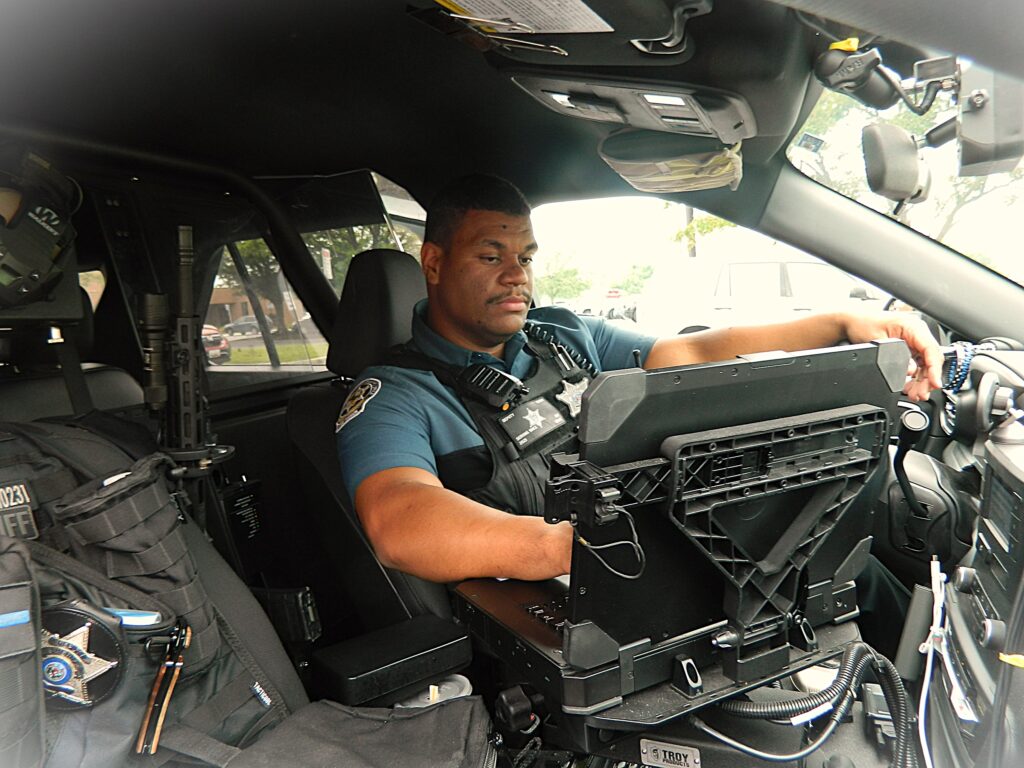
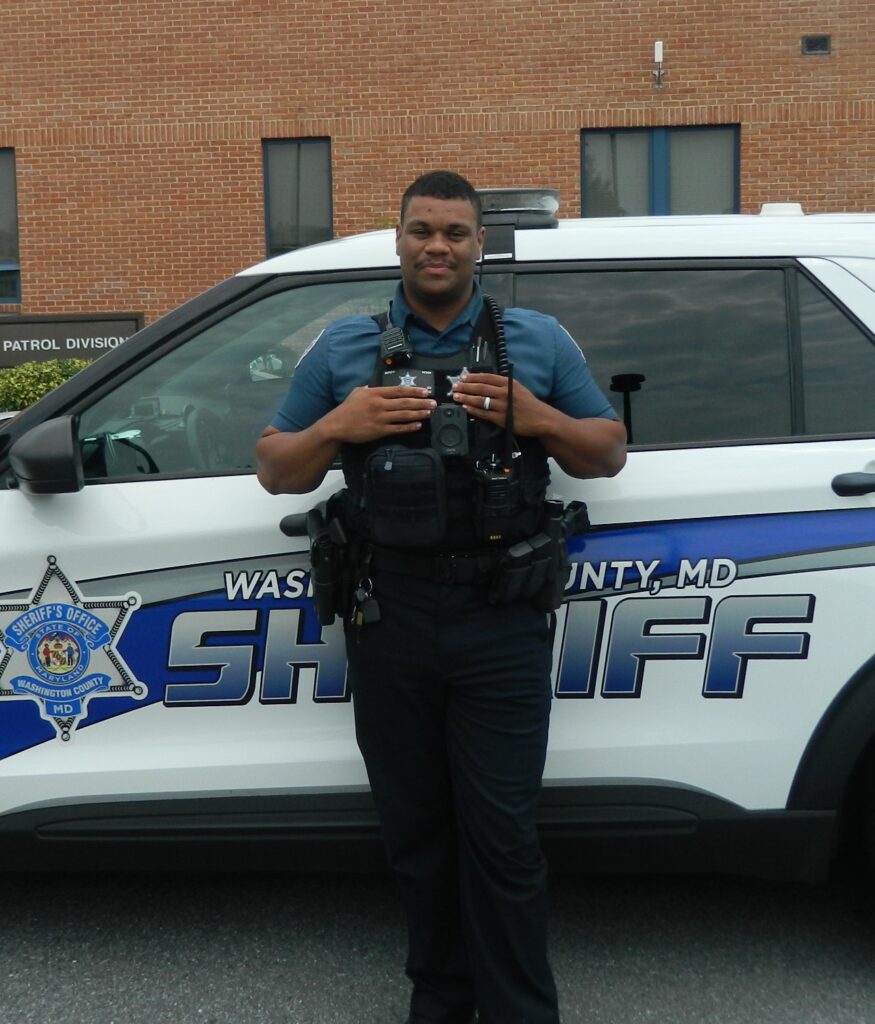
HAGERSTOWN – Born and raised in Hagerstown, Nikolas McKoy is a composed and studious young deputy with the Washington County Sheriff’s Office who modestly embodies the spirit of a real hometown hero.
In less than four years with the department, the youngest son of a retired Hagerstown police officer has exhibited dedication to his community, and through his passion for case law made innovative contributions to training that have set him apart as a rising star in the profession and earned him sheriff’s Patrol Deputy of the Year honors.
“DFC McKoy has devout loyalty to this agency and the law enforcement profession. With a special interest in the field training program, he created an impressive, extensive manual to assist deputies in the field training process,” Supervisor Sgt. Philip Rowe wrote in his nominating letter. “He has become an informal leader (among his colleagues).”
A love for case law
The 93-page field guide, which McKoy researched and wrote on his own time without being asked, assists with almost all categories of calls for service and explains department policy and case law. The quick-reference guide, alphabetically lists nearly every call type in the office database, outlining how each call should be handled in accordance with Maryland law and department policy.
In an interview, McKoy said he was studying up for certification and general instructor when the idea popped into his head. In six months, various colleagues had vetted the guide and leadership approved its dissemination department-wide.
“Yes, everyone seemed to love it,” he acknowledged. “It breaks down every call for service that we have experienced, and generalizes on how to handle it. If there’s a call they’ve never previously had, a deputy can look it up before arriving at the scene.” He quickly clarifies the project wasn’t any kind of flex for recognition or notoriety, but rather an offshoot of his natural affinity for researching case law, from state and local benches all the way up to the U.S. Supreme Court.
“I read case law for training in my off hours,” he said. “It gives you a wider understanding of what you can and cannot do. It informs my day-to-day operations. Whenever you are on scene, you have a million thoughts at once, and you have to consider them all to do the right thing.”
Rowe’s letter added that McKoy “shows up on a daily basis to learn as well as to work,” which shows in the consistently high quality of his investigations and subsequent reports.
A book that fills a gap
Regarding the manual, Public Information Officer Sgt. Carly Hose said that while policies have long been in place, no guide like this existed. “Nick saw a deficiency and took it upon himself to fill the gap, making the job easier for everyone.”
The four-section manual covers about a dozen key court cases that inform an officer’s rights and restrictions in the courts of their fulfilling their duties, provides brief summaries and practical applications relevant to patrol work. There is a section on calls for service from the public or other agencies that might involve crimes in progress, accidents, disturbances, suspicious activities or requests for assistance.
A traffic charging guide puts common charges a deputy might make in common terminology rather than legal jargon, and finally a section providing guidance on writing reports, using samples culled from previous incidents. Each arriving deputy received a copy on his or her flash drive, and is divided into sections for quick access and reference.
“The Office has long had policies in place but no one-stop guide as such,” Public Information Officer Sgt. Carly Hose said. “Policy books are cumbersome, and this guide provides a much quicker way to access critical information.”
Giving back to his community
McKoy inherited his love for teaching from his father Brett McKoy, who continues to teach at the Washington County Public Schools’ criminal justice program since retiring from the Hagerstown city police after a 30-year career on the beat. The elder McKoy is also a local pastor.
“I grew up with a clear image of what the job was,” McKoy said. “Dad started telling me about the good, the bad and the ugly when I was a teenager. . . When you’re serving where you were raised, you know the area, the pitfalls, and what to expect. You want to make your community a safer place.””
During the most recent session, he didn’t just teach an old standard curriculum, he wrote a brand-new one focused on scenario-based training.
“I give them scenarios, we discuss what they think they should do, then review the case law to see what’s allowed,” he said. One recent example was what to do when a suspect in a stopped vehicle repeatedly moves his hands around the belt area, indicating a possible concealed firearm at the waist.
After a lively debate, McKoy explains a Supreme Court ruling that permits officers to order a suspect out of a vehicle if they believe there’s a threat to their safety. “Knowledge gives them confidence. It’s easy to slip your mind under pressure, so I help them remember in the midst of stress and chaos.”
No bad days
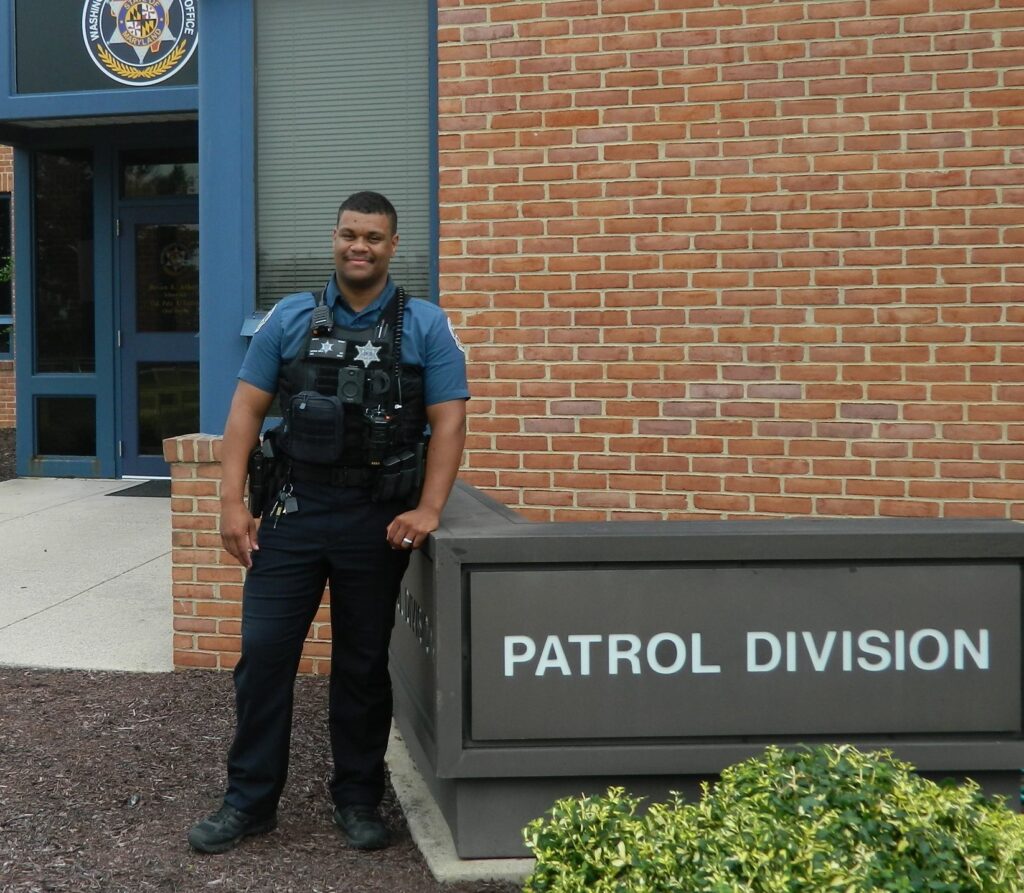
McKoy speaks in a calm, assured voice and maintains eye contact in conversation. His face that betrays his youth, while his sculpted biceps command respect. His unflappable demeanor helps him deal with unruly behavior, rudeness, and even racism – occupational challenges all police officers face.
“You can’t take any of that personally,” he said. “You wipe the slate clean from call to call.” A high-stress, violent scene may be immediately followed by the investigation of a stolen garden gnome. “You have to be ready for anything,” he chuckled. “You’re not allowed to have a bad day.”
And there is of course the issue of danger. Earlier this month, a Washington County deputy was shot responding to a domestic dispute. Thankfully, the injury was not life-threatening. McKoy says of course that could have been any of us, and could have had a more serious result.
“In our career, you can’t dwell on it because if you do it slows down your reaction time, and you potentially put yourself in more danger than doing what you were originally going to do. You have to keep rolling.” Being married with a young family further complicates matters. “My wife worries to a degree, but she’s getting accustomed to it,” he said. Touch wood.
McKoy wants to acknowledge his colleagues who assisted the project that led to his selection of Patrol Deputy of the Year. They include lieutenants Haugh and Monn, sergeants Rowe, Stotty, and Snodderly, and deputies Sivic, Colvin, Fazenbaker, Repp, Fogel, McCoy (no relation) and Litten.
‘An adrenaline rush’
Clearly, McKoy is happy in his profession, and says he enjoys the adrenaline rush of hurdling fences through neighborhoods or engaging in high-speed pursuit down highways, regardless of possible outcomes. He plans to continue teaching to and share the wisdom his hours of ad hoc research import, and recruit and train the deputies of tomorrow.
One of more than 100 sworn deputies in the department, his influence is already felt, and his manual is just the first of many marks he will make in his profession. Nikolas McKoy deserves recognition as a hometown hero whose dedication to law enforcement matches his commitment to his community.
“Like water, I’ve got to keep flowing down the path.