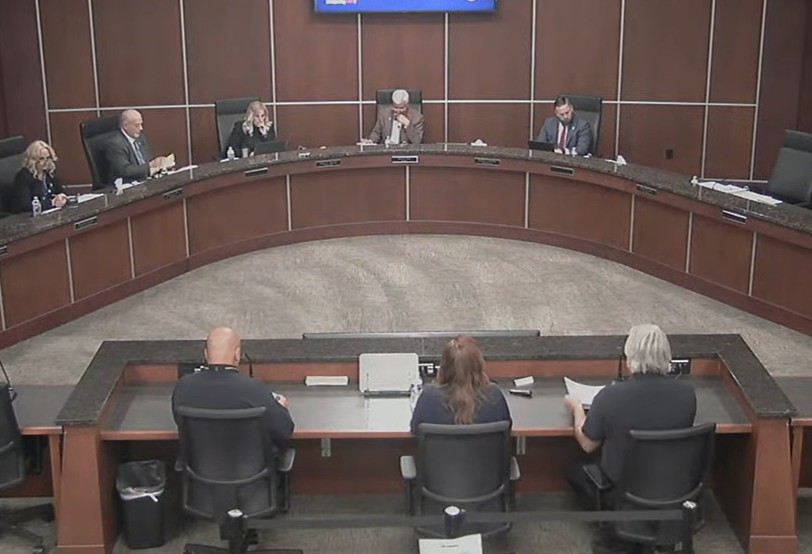
HAGERSTOWN – After suspending Tuesday’s session due to disruptions following an earlier vote on a resolution supporting the federal Immigration and Customs Enforcement (ICE) in Washington County, the Board of Commissioners later reconvened Tuesday to consider agenda items, including a request for increased funding for senior services amid growing demand from an aging population.
In its testimony before the commissioners, the county Commission on Aging sought an additional $300,000 in county funding for fiscal 2027, a 21% increase from last year, which would bring the total county investment to $1.72 million.
“We serve Washington County’s fastest growing demographic – older adults,” said Board President Ed Lough. “Their rapid population growth is the primary driver behind the increasing demand for our services.”
Lough noted that more than 550 residents are on waitlists, including 315 awaiting eligibility appointments and 140 for meals. Projections from the state Department of Planning show the 65-and-older population growing about 35% from 2020 to 2035, reaching roughly 41,000.
Vice President Tim Delbrugge highlighted staffing woes, citing 33.2% turnover in 2025 and below-market salaries. “None of our staff were at the 50th percentile of their market salary,” he said, adding that executive positions likewise fall short of the 47th percentile.
Treasurer Al Martin said the request represents about 38% of the agency’s $4.5 million budget, with other funds emanating from state, federal and local sources, including $433,600 in in-kind building space from the county.
CEO Amy Olack stressed proactive planning: “It’s really important to be proactive [requesting funding] before you have a critical need,” she said.
Commissioners did not vote on the request, deeming the presentation informational. Chief Financial Officer Kelcee Mace said the request would be considered during the formal budget process in May.
The board did approve purchasing a $1,000 table for six at the commission’s April 26 gala at St. James, using contingency funds. “That sends a great message to our community of support,” Lough told commissioners after the vote.
Approval of CDBG changes for the San Mar project
The board voted 4-0 to approve submitting a grant extension, spend-down waiver and budget modification for an $800,000 fiscal 2025 Community Development Block Grant to San Mar Family Community Services.
“The project is running a bit behind schedule,” Maria Kramer, director of the Office of Grant Management, told the commissioners, Joined by San Mar Family and Community Services Deputy Executive Director Jerica Washington and CEO Keith Fanjoy, Kramer explained the requested changes would extend the grant deadline beyond July 1, waive the requirement to have spent at least 50% of the $800,000, and revise the budget to cover previously unbudgeted soft costs such as planning, design, and permitting.
The grant was originally approved only for construction expenses, but San Mar has incurred those costs up front and now seeks reimbursement. The commissioners voted unanimously to approve submitting the grant extension, spend-down waiver, and budget modification to the U.S. Department of Housing and Urban Development, which administers the block grant program.
Renewal of cyber security IT contract
Commissioners also unanimously approved renewing a sole-source contract for cyber intrusion detection and monitoring with the Information Technology Department for $227,500, which will be the last one-year renewal on the contract, Purchasing Director Brandi Kentner said.
Chief Technology Officer Josh O’Neal explained that the system detects unusual network activity and integrates with email to prevent phishing. Funding is contingent on fiscal 2027 budget approval.
New defibrillator for emergency services
The board voted 4-0 to authorize a sole-source procurement of a LifePak 35 monitor/defibrillator from Stryker Medical for $61,300.
“This will complete the upgrade of all three EMS supervisor vehicles to the most current technology,” said David Chisholm, deputy director of emergency services.Partial funding of $24,450 will come from a state Emergency Medical Services grant.
Family support grant approval
Commissioners unanimously approved applying for and accepting a $460,000 grant from the Maryland Administrative Office of the Courts’ Department of Juvenile and Family Services for Circuit Court family support.
The funds cover salaries and fringe benefits for the family services coordinator and permanency planning liaison positions, as well as services such as self-help clinics, mediation, evaluations and more, according to Amie Spigler, the family services coordinator.
If not awarded, the county would cover salaries from the family law fund, with other services potentially eliminated, Grant Manager Richard Lesh added.
Rural Health grant for the EMS blood program
The board voted 4-0 to approve submitting and accepting a $27,000 fiscal 2027 Rural Health Grant – Blood Program from the state Institute for Emergency Medical Services Systems.
“This grant will allow the Washington County EMS operational program to enhance an existing program,” Lesh told the commissioners.
Deputy Director of Emergency Services David Chisholm said the funds will expand the blood program to the two remaining supervisor vehicles and will reimburse budgeted purchases.
Budget adjustment for Clear Spring EMS
Commissioners unanimously approved a fiscal 2026 operating budget adjustment related to the EMS staffing agreement with Clear Spring Ambulance Club, approved Dec. 16, 2025.
The adjustment transfers transition funds to EMS lines and adds anticipated billing revenue for reimbursements, Chief Financial Officer Kelcee Mace said.
New AI use policy
Finally, the commissioners voted 4-0 to adopt a new policy governing the use of artificial intelligence by county personnel.
County Attorney Zachary Kieffer presented the policy, noting its development in collaboration with the Information Technology Department.
With the increased prevalence and usage of AI in the workplace, he said, the new policy was developed to cover appropriate use by county employees.
Kieffer did not detail specific rules during the open session, keeping the focus on creating the policy amid rising AI adoption across government operations.