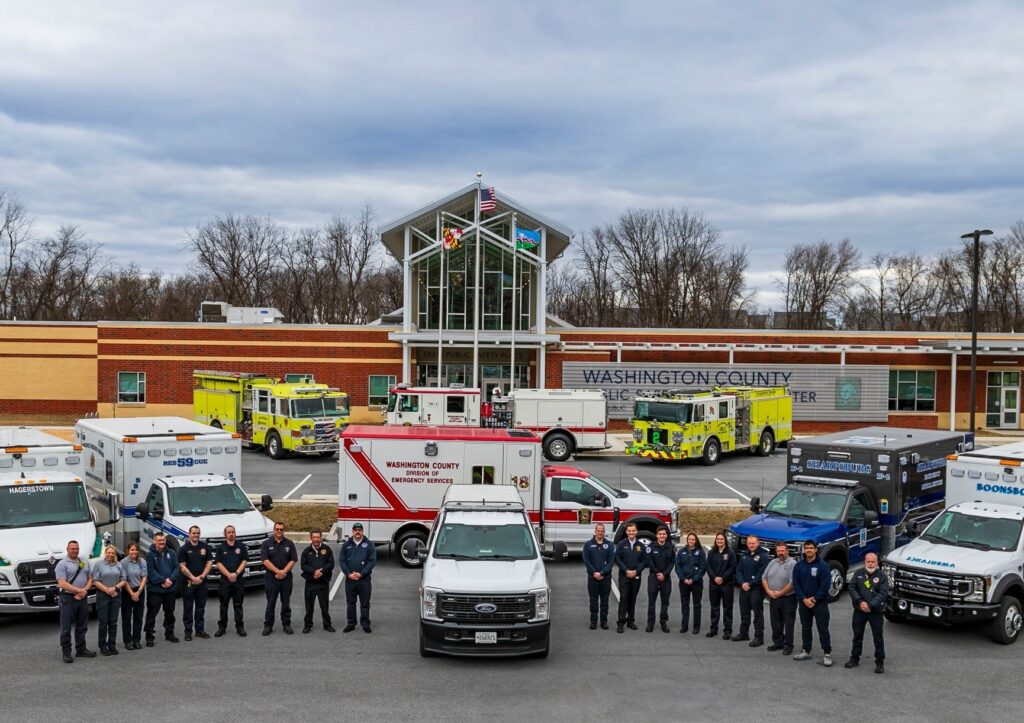
HAGERSTOWN – Washington County purchased two new reserve emergency vehicles, including a fire engine and an ambulance.
County officials noted that the additions, approved by the Board of County Commissioners, will help ensure continuous fire and emergency services when frontline units are unavailable due to maintenance or repairs.
The new vehicles are equipped with advanced safety and operational features, including systems to reduce exposure to harmful substances, enhanced vehicle stability and control, occupant protection measures such as airbags and seatbelt alerts, and improved visibility through camera systems and lighting.
Noise reduction and ergonomic seating further support responder comfort during high-pressure operations. Integrating such modern technologies enhances safety and extends the fleet’s lifespan by reducing wear on frontline vehicles.
“These new reserve vehicles allow us to maintain uninterrupted emergency services,” Director of Emergency Services R. David Hays said. “This investment underscores our dedication to reliability, preparedness and the safety of our residents.”
Washington County’s emergency fleet totals approximately 170 vehicles, including engines, tankers, ambulances, rescue squads and support units, serving over 10,000 annual calls for its 155,000 residents. Of these, about 20 are backup units managed by DES to ensure coverage during maintenance or high-demand periods.
About 30 vehicles are county-owned, primarily reserves and special operations units, while the remaining 140 to 150 are owned and operated by 29 volunteer fire and rescue companies.
Expected to remain mission-ready for over 15 years, these vehicles will be stationed at designated county facilities to support first responders across the region. By maintaining a robust backup fleet, the county ensures its emergency services remain responsive and ready to meet community needs.
Statistical analysis shows the county’s emergency fleet performs favorably compared with other suburban and rural areas, with about 1.1 emergency vehicles per 1,000 residents. The new additions bring the reserve fleet to approximately 12 percent, closing the gap on the National Fire Protection Association’s recommendation of 20 to 25 percent.
Nationally, the fleet size and setup are typical for suburban and rural areas with volunteer systems, outperforming smaller regions in total vehicles but falling behind urban areas in spare vehicles. The new acquisitions help the county better meet national standards.