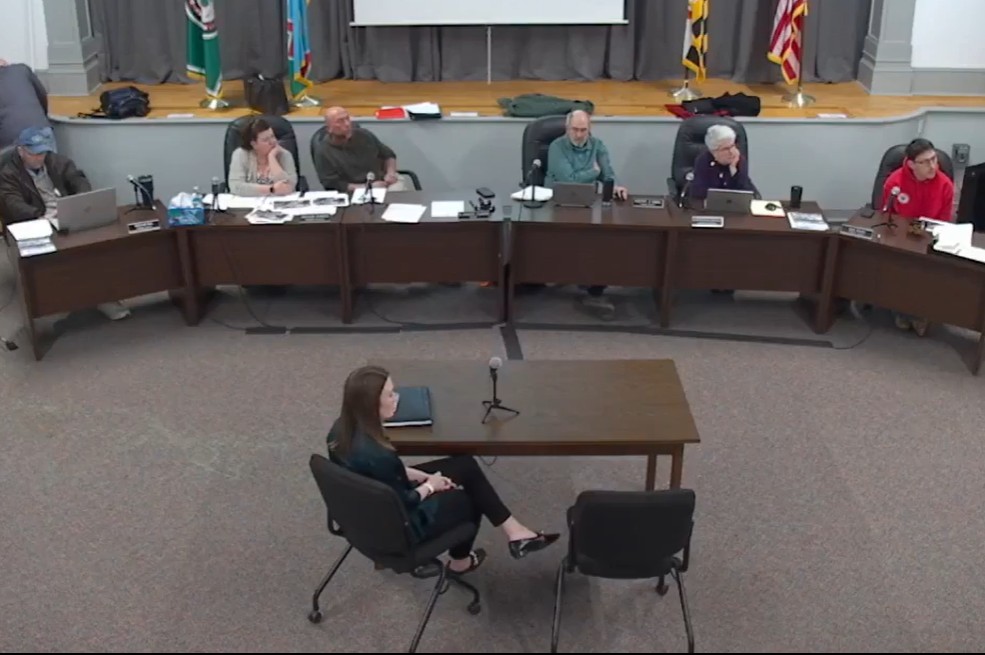
SMITHSBURG – At its Feb. 17 special session, the Smithsburg Mayor and Council got an update on the town’s water and sewer utilities, learning that while the systems are stable after recent rate adjustments, major upcoming infrastructure upgrades could force significant bill increases unless more grant funding or other aid is secured.
Michael Harshman of the Southeast Rural Community Assistance Project presented a draft rate study showing that water and sewer funds were in good shape for 2022-2024, with positive net balances. But planned capital projects to replace aging pipes, improve reliability and meet regulatory needs, potentially costing millions, would add substantial long-term debt if financed through low-interest federal loans.
Without additional grants, the town might need sharp rate hikes to cover annual debt payments, with one rough scenario suggesting rates could need to roughly double to fully fund everything through user fees alone, Harshman said.
Harshman is Maryland state lead for the Southeast Rural Community Assistance Project, a nonprofit that provides free technical assistance to rural communities on water and wastewater issues.
To mitigate affordability concerns, he recommended steps like a water loss audit to address the current losses of 20-30%, well above the typical 12-15%, reviewing billing structures that may encourage high usage, and pursuing grants early from federal agencies like the U.S. Department of Agriculture and Environmental Protection Agency.
Many of Maryland’s small towns face similar issues of aging infrastructure, rising repair costs and limited customer bases, which have been driving recent rate hikes and infrastructure upgrade needs. Statewide, water systems face pressures from aging pipes nearing the end of their life, new contaminant regulations and funding gaps. The state got a “C” on its 2025 infrastructure report card.
Council members expressed relief at the town’s recent 2024-2025 rate updates, which brought costs closer to balance, but voiced concern about passing on higher costs to residents. They directed SURCAP to refine the study using 2024 data, water-loss details and options such as a commercial tier, while preserving in-town/out-of-town differences to minimize increases during the 2027 budget process.
Town officials reminded residents that the utility is not self-generated but a resale service, so bills reflect purchases, operations, and necessary repairs to avoid disruptions such as pressure issues or leaks seen in past projects.
No immediate rate changes were proposed.
Town directs consultants on street safety upgrades
The council provided guidance to consultants on three pedestrian and accessibility projects funded in part by state or federal programs.
On Main Street near the town square, members voted 4-1 to proceed with Alternative 4, modified to maintain 14-foot travel lanes instead of narrowing to 12 feet. The option retains existing lane widths while adding crosswalks, signage, traffic signals and accessible ramps.
Council members cited concerns about delivery-vehicle parking, snow removal and business impacts, with one noting that “the juice is not worth the squeeze” on narrower lanes. A prior motion for the original 16-foot lanes failed 3-2.
For Main Street near schools and Geyser Way, the council endorsed Alternative 3, which includes a concrete sidewalk along the south side, a pedestrian crossing island with rectangular rapid flashing beacons (push-button activated), and adjustments to the Geyser Way crosswalk location toward the midway point near Vody’s Court, also with beacons.
Members emphasized the need to ensure safety for schoolchildren, with one council member likening children’s daily street crossings to “playing chicken.” The project addresses a steep hill where vehicles accelerate.
The council approved Alternative 2 for Veterans Park on Water Street, featuring curb extensions, a bus boarding bulb to reduce sideswipe risks, reconfigured driveway access for accessibility, and a push-button flashing beacon for crossing Water Street. The crossing placement aligns with park pathways and prioritizes conflict with right-turning vehicles.
The projects tie into broader safe streets initiatives and will inform the town’s capital improvement plan.
Annexation petition advances for commercial area
The council also talked about a request to add about 28 acres of land to the town near the intersection of Main Street and Maryland Highway 64, which includes some railroad tracks and road rights-of-way.
The landowners, including Bluegrass Commercial, TCB Scott Properties and a few others, requested that the town annex the land so it falls under Smithsburg’s rules and zoning instead of Washington County’s.
The county has zoned most of the area as business, local or residential transition, and the owners are seeking to zone the portion closest to the road as general commercial, which would allow businesses such as shops and restaurants.
The back part near the railroad would be zoned employment center, which could allow offices, light industrial uses or other businesses that create jobs, representatives for the owners said.
The request also seeks to address a long-standing issue of unclear ownership and access rights on Bishop Lane. The proposed agreement would have the town and the developers work together to develop a solution, such as designating Bishop Lane an official town street, realigning it, or closing sections to improve the road layout. The owners are not asking for any special tax breaks or other exceptions.
Under state law, when a town seeks to change zoning in a major way within the first five years after annexation, the county must grant its specific approval first. If the county fails to approve the change, the developers could pursue alternative zoning approaches or wait to see whether state laws change to give towns more control, they told the council. No detailed building plans have been submitted yet.
The council told the owners the official process can begin at the March 3 meeting. A public hearing and a separate hearing on the zoning change are likely to occur in mid-April. Mindful of protecting Smithsburg’s “small town feel,” annexing the land would give the town more say over what happens at this key “gateway” entrance. They encouraged residents to share their thoughts during the upcoming public hearings.