
HAGERSTOWN – While many are aware of the arts offerings downtown, those who venture away from the square to brave the winding country roads outside the city limits will find a true artistic gem of our region. The dedicated volunteers at Potomac Playmakers have been delighting local audiences for 100 years, making them one of the oldest community theaters operating in Maryland today.
Even for such a well-established group, enticing people to a Shakespeare performance can be a tough sell. “By William Shakespeare” after a title can elicit unwelcome flashbacks of painfully boring high school English classes. Alternatively people may assume the show is only fit for self-appointed high-brow intellectuals.
When inviting viewers to their most recent production,”The Taming of The Shrew,” Director Caitlin Cutright assures those who are hesitant “You haven’t seen our Shakespeare. You just have to give it a chance.”
The play is still available in two performances today, Jan. 17, at 3 and 7:30 p.m. and Sunday Jan. 18, at 3 p.m.
Cutright drew inspiration from the 1999 teen adaptation “10 Things I Hate About You” to help emphasize the fun in the performance. She added modern twists and energetic blocking that will keep even the most skeptical attendee engaged. The Playmaker’s ensemble of “Taming” hopes that appealing to high school nostalgia may overcome audience hesitation.
To fully appreciate their efforts and to conquer possible “Shakes Fear,” it can help to understand a little Shakespeare 101. In many ways the traditional elements of this classic work are highlighted rather than hidden by the millennial sheen liberally applied by the concept.
The theater: Classic charm meets modern comfort
The original “Taming” would have been performed on the outdoor Globe Theatre with groundlings, or low-paying ticket holders, standing in a yard surrounding the stage. Cutright also encourages viewers to get close to the action, but they will find themselves significantly more comfortable than their 1600 counterparts.
The leatherette, movie-theater-style seats are exceptionally comfortable. If you find a spot you particularly like, the company is currently running a “Sponsor a Seat” fundraiser, allowing contemporary patrons to mimic aristocratic sponsors of old and display their name while supporting the Playmakers’ next century of performances.
In addition to plush seating, the auditorium boasts red velvet curtains and brass chandeliers which provide an elevated but still accessible vibe, bridging the gap between historical charm and community warmth.
The setting: Location, location, location
While Shakespeare’s audience expected exotic locales like Taming’s original setting of Italy, Technical Director Ali Baughman and Props Master Kris Cooper offer up a bit of time travel instead. They have created a coffeehouse set packed with details to delight those who lived through the turn of the millennia.
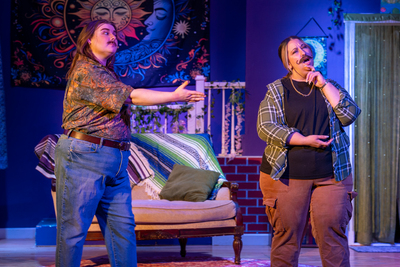
There are purple walls adorned with wisteria murals, moon and tree batik tapestries, and even a couple of Baja blankets. The furniture looks thrifted, and the community bookshelf is frequently raided. This cozy, familiar atmosphere strips away the stuffy reputation of the Bard and replaces it with the vibe of a local hangout. Grab a hot drink from the concession stand and you’ll really feel like just another patron of the cafe, eavesdropping on some steamy town gossip.
The set is also packed with doors. There are stairs leading to an unseen upper level, two doors in the back wall, a door on each side of the stage and entrances from the aisle. Cutright and the cast use all of these to their advantage to keep the action moving and changes between scenes seamless. The feeling that a character could pop in or out of the play at any time adds to the comedic potential.
Baughman uses the venue’s LED lighting system judiciously to create mood and focus in the scenes, particularly those which are partially in the aisles. This more utilitarian approach allows listeners to concentrate on the wordplay happening onstage with a clear view of the speakers.
Since actors are not individually miked, sound does tend to be the biggest challenge. Most performers fill the space with their natural projection, but some of the quieter moments can be a tricky to catch.
The Bard meets Bops
Elizabethan audiences had a live band to supplement their playgoing experience. While no sound designer is credited, Assistant Director/Stage Manager Allen Jenkins was overheard discussing the curation of the show’s playlist. Gen X-ers and millennials will definitely recognize the ‘90s hits that are incorporated, but the “deep cut” feel of the choices makes that recognition a bit sweeter, since they are likely tunes that have faded from memory.
The story: Gender dynamics on full display
If your memory of the play is a bit foggy, here is the Cliff Notes version of the drama brewing in the coffee house:
- The conflict: Wealthy father Baptista has two daughters. Bianca, the popular younger sister, is forbidden from marrying until her “shrewish” and sharp-tongued older sister, Katharina, is wed first.
- The schemes: To get close to Bianca, the smitten Lucentio disguises himself as a tutor, while his servant Tranio swaps identities to pose as a nobleman. Lucentio’s rivals for Bianca’s affection, Gremio and Hortensio, are also scheming for access to the fair Bianca.
- The taming: Enter Petruchio, a boisterous friend of Hortensio who is looking for a rich wife following the death of his father. He takes on the challenge of marrying—and “taming”—the headstrong Katharina through a series of psychological battles.
The style: Elaborate costumes
Credit must be given to actor Autumn Carver, who pulled double duty as the costume designer and spoiled ingénue Bianca. While not producing the elaborate court attire the original era would require, her attention to detail in recreating Y2K fashion moments is apparent. Her wardrobe as Bianca perfectly embodied the era. From her “cherry baby” belly tee and butterfly hair clips to a modest plaid skirt and sweater, then her final metallic pink bodycon dress, Bianca may play innocent, but there is some Britney Spears style seduction simmering under the surface.
Carver doesn’t save all the fun for herself. From a perfectly curated pair of jorts (jean shorts), a classic white and black checkerboard top and a Members Only jacket that is probably older than the actor it adorns, she displays a true understanding of the chosen time frame and enhances the whimsy of the piece.
Cross gender casting: A delightful display of fake mustaches
In the Early Modern English theater women were forbidden to perform. As a result, the first actors to portray Bianca and Katherina would have been young men in women’s clothing. The tradition of cross-dressing is continued by the Playmakers. Quite a few female identifying actors don a dizzying array of fake facial hair to populate the world of the play, which is most definitely a masculine one.
As the elderly and rich Gremio, Jessica Edwards serves all the swagger you would expect from a small-town captain of industry. You can’t help but feel bad for Baptista’s neighbor when he is so easily outclassed by a younger, richer aristocrat who is traveling through. Edwards’ reactions throughout the show to the events onstage add interest to any scene she is a part of.
Lyndsey Morris ably portrays Biondello, one of several utility players who carries messages, assists in plots and generally greases the wheels of the action of the play. Morris does an excellent job, giving a slightly confused, but ready to assist attitude, to Lucentio’s spare man servant.
Jade Harper earns the award for most characters portrayed as an ever-present and deeply interested barista, a much abused member of Petruchio’s household, and a traveling merchant, or Pedant, who gives serious alpha male energy to some very crucial scenes.
The servants: Comedic relief mixed with intrigues and plots
The “upstairs/downstairs” dynamic is in full effect throughout the production. Filling out a bevvy of charming servants were Ty Unglebower as Grumio (not to be confused with the aforementioned Gr-E-mio) and John Bewley as the tailor and Curtis.
Unglebower expertly bandied words with his over the top master Petruchio. His able handling of confusion over knocking at a non-existent door kept the punny exchange from turning confusing. While Bewley provided the perfect example of Baptista’s famous line “pitchers have ears” by popping out to eavesdrop at an opportune moment.
Exasperated parents: As common then as now
Shakespeare’s comedies are full of frustrated parents, and “The Taming of the Shrew” is no exception. Kyle Tirak delivers a standout performance as Baptista, finding the perfect balance between the transactional nature of a father arranging marriages and a genuinely loving protector.
Alongside him, Kelli Donaghue plays Vincentio as confidently befuddled, capturing the exact energy of a parent who is two steps behind the schemes of the younger generation.
Identity swapping: Who is who again?
The plot of Taming relies heavily on disguises. Gabriel York, playing Tranio, shows clear and concise delivery throughout his convoluted plot line, ensuring the viewers never loses the thread of the story during moments of complex exposition.
As one of Bianca’s suitors, Hortensio, the hilarious Kris Cooper takes a turn pretending to be the musician Licio but is all too soon back to their foppish ways as a local bon vivant in love with love. Shakespeare’s works often feature a character that acts as the audience ally – an everyman who connects with the viewers through humor, often at their expense. Cooper’s all-in portrayal of Hortensio and clear understanding of the text makes the character a shoo-in to be a fan favorite of the piece.
In a surprise cameo, a certain sassy Widow fulfills Hortensio’s desire for wedded bliss. However, her snide jabs at Kate and Petruchio in the final scene hint that more heartbreak may await Cooper’s enjoyable everyman.
The lovers – wit and wordplay
As the smitten Lucentio, Brady Webber falls head over heels for Carver’s Bianca. Webber brings a charming screen star energy to the role. His performance melds the earnestness of Timothée Chalamet with Ashton Kutcher style bravado to generate a “puppy love” charm that is all his own. You can see why Bianca is swept up in his amorous attentions.
The relationship of the title and at the heart of the play is that of Katharina and Petruchio, played by Victoria Wakelin and Joshua Peters. Both actors handle the text with impressive confidence. Their vocal energy and snappy pacing ensure their famous battle of wits feel fresh and combative, making Elizabethan English as natural as ‘90s slang.
Wakelin is satisfyingly awful for most of the run time as the beleaguered sister of goody-goody Bianca. It’s clear that the younger sister has a side to her significantly less sweet than the men on stage are aware of. She maintains her unpleasant air for the majority of the show, only softening in the final scenes.
Peters as Petruchio also embraces the brutish energy the character is known for. There is little respite from his broad proclamations, man-splaining and boasting. The choices are completely justifiable, but they do make it difficult to find redeeming value in the male half of this power couple, even as he also begins to mellow in the final moments of the play. Through no fault of Peters, Petruchio is a hard pill to swallow.
It’s important to note that the gender themes in “The Taming of the Shrew” are often polarizing, especially among those who love Shakespeare’s work. The company handles these moments the best way they can, leaning into the comedy and the more equal (but often still misogynistic) social dynamics of the early years of the 20th century.
They should be especially commended for their professional handling of the stage combat elements that come from the pushing, grabbing and carrying required in multiple scenes. Wakelin makes a clear effort to have Katherina’s taming suggest a broader maturing in her outlook rather than abusive submission.
However, audience members sensitive to the topics of abuse and female disenfranchisement may still find several of the play’s traditional conclusions to be troubling moments in an otherwise lighthearted evening.
Forewarned is forearmed so, as with many classical works, the best approach is to attend! Enjoy the moments that entertain, consider the elements that are challenging and, most importantly, do your part to ensure another 100 years of full houses for a valuable community arts organization.

Know before you go:
Potomac Playmakers’ “The Taming of the Shrew” is a fast paced and entertaining version with an appealing modern setting. The production runs approximately 2.5 hours with one 15-minute intermission.
Tickets are $20 for General Admission and $15 for Seniors (65 and older.) They are available at the door or online. (Link Address: https://www.potomacplaymakers.org/get-tickets/#smtx-click)
The Performing Arts Center is located at 17303 W. Washington St., Hagerstown.
The show as script is generally considered appropriate for all ages, but parents should note the actors add improvised remarks as they are leaving the stage which could contain modern curse words and which also included joking references to suicide the night of the review. The text contains double entendres and implied sexual relationships that are framed comedically. As always, audience members are advised to do some research about the play and use their judgement.
Up next:
Friday, Jan. 30, and Saturday, Jan. 31: The Playmakers host the the Maryland Community Theatre Festival Association. Each day feature a variety of unique short performances.
Friday, Feb. 27 through March 8: “Whodunit….The Musical“ Enjoy a comedic take on the classic murder mystery genre.
Information about all upcoming productions as well as auditions can be found on The Potomac Playmakers’ website. (Link Address: https://www.potomacplaymakers.org/get-tickets/)
Photo credit: Allen Jenkins