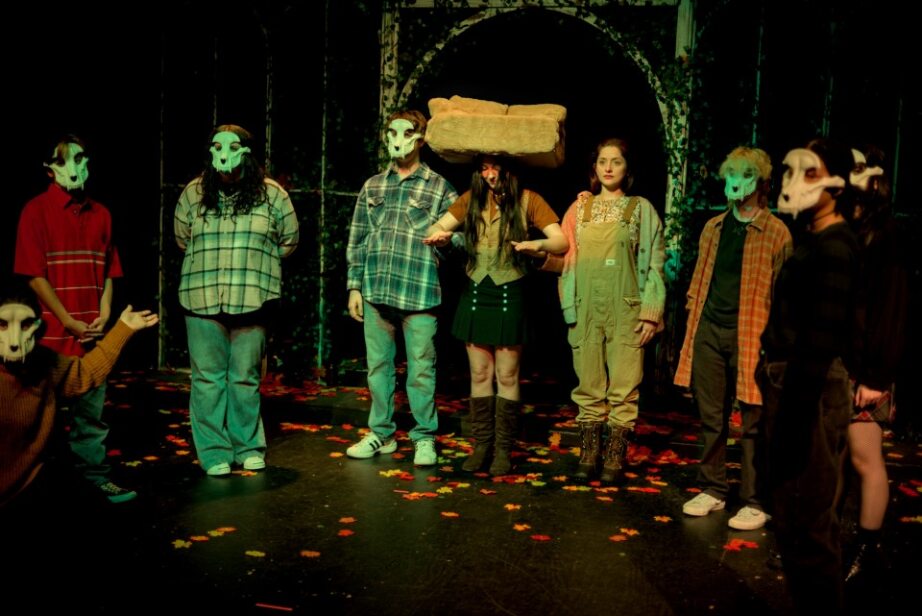
HAGERSTOWN – Wanna see a gothic suburban dystopian play that will make you feel like you’ve been dropped into an episode of “Stranger Things” or “Black Mirror?” Then here’s how to spend your Sunday afternoon:
The Kepler Performing and Visual Arts Center Black Box Theater at Hagerstown Community College presents “Concord Floral,” written by Jordan Tannahill, with co-creators Erin Brubacher and Cara Spooner. The show’s limited Nov. 21-23 run closes Sunday, Nov. 23, at 2 p.m.

This is a modernistic reimagining of “The Decameron,” written by Giovanni Boccaccio in the gothic medieval era. Boccaccio frames a tale of 10 young Florentine nobles who flee the city to dwell together in refuge from the Black Death. Each shares a story per day to pass the time. The tales encompass a full range of experiences, from scintillating to satirical. Considered a masterpiece in classical Italian prose, perhaps Tannahill assumed it safe to draw inspiration from work also influential to Chaucer and the Bard. Pretentious? Tannahill’s work may not be Shakespeare, but it is markedly compelling, and he’s prone to soliloquizing.
Director/Music Director/Co-Sound Designer John Milosich is at the helm of the HCC production of “Concord Floral.” He noted, “For the cast of 10, only 10 auditioned.”
That fluke yielded unbelievable talent, but wise directorial choices are also at play.
Milosich said, “The speech flowed naturally for them from the first read. They required virtually no direction.”
Since the play premiered in 2014, it has not lost its edge with time, the teen vernacular still feeling relevant and real.
Technical Director Jason Buhrman creates an open-ended playground, staged to pivot imagination instantaneously with the suggestion of narration, or light and well-sold performance.
In the shadows of a scarcely lit stage, fallen leaves litter the floor and ivy crawls on the abandoned skeletal remains of Concord Floral, a sprawling complex that once housed the largest supplier of roses. Costumed as a living garden, Maria Balmori-Calderon delivers a poetic performance as Greenhouse, personifying the property as the narrator, explaining the history of the once-vibrant one-million-square-foot edifice where roses were produced. Roses that acknowledged major life turnings and all tied to this place, that has now given way to decay and abandoned remains. Here teens take refuge for all manner of activities that defy adult supervision.
“A life without beauty is unbearable,” Greenhouse laments.
All of the play’s human characters are named after varieties of roses, and their stories have moments of beauty, wilting losses, and ultimately, death.
Minimalist staging and use of light to define multiple spaces on stage at once, leaves plenty of room for imagination to fill in the suggestion that the characters find themselves in a vast space, along with the entirety of the play’s other locations, all packed into the cozy confines of a black box, with nary a set change.
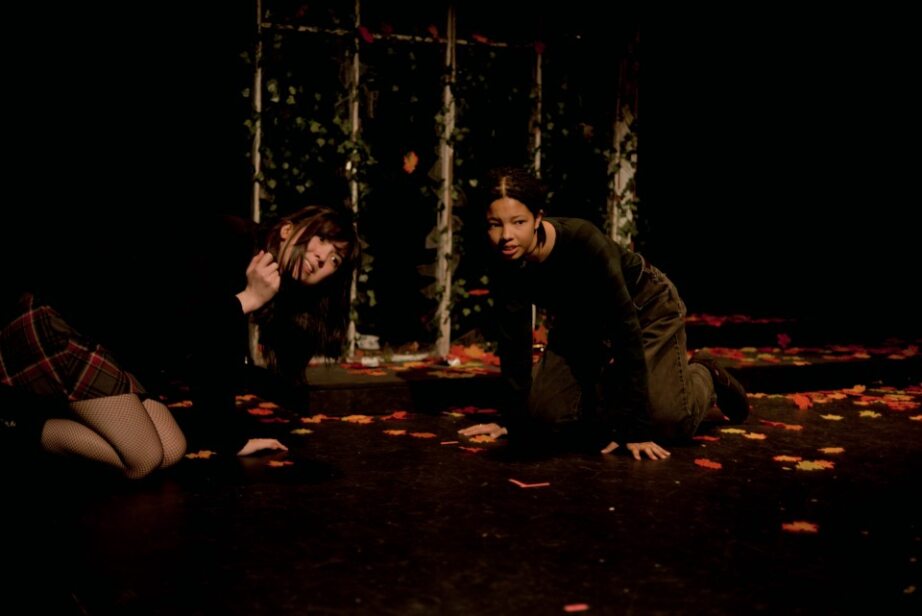
Rosa and Nearly Wild make a gruesome discovery
Nearly Wild, is played exceedingly well by Jade Fraction, with a nuanced vulnerability verging on sweetness, that peeks out from the edges of her insouciant teen demeanor.
Nearly’s friend, Rosa Mundi, is played by Karis Patterson with ballsy competence posturing on shaky moral ground. The two shape the border pieces of a tale that will be inset by all the other player’s haunting jigsaw puzzle of an allegory.
The two girls are hanging at the greenhouse one night to smoke pot, when, searching for her lighter, Rosa accidentally drops her cellphone down a well. In the simply staged but riveting search via the light of Nearly’s phone, the girls spy the body of a dead girl in a red sweater in the depths below. In an attempt to retrieve the phone, it falls deeper, into the very cavity of the deceased.
Giving up on phone retrieval, the girls get the hell out of Dodge, making a pact to not tell anyone – especially the police. Their secrecy is not-so-iron-clad … as you might expect in a teen gossip ring. Soon they are collectively haunted by more than a spooky account.
The full-throttle creep begins when Nearly receives a phone call … from the dead girl, Bobbie James, played by Madelynn Renken. The call is coming from the irretrievable phone for which Rosa cancelled service.
But Bobbie is not just calling, she can see Nearly. She says she’s in her back yard. She can confirm the number of fingers Nearly is not holding up. She’s real. And she torments Nearly by not cooperating in attempts to validate her existence to the other teens, making Nearly the object of ridicule and exclusion, a theme that will continue to expose ugly roots throughout the show.
Tannahill’s writing flows between naturalistic dialogue and magical realism monologue, including anthropomorphizing objects and animals.
Fox, played well by Ax Whitacre in a performance that spans compassion to bemoaning to humor, struggles to understand why humans feel compelled to have sex here, where he has sex, when they have their own homes and places for that. He laments, “Humans … they feel entitled to everything.”
Bobolink, a bird played poignantly by Yasmine Rodriguez, has known the anxiety of entrapment, and makes home in the greenhouse. She speaks to loss of habitat and the threat of losing her nesting place if the greenhouse is demolished to build a parking lot. She says, “Everything changes. You can’t avoid that. We find new houses. New places of being.”
Even a discarded Couch, played by Angelina Delvecchio, is anthropomorphized to highlight abandonment and becomes the platform for dark secrets, sex, rain and wet cloying fluids.
There’s a poetic lyricism throughout the show that expresses with such beauty, you almost feel washed clean from all the f-bombs.
“Something in the air has shifted,” Nearly says as the truth of her claims begins to sweep over each teen, taking hold.
There is a pervasive tone of discomfort, of not knowing what to expect, and a sense that whatever comes next, guarantees danger.
If you cannot tolerate the perversely uncomfortable, you may find parts of this show more a spoonful of poison than a cup of tea, especially as laid out in Jason Harris’ portrayal of Just Joey, a character that demands a courageous performance.
Bird-loving John Cabot, played with the right touch of sincerity and truth by Josh Sarceno, fears being unable to protect the vulnerable as habitats are torn down for new development.
Forever Irene, played by Allison Jankowski with subtle dark quirky humor masking painful yearning, is seen when she doesn’t want to be, and seems desperately invisible when she wants to be noticed.
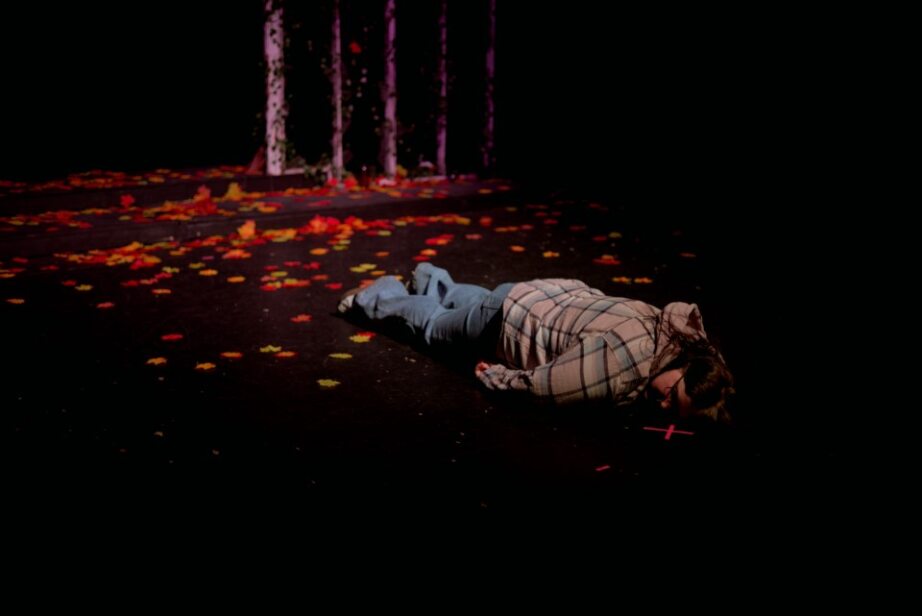
Forever Irene, practically mowed over by feelings of invisibility
The cast maintains nail-biting tension for the entirety of the show. Intimately staged, you would be able to see, smell, and almost taste the acridity of a foul performance. The only rot here is the decomposing dead girl … and she’s not going away.
Raw truth underlies the uncomfortable dark grit in this grunge-goth suburban subculture that would be so much more comfortable to remain hidden, but this show is not about being spared. The filth-stained sweetness and innocence of youth is sullied into the stuff of teen bully monsters, all tied by different threads to the red-sweatered-dead-girl, who haunts each teen by returning them to their darkest truths and ownership of ill-placed actions. But can that yield redemption?
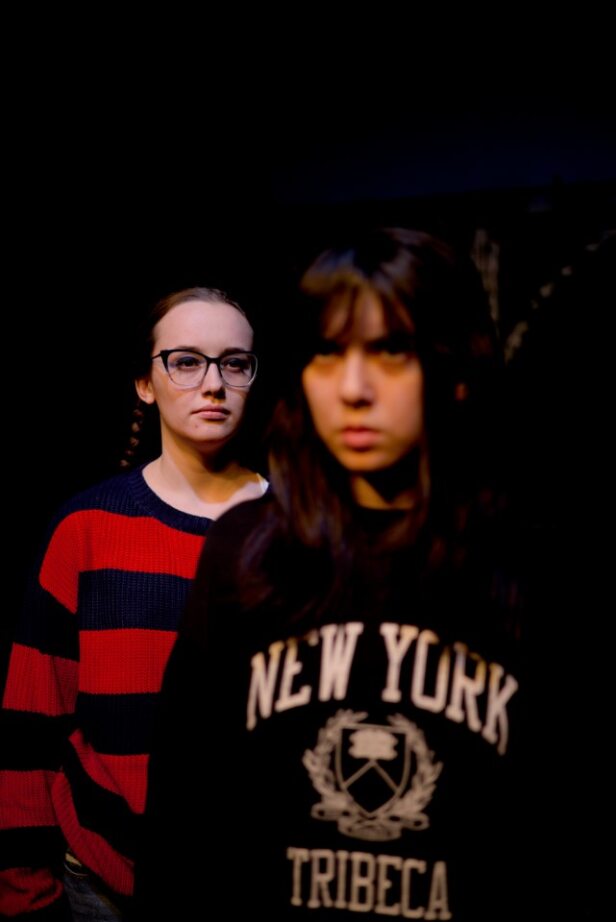
A red sweater stitches together a complicit community
Costume design by Channing Tucker produces an ensemble of grunge flannel-clad teens, a goth girl in fishnets and combat boots, and a greenhouse in floral painted overalls. Tucker’s mask work ranges from the natural beauty of animals to grim skeletons, to the vines and florals of Greenhouse. Facing the unique challenge of having to build costume for a personified couch, Tucker and Costume Assistant Jack Dempsey rise to the occasion. The duo most remarkably creates the decomposing body of the dead girl, by transforming a body suit into a living corpse with peeling skin.
Lighting Engineer Marlie Mitchell allows conservation of light to rule, at times using spotlit columns to draw focus to the stark internal isolation of each player, surrounded by encroaching shadows.
Co-Sound Designer Jason Buhrman joins forces with Director/Music Director/Co-Sound Designer Milosich to craft evocative sound, further supported by Tommy Ramirez and Christopher Jacobs, with audio engineering by Brendan Capino.
A twist lends complexity to the ultimate fate of the dead girl, as my critic compadre and I debate post-show, recounting the shards of possibility over which the plot steps.
“Concord Floral” is a cautionary tale of mob mentality, cruelty and complicity, highlighting the difficulty to find redemption when consequences of actions are irreversible.
“10% of any population is cruel; 10 percent is merciful, and the remaining 80 percent can be moved in either direction.” – Greenhouse
Stellar performances by the entire ensemble cast are supported by technically smart and innovative approaches to masterfully create from minimalism. The winning combo never loosens grip for a moment in a show that begs reflection long after you leave the theater.
Audience Advisory: This show contains a high level of profanity, references teen casual and explicit sex, and drug and alcohol use. Mature audiences are advised.
Tickets for the closing Sunday, Nov. 23, 2 p.m. matinee are $5.50, available at: https://hcckepler.square.site/. Seniors, students, faculty, and staff are free admission. The Kepler Center is located at 11512 Kepler Drive, Hagerstown.
Mark your calendars now for HCC’s spring production of “Urinetown,” April 24 and 25, 7 p.m., and April 26, 2 p.m.
Photo Credit: Evon Shank