MONT ALTO – Nearly two weeks after Penn State University administrators met with a select group of 60 invitees in the shiny new Allied Health Building on the Mont Alto campus, apparently nothing has been decided. And at least some people in the area are continuing the fight to keep the campus open.
The leader of student protestors who carried signs outside the meeting noted, “As scary as this situation is, I started this fight and will do everything in my power as a student to make sure Mont Alto stays where it is. Even if it’s an uphill battle, I’d rather slide off the hill than stop.” In the closed meeting with a list of 60 selected but undisclosed invitees Penn State administrators, led by interim Vice President for Commonwealth Campuses Renata S. Engel, discussed options to divest and repurpose campus assets.
Among the 60 were invited community leaders and high-end donors. The campus is slated to close at the end of 2027, and university officials apparently are uninterested in entertaining opposition to the plan.
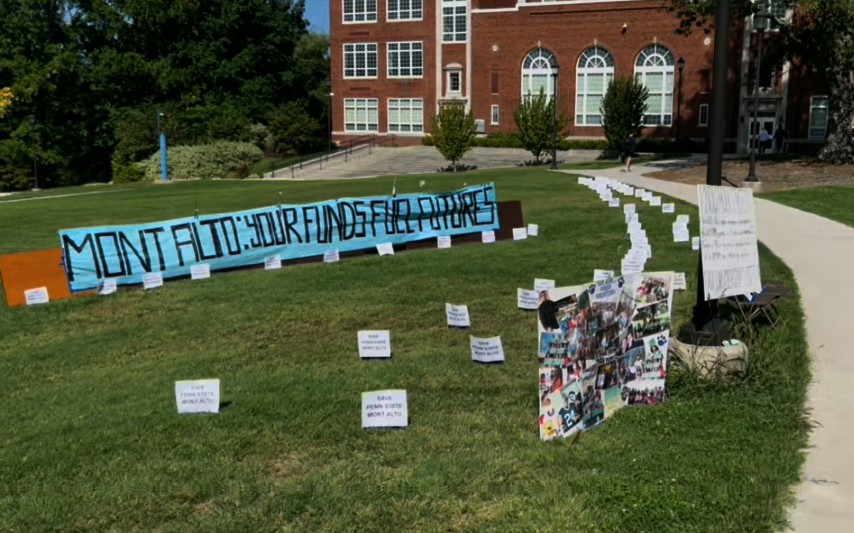
Outside the Allied Health Building, where the meeting was held, Jawad Malik, senior and resolute leader of a student group opposed to the university’s May decision to close Mont Alto among seven of the university’s 20 “commonwealth” campuses, led a small group of students in a sign-holding protest. The students were barred from entering the closed-door discussions and threatened by police with forcible expulsion if they made noise.
After the meeting, Malik spoke with several attendees who disclosed details of the discussion. He said he learned the administration acknowledged errors in the data used to justify Mont Alto’s closure, particularly the omission of the campus’s strong two-year graduation rates, which outshine many other Penn State campuses.
“They knew they messed up the data, but they can’t do much about it now,” Malik reported to LocalNews1.org. The omission, some insiders claimed, was intentional to downplay Mont Alto’s academic success and bolster the case for closure.
Attendees also revealed that Penn State is exploring options to offload Mont Alto, potentially transferring it to the university-affiliated Penn College of Technology, known as Penn Tech, or possibly splitting the campus among other schools or companies.
“People don’t have a clear idea of what to do at Mont Alto,” Jawad surmised. “They seem to have admitted they screwed us over and apologized but won’t do much about it.”
Community members in the meeting pointed out the protest signs as evidence the decision to close the campus might have been hasty, which his sources said didn’t change the university’s dismissive stance and caused tension in the meeting.
Malik remained undeterred and defended the demonstration: “It’s who we are; it’s our free speech.”
Just four days after the closure announcement leaked in May 2025, Malik, a business marketing major, and Yara Amleh, a senior nursing student and Student Government Association president, compiled a 37-page dossier of testimonials from students, alumni, faculty and staff, highlighting Mont Alto’s important role in providing accessible quality education, and its economic importance, to Franklin County.
Their efforts, driven by personal connections to the tight-knit campus community, have included organizing campaigns, producing videos and engaging with university administrators and state officials to advocate for reconsideration, despite repeated discouragement. Their work has galvanized the community, which still hopes to present their case to the Penn State Board of Trustees.
The opposition’s rallies, petitions and data-driven advocacy exposed Mont Alto’s strong performance metrics, including graduation rates that rival or surpass other campuses. Their efforts have rallied community support, though the struggle has taken a toll.
“It’s been 50/50,” Malik admitted. “Some say it’s hopeless and bad for mental health, while others want us to keep fighting. My team is divided. Some strong people back us, but others have lost hope. It’s getting thinner and more exhausting.”