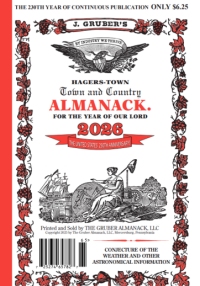
HAGERSTOWN – LocalNews1 has partnered with The Hagerstown Town and Country Almanack to bring you a story every Monday taken from current or past editions of the Almanack. First published in 1797, it’s the second oldest almanac in the United States and has been in continuous publication for 230 years.
It is the only almanac in the United States still published by the founders’ direct descendants.
Here is this week’s offering from the Almanack:
Have you ever looked up at the moon and wondered how the lunar cycles work and what they mean to us? Here are some “moon facts” provided by the Almanack.
Up and down signs of the moon are often confused with the ascending and descending nodes of the moon’s orbit, but this is not the case at all. According to the Almanack, the moon follows closely to the path taken by the sun. Here is a direct quote taken from the Almanack.
“Their paths are never more than 6 degrees apart since the plane of the orbit of the Earth forms an angle of just over 5 degrees with the plane of the orbit of the Moon. Thus, the Moon is said to be in its ‘up”’sign, at that point in its path where it is farthest south.”
This occurs approximately every 29 days, which is a lunar cycle. About two weeks later the moon has then moved to its northernmost point in orbit and then turns downward heading south which means the moon is heading down, which gives it the downward sign.
The Almanack also states that, “since the orbit of the Moon is inclined to the orbit of the Earth by about 5 degrees, their planes have a line of intersection and the Moon crosses the apparent path of the Sun (the ecliptic) at two points each lunar period. These points are called the lunar nodes, ascending if the Moon is headed north of the ecliptic, and (about 2 weeks later) descending as the Moon crosses in return and heads south of the path of the Sun. The ascending node is indicated by the dragon’s head and the descending node by the dragon’s tail.”
If you have ever wondered about eclipses of the sun and moon, the Almanack provides some insight for that as well.
“Whenever New Moon coincides with either node, an eclipse of the Sun occurs; conversely, when Full Moon coincides with either lunar node, an eclipse of the Moon is the result. A check of the calendar pages of this Almanack will illustrate these facts for the various eclipses listed for this year.”
The Harvest Moon and Hunter’s Moon are two popular lunar cycles that attract attention from onlookers every year. The Almanack provides some facts for these two spectacles for 2026.
“The Harvest Moon is the Full Moon that falls closest to the Autumnal Equinox at a time when the moon rises soon after sunset on several successive days. According to tradition, the extra light from the moon during that period gave the farmer more time in which to finish up his chores and bring in the harvest. In 2026, the Autumnal Equinox occurs on Tuesday, Sept. 22nd and signals the beginning of Autumn.
The Full Moon closest to that date occurs on Saturday, Sept. 26th and is the Harvest Moon of 2026. The next Full Moon that follows has traditionally been known as the Hunter’s Moon. Based upon historical writings and Indian lore, this full moon gave off additional light as well, which in turn, gave Native American hunters more time to hunt for game. The next full moon occurs on Sunday, Oct. 25th and is therefore, the Hunter’s Moon of 2026.”
There are a few moon facts and information you will find in The Hagerstown Town and Country Almanack.