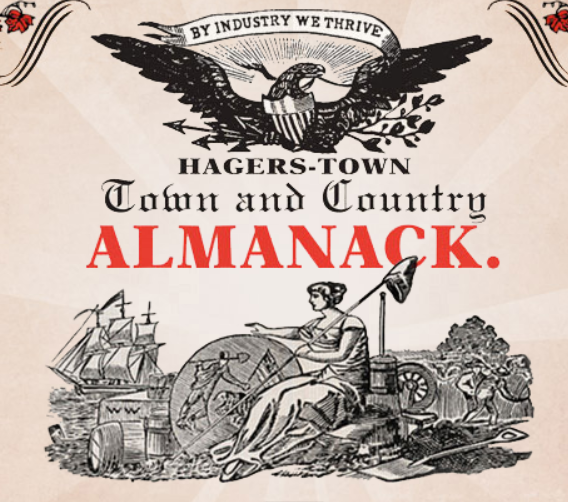
LocalNews1 managers are happy to announce our partnership with The Hagerstown Town and Country Almanack.
First published in 1797, it’s the second oldest almanac in the United States. Beginning in a South Potomac Street print shop in Hagerstown, it’s the creation of colonial printer John Gruber and his son-in-law Daniel May.
Along with the Hub City’s (Hagerstown) founder and namesake Jonathan Hager, Gruber is thought to be one of the town’s “favorite sons.” Gruber’s almanac has been in continuous publication for 230 years and is the only almanac in the United States still published by the founders’ direct descendants.
Our partnership
LocalNews1 will provide a story every Monday, prepared by our writer Faith Crawford, and taken from current or past editions of the Almanack. Readers wishing more can follow the link at the end of this story to order their own copy.
Ancient origins
Almanacs provide immense value for all types of people. So let’s dive into a bit of their history, why they’re so useful, and their evolution into the modern day format.
Almanacs are one of the oldest and most dependable documents that help inform everyday life. In keeping with tradition, most are conveniently pocket-size. But the content within is much larger. It provides detailed information that’s useful to people from all walks of life, from farmers and sailors to students and standard citizens.
Their roots stem from the deep wisdom of ancient civilizations. Astronomers in Babylon tracked celestial cycles to help predict planting seasons. Greek and Asian academics forged in-depth calendars that married mathematics and astronomy with local folklore.
By the Middle Ages European almanacs were normally handwritten guides with agricultural advice, lunar phases and calendars that noted special days for events like feasts. With the invention of the printing press almanacs became more accessible to the public.
Across the pond in colonial America versions like “Poor Richard’s Almanack,” written by Founding Father Benjamin Franklin under the pseudonym Richard Saunders, became bedrocks of not just useful, actionable information but for wisdom, wit and social and cultural commentary. Early versions like these helped spread scientific information, improving exploratory navigation and informed agricultural life.
In the fast-paced modern digital world almanacs offer something that’s becoming more and more rare – curated wisdom. The form of almanacs has evolved with technology, but the original intent remains unchanged. They offer a guide to understanding time, seasonal and weather patterns, as well as the world around us.
Into the 20th century
Thanks to the Industrial Revolution, by the 1900s society had become more modernized. Elevated versions like “The World Almanac and Book of Facts” started including political, statistical and global content. With broader content being covered, almanacs became an invaluable reference resource for journalists, writers and students in need of vetted, trustworthy facts.
Publishers started to mix humor and personality with utility. Jokes and life lessons appeared beside more accurate weather predictions. Oceanic tide tables beside astronomical events and farming tips.
They were especially valuable to residents of rural and agrarian areas. People in less populated locations used them as a guide to plant their crops, stay aware of what to expect as seasons changed, and feel connected to a larger world beyond their immediate area.
Late in the century and early millennium, as the internet came into its own, almanacs retained their reputation for accurate, carefully curated content – something that was becoming increasingly difficult to discover beneath the neverending noise of the world wide web.
Almanacs in the digital age
Almanacs remain credible and popular because they offer something intangible. Trust. The content within is researched, edited and verified with a level of scrutiny that many online sources simply aren’t. Through snapshots in time they’re not just a practical, informational resource but represent historical connections that are rooted in tradition but are always looking toward the future.
The perennial ritual of picking up a new version of an almanac isn’t just that. It’s symbolic of a pattern of long-term, forward thinking in a world that’s only satisfied with instant gratification.
LocalNews1 managers are honored to partner with Gruber’s Hagerstown Town & Country Almanack to bring you the most relevant, timely and informative content about and around Washington and Franklin counties.