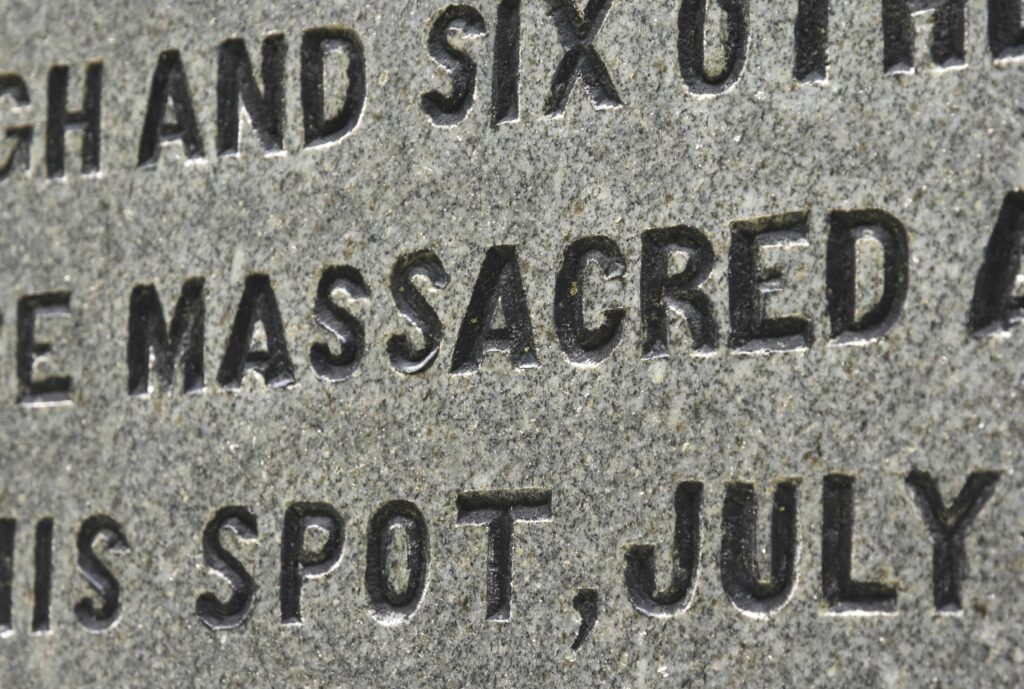
Within the confines of a rural park outside Greencastle, local history recalls a brutal attack that occurred 261 years ago. This peaceful place once became a flashpoint for the struggles between white settlers and Native Americans during an epic era of Pennsylvania history. At this now quiet retreat, a schoolmaster and ten defenseless students died on July 26, 1764, during a horrific incident known as the Enoch Brown Massacre.
Memories of that awful day evolved through stories passed down by generations of ancestors and citizens. These tales eventually created the fervent sentiment needed to honor the innocent lives that were lost. A stone monument and a granite gravestone denote where the remains of eleven murdered souls rest. These unfortunate individuals were victims of the societal pressures that festered hatred when the dreams of pioneer settlers clashed with the culture of Indians who once roamed this modern-day Pennsylvania territory.
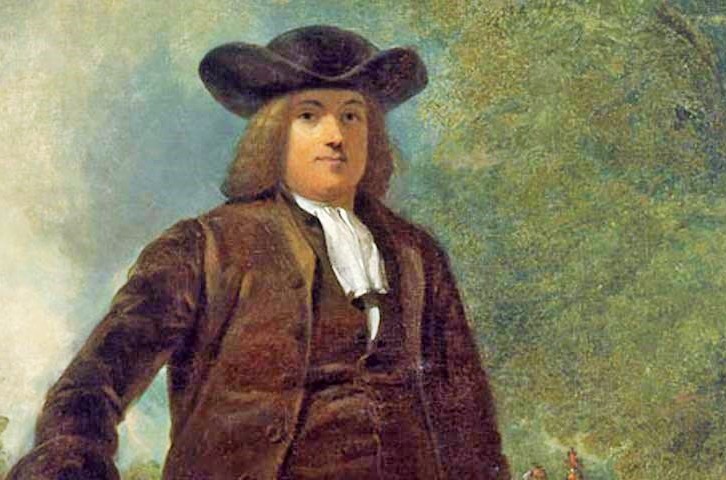
Antrim Township had existed for two decades by 1764, but it would be another twenty years before Pennsylvania created Franklin County from existing Cumberland County. Scotch-Irish settlers like the Allison family (John Allison later founded Greencastle in 1782) immigrated and mixed with German immigrants to claim prized land ceded to Quaker William Penn in 1681.
Before the colonies took up arms against Mother Britain, conflicts in the region centered on internal land squabbles that decided who would inhabit and control “Penn’s Woods”, a landscape blessed with bountiful natural resources. White settlers owned a sense of manifest destiny, while native tribes simply wanted to live on land they had stewarded for centuries. William Penn tried brokering a truce with early treaties. But as immigrant settlements further encroached on Indian territory and left a trail of broken promises, tensions escalated.
The French and Indian War erupted in 1754 when France allied with certain tribes to fight the British Empire for North American control. During this period, prominent white settlers established local forts to protect against native and foreign invasion. Among the tribes in the southern Pennsylvania area during that time were the Lenape, also known as Delaware Indians. They were unfamiliar with a land ownership concept, believing the earth belonged to the creator, and they only inhabited it.
Within this hostile frontier environment, settlers wanted to live their best lives, which included educating their children at community-run schools. Stories handed down about schoolmaster Enoch Brown suggest he was the 13th child in a family that immigrated from Ireland and settled in Virginia. Because 13 was considered an unlucky number, his parents named him Enoch, a biblical figure from Genesis, who “walked with God” and was taken to heaven without experiencing death.
As an adult, Brown taught at a school near the headwaters of Conococheague Creek at the site of a bubbling spring. Since few newspapers existed in the Pennsylvanian frontier region at that time, little is known about the school’s beginning, and enrollment probably varied depending upon the time of year and various planting and harvesting stages.
After the French and Indian War ended with Britain’s victory, the French ceded their vanquished territory to England, disregarding any native claims to that land. As a result, that war didn’t resolve the lingering land issues between the British and Native Americans.
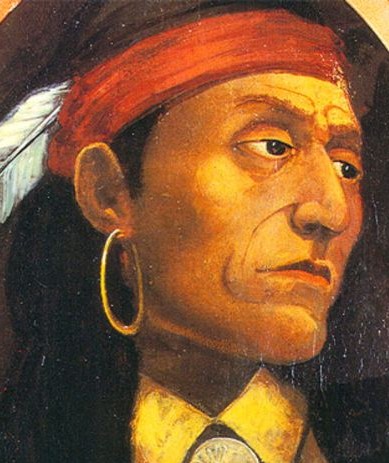
An Ottawa chief named Pontiac emerged as a key leader who led a coalition of various tribes, which included the Shawnee, Ottawa, and Delaware groups, to challenge British control. While most of “Pontiac’s War” battles took place in the Midwest, starting in the spring of 1763, tensions spilled Eastward into Pennsylvania territory.
As war conflict heated up once again, a group of radical Pennsylvania settlers, known as the “Paxton Boys”, formed a vigilante mob to defend themselves against attacks from Conestoga Indians. During two December 1763 attacks, they murdered 20 unarmed Indians in Lancaster County, including women and children.
However, as 1764 reached its midpoint, tensions seemed to ease in the Pennsylvania region where Brown conducted classes at the local log schoolhouse. Historic speculation suggests that parents of these schoolchildren had become complacent about the distant war and needlessly put their kids in harm’s way. An ominous sign of the coming tragedy happened on July 25, when Indians murdered a pregnant woman named Susan King Cunningham nearby.
The following morning, stories say natives were lurking in the area when eleven students gathered for classes at Enoch Brown’s schoolhouse. Nine boys and two girls (from ages 10 to 15) appeared for classes on July 26. Some of their names are known, including Ruth Hart, Eben Taylor, Ruth Hale, and George Dunstan. Other students attending remain unknown to this day.
Specific aspects of the fateful school attack are speculated and debated, but most agree it occurred in the morning. Enoch Brown was unarmed and would have pleaded with the three Delaware Indian invaders to spare his students. While some future accounts suggest Brown was shot, that type of injury isn’t verified. The Delaware tribesmen beat the children to death with clubs and then scalped them.

Historians also speculate about the age of the attackers, but consensus gleaned from later accounts seems to favor that they were young men not much older than 20. They left the school with the captured scalps, likely convinced they had killed everyone on site. But one boy played dead and survived the attack. His name was Archie McCollough. Stories say that Archie, aged 10, hid in a fireplace. After the attackers fled, he crawled to the spring outside to cleanse his scalped head, where rescuers found Archie.
Outrage about the school massacre, combined with the pregnant woman killed a day earlier, spurred a search party for the killers. In an unusual twist to this tragic incident, Archie’s cousins, John and James McCollough, had been kidnapped on the same date eight years earlier by the Delaware tribe and were still held captive. John remembered when the attackers returned with the schoolchildren’s scalps. Elders berated those warriors for their violent actions. The Chief called the three men cowards, the worst insult possible in their culture.
According to legend, the Delaware attackers were caught and executed for their crimes. Following the massacre, Pennsylvania renewed its “Scalp Act”, which offered a $150 bounty for a male Indian scalp, and $130 for a female or male under age 10. The British used biological warfare against the natives, distributing smallpox-infested blankets to unsuspecting enemies. During this hostile period, neither white settlers, British troops, nor Native Americans could claim the moral high ground in the violent tactics used for brutalizing their territorial enemies.
After Pontiac’s War ended in 1766, white colonists pushed native tribes further west. The North American colonies turned their attention toward gaining independence from Britain. The Delaware tribe eventually ended up in Oklahoma and Kansas, joining many other tribes forced from their homelands to western landscapes.
Stories about the Antrim-area massacred schoolchildren and headmaster persisted into the 1800s. According to legend, mourners buried the bodies head-to-toe in a large box at a common gravesite. The school disappeared, and one account suggested grieving families burned it.
In 1843, local leaders excavated the unmarked grave and confirmed the remains of Brown and his students. In a process that took another four decades, the group decided the massacre site was sacred and required preservation. When Franklin County celebrated its centennial in 1884, the necessary traction to create a formal park finally commenced.

On August 4, 1885, 5,000 community members gathered to dedicate a monument to Enoch Brown and his departed students. One speaker cited Brown’s noble nature, saying he was as much a hero as the most glorified soldier. “The school house was a symbol of our civilization, and that brave and self-sacrificing man, who yielded his life for his scholars, was a pioneer and martyr in a blessed cause.”
Next came a poem reading from John Cooper, the “gifted bard of Greencastle,” who read his literary creation, penned for the event. “It threw a halo of poetic fancy around the memory of the martyred schoolmaster and scholars,” the host recalled.
Despite the noble effort to preserve the three-acre site with the erection of stately monuments, many questions still linger about the identities of the participants and the follow-up to the tragedy. Thirteen years after the monument’s dedication, two new male names, the Dean brothers, were etched into the memorial in 1898. Still, history has recorded little about Enoch Brown’s life, the man whose name represents the massacre. The attack’s lone survivor, Archie McCollough, also seemed forgotten.
Throughout Greencastle’s history, the Enoch Brown Massacre remained a prominent and heartbreaking episode. In 1964, to commemorate the 200th anniversary, a golden coin was issued with the park’s monument imprinted on its face. An author wrote a book for the occasion and attempted to clarify lingering mysteries about the tragedy. One fact debunked was a myth that the Delaware invaders walked backwards away from the scene to throw off would-be trackers. Historians placed that book in a Chambersburg time capsule to be opened in 2064. The massacre’s 250th anniversary came around in 2014, and historians reaffirmed that both sides committed atrocities during that contentious period.
In 2015, a member of the McCollough family researched the three ancestors who had been kidnapped or wounded by the Delaware tribe. Rodney McCollough wrote and published “The Scalping of Archie McCollough” as part of his ongoing research into his family’s history. During his preparation, he tracked down available facts through census records and old newspaper accounts.
Many generations removed from his kin, Rodney McCollough discovered new information about his ancestors. Ten-year-old Archie, nearly killed by the vicious attack in 1764, grew into adulthood, became a blacksmith, married, and fathered two children. His family moved to Kentucky, where all traces of him vanished in 1810. Archie’s cousin, John, published a diary of his eight-year captivity with the Delaware tribe and filled in many gaps about the McCollough family’s frontier history.
While Rodney McCollough has lived his adult life in Indiana, he travels to Franklin County for yearly family reunions. He is proud to preserve his ancestors’ heritage and shed new light on local history. McCollough’s book is available on Amazon for curious readers who want to learn from his diligent research.
Today, Enoch Brown Park seems frozen in another era. “It’s still an isolated place, you can picture what happened there,” McCollough said. Mature trees offer shade and a sense of mystery, and the spring continues to gurgle through the property, named for a resilient boy who survived an attack still discussed 261 years later.

An inscription on the tapered monument sums up the sentiment felt at Enoch Brown Park:
“The ground is holy where they fell,
And where their mingled ashes lie,
Ye Christian people mark it well,
With granite columns strong and high.”