When George Frick started his fledgling business enterprise in 1853, he likely didn’t envision his engineering talents would someday benefit customers all over the world. Frick perfected his industry in Waynesboro, Pennsylvania, and through his company’s commercial success, he elevated the community’s collective manufacturing stature to international heights.
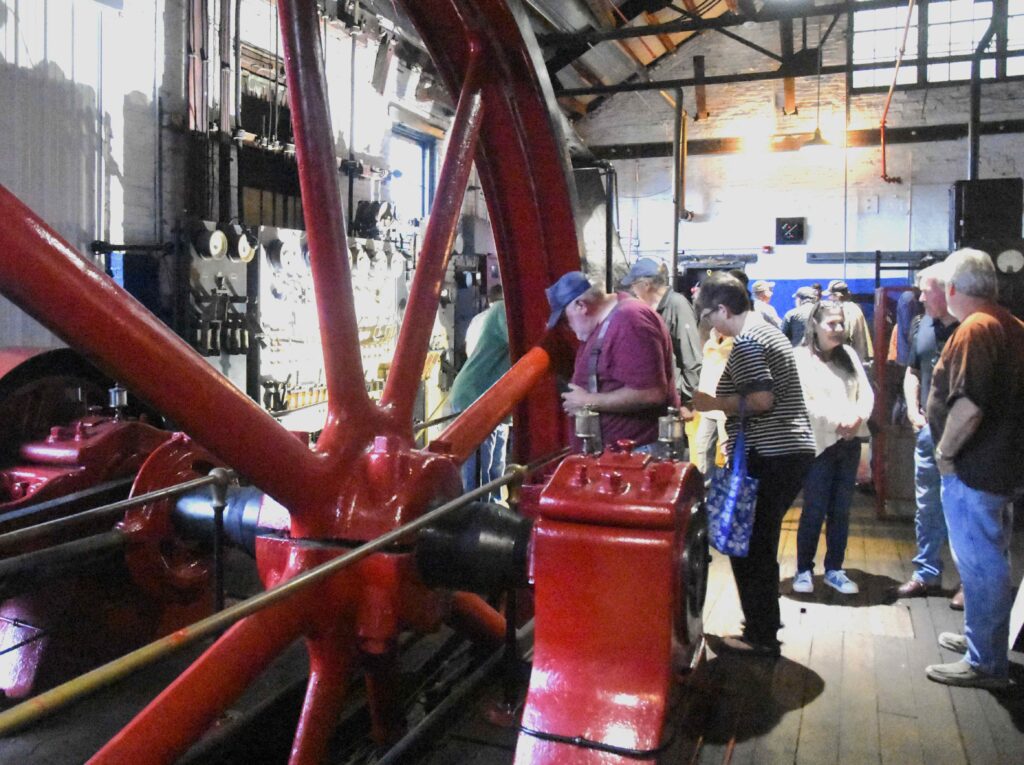
Thanks to the preservation efforts of two devoted Frick employees, a restored power plant that once created vital electricity for Waynesboro’s Frick campus still survives. The structure embodies unique aspects of the company’s evolution during the early 20th century. A recent open house, sponsored by the Waynesboro Industrial Museum, gave visitors a glimpse inside Frick’s former world. Exhibiting freshly painted machinery, the plant seemed poised to recharge its long-ago electrical mission.
George Frick was born in 1826 and moved with his family from Lancaster County to Quincy in Franklin County when he was 9. His Father encouraged his tinkering, and George apprenticed to a millwright in Maryland when he was 17. Returning to Quincy with new skills but no formal technical training, he soon built his first steam engine. That basic two-horsepower machine was the forerunner of a manufacturing giant.
As Cumberland Valley industry grew in the mid-1800s, new-fangled steam power provided improved efficiency above traditional water-powered operations. Farmers wanted new machines to help with their seasonal tasks, the most laborious being threshing wheat. George Frick seized these opportunities and started his company at Ringgold, Maryland, at age 27. His new enterprise built portable engines that powered threshers, followed by traction engines that allowed sawmills and threshers easy movement from place to place. With business thriving, Frick moved his manufacturing headquarters to Waynesboro in 1861.
The company survived the Confederate invasion, which included the rebels’ local pilfering, during the Civil War. However, by 1870, Frick was starved for working capital to keep up supply demands and to expand his business. He tapped second cousin, Christian Frick Bowman, as a major investor, but Bowman contracted typhoid fever and died in 1872. George Frick’s oldest son, Frank, also succumbed to that illness.
Once again, Frick searched for investment capital and other local towns tried to convince him to move his plant elsewhere. The railroad had yet to reach Waynesboro, so the community had a disadvantage in keeping its prized industry.
Thirteen Waynesboro businessmen approached Frick, seeking a profitable partnership. Seed money was scarce during the financial panic of 1873, but that year this new group invested $34,000 and took control at Frick. George Frick remained as general manager and treasurer. During the next 10 years, Frick Company enjoyed rapid expansion.
After growing its business on South Broad Street, Frick moved its operations to a 30-acre campus on Waynesboro’s West Main Street in 1880. The company has remained there ever since. Railroad tracks finally arrived in town and passed adjacent to the new Frick plant.
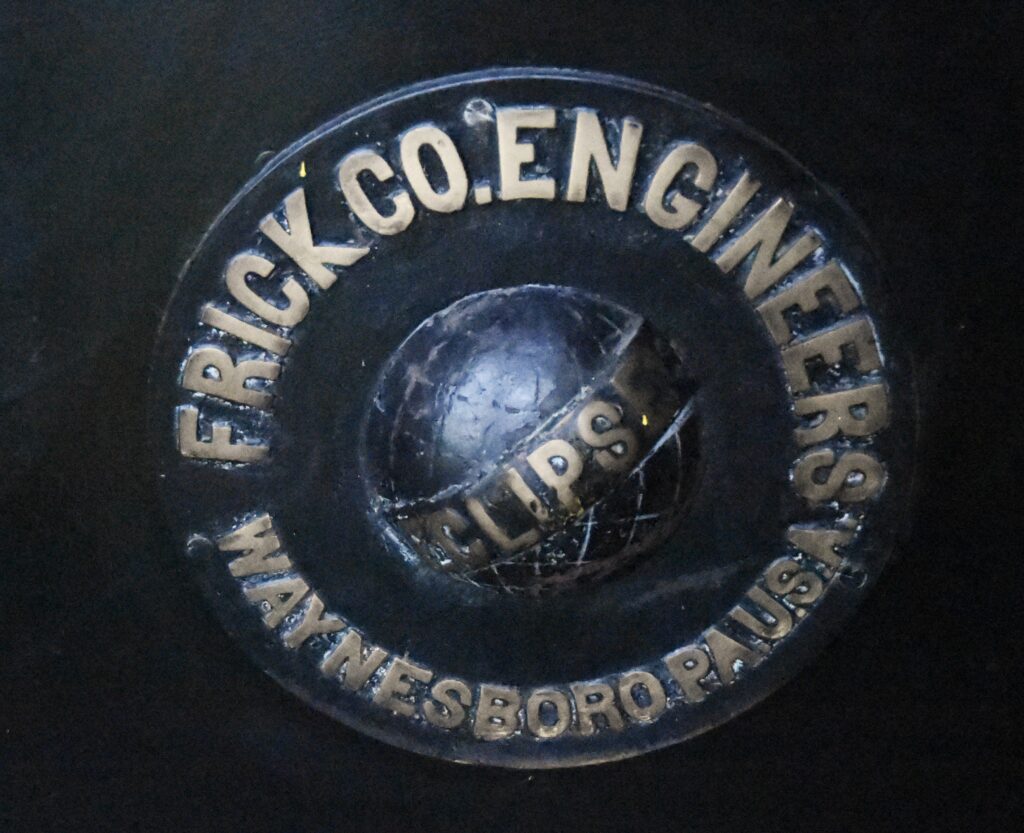
Frick’s products won industry recognition, winning first prize in a Melbourne, Australia, competition, and earned the same honors at St. Louis and Chicago expositions. George Frick explained his business philosophy: “I use good materials. My employees are all experienced workmen. All my machines are sold under warranty.” Frick retired in 1888 at age 62, but he had spent 43 productive years in manufacturing. Frick’s motto was: “Be sure you’re right, then act quickly.” George Frick died in 1892.
Frick’s sons, Ezra and A.O., took the reigns as the company branched out into a new line of equipment that would solidify their world famous reputation: refrigeration equipment. Like before, Frick’s latest product line grew rapidly and between 1890 and 1900, demand soared.
Cold storage facilities, packing plants, breweries and large hotels and restaurants bought Frick refrigeration products. Frick shipped machines to Japan, South Africa, India and Spain. The company established itself as a world leader in the design and manufacture of industrial refrigeration compressors and control systems.
Frick’s West Main Street plant expanded near the turn of the century. The first power plant couldn’t handle the additional workload, and the company decided a second power facility was necessary. Stories passed down through generations remember that people came from all over the county during the early 1880s to see the Frick factory glowing at night, illuminated by that first power plant. Waynesboro citizens didn’t enjoy home electricity until a dozen years later.
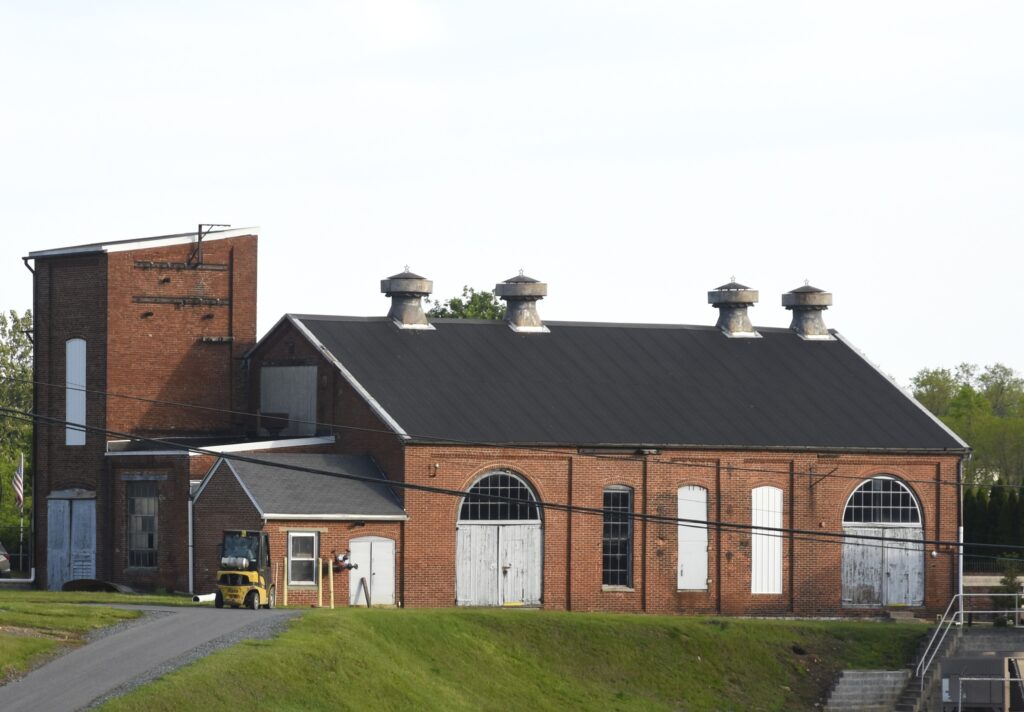
Construction started on the second power plant, located at the far western edge of the campus, in 1902. Frick engineers designed the building to produce electricity to run machine tools and to power updated lighting inside the plant. The compressed air required for operating tools and conducting pressure testing would also be created there. Steam generated would provide heating for the plant during the wintertime.
When the second power plant started construction, the nearby Mont Alto Iron Works shut down, and its assets were auctioned. Recycled red bricks from that enterprise were likely part of the second power plant’s construction. The Waynesboro Record newspaper followed the building’s progress, stating: “Work on the new plant is moving slowly, but when it’s completed, there will be no shop in the valley so completely equipped with light and power.” The new Frick power plant went online in 1904.
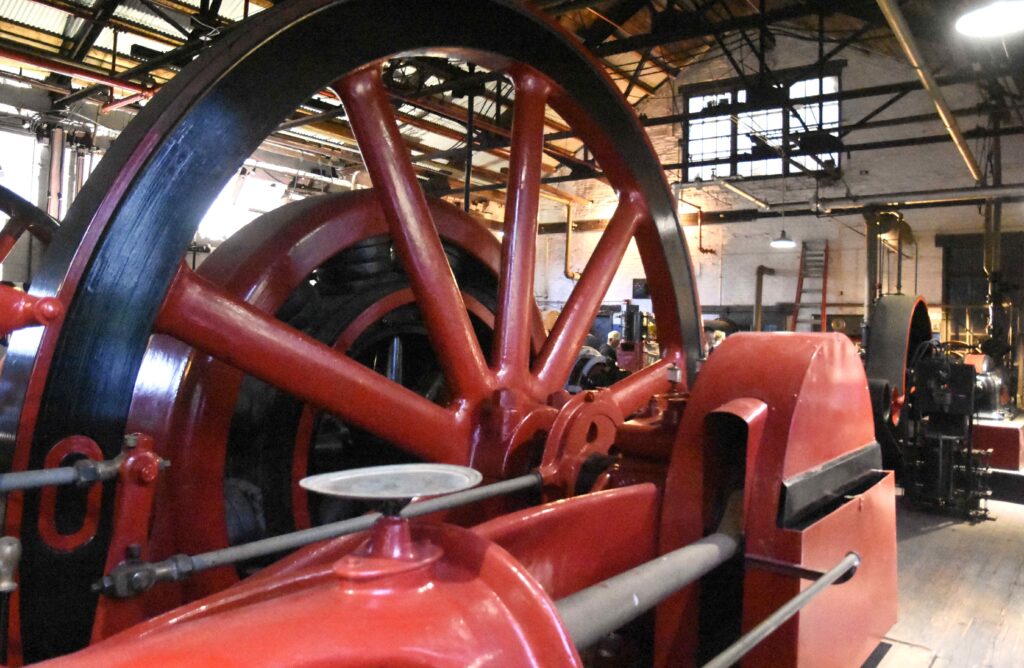
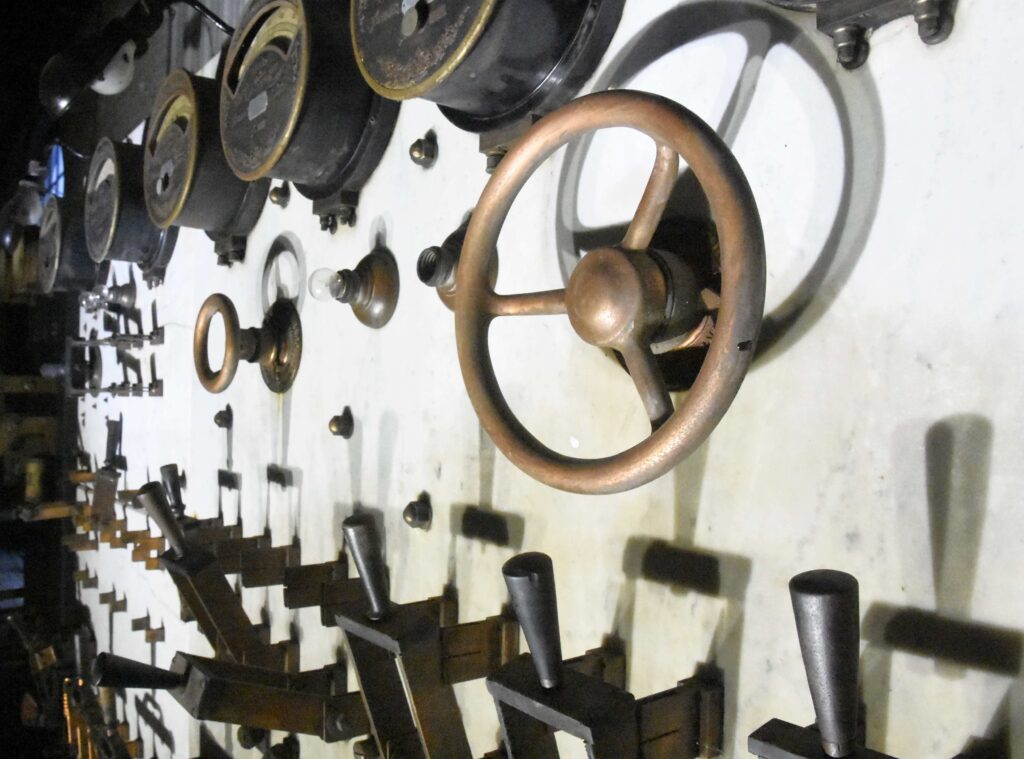
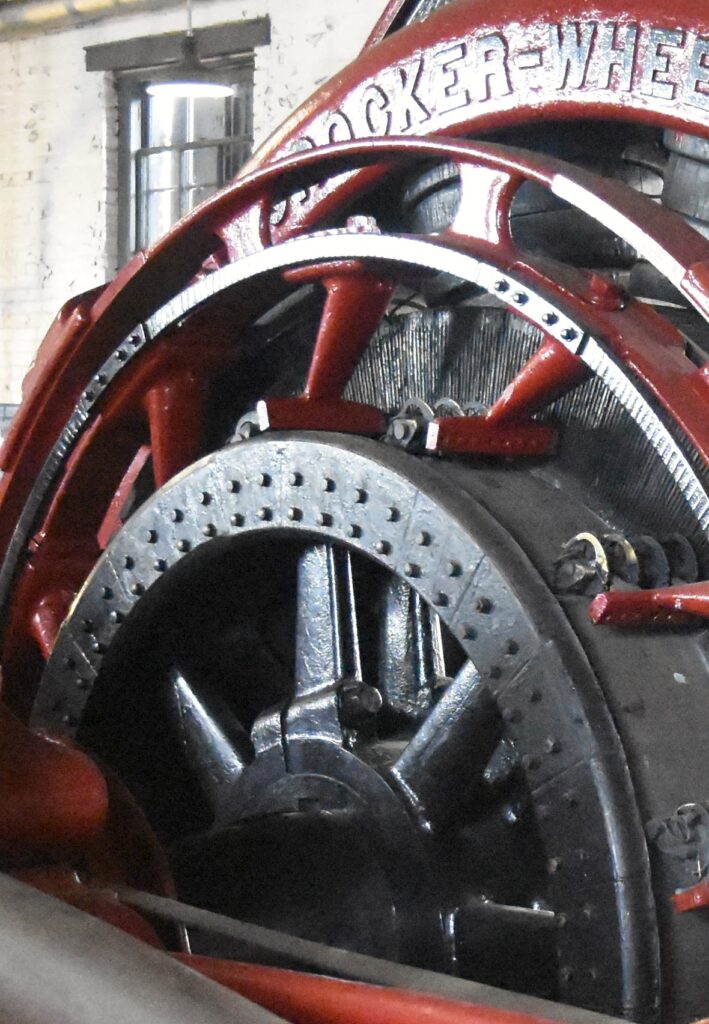
This Frick powerhouse, designated as Building 48, had several state-of-the-art power generators onsite. Some of the machines were so large that Frick constructed the building around them. The engine room has seven significant pieces of surviving equipment – two air compressors, three steam driven electricity generators, a motor generator set and an example of a stationary steam engine of a type that George Frick fabricated in the 1850s. A massive switchboard boasted overload breakers and high-quality meters, representing the best technology of that time.
During the 1890s era of American electricity, a spirited fight between preferences for Direct Current and Alternating Current brewed. Inventor Thomas Edison favored DC, but industrialist George Westinghouse thought AC was superior. Frick picked DC for the new power plant since they had already invested in that mode for earlier Waynesboro campus electrical needs.
Seven boilers burned coal to generate the steam that powered the gigantic equipment. The plant could run on three boilers, but several served as backups, while others provided facility heat during frigid weather. Two coal-passers fed three firemen who shoved the black fuel into the furnaces, and a shift engineer supervised the plant’s operations. These boilers burned one railroad car of coal most days, hauled by train to the power plant by a yard engine nicknamed the “George Frick,” which served until 1946.
This constant coal-burning process produced a large amount of cinders, and once removed from the boilers, workers sprayed the ash with water to minimize dust. Frick converted two boilers to burn sawdust and shavings from the woodworking shop for efficient waste disposal. In 1956, Frick spent $89,003 operating the building, burning 6,674 tons of coal. Working at the power plant was a grimy occupation, and men returned home every night covered in black soot.
One of those dedicated workers was Ed Helfrick, who worked at the power plant from the 1920s to the 1950s. His son, Bill, remembered delivering lunches and coffee to Ed at the Frick plant during school breaks. As an adult, Bill followed in his father’s footsteps and worked in the industrial field at Waynesboro’s Landis Machine Company.
Anna Pennsinger recalled childhood memories at age 96; she lived across the street from the power plant in 1913. Young Anna peeked into the building’s windows to watch the giant flywheels turn. She befriended superintendent Lonnie Stover (who worked at Frick for 54 years), and he let her come inside once a week. Anna remembered soot escaping the plant’s giant smokestacks and settling onto her family’s clean laundry that hung out to dry.
Another devoted Frick power plant employee was Danny Sprenkle, who lived on a farm in Greencastle. One winter day when a snowstorm struck, Sprenkle needed to get to work and feed the boilers by 4 a.m. He drove his farm tractor into Waynesboro through deep drifts of fallen snow. Sprenkle had the plant running at full capacity when Frick workers arrived for their daily shift at 6 a.m.
Today, the Frick power plant engine room is a nostalgic trip to yesteryear. Little changed at this building section after the 1920s, and workers operated the reliable equipment until 1969.
Waynesboro Industrial Museum board members, which included President Brian Shook, attended the power plant’s recent open house. The museum originated in 2000, and its mission is to provide awareness and insight about the area’s rich manufacturing heritage and to encourage careers in industry. WIM houses a significant collection of Frick artifacts at their 235 Philadelphia Ave. location.
After delivering museum announcements, Shook turned over the program to Bill Yoder. This Frick product service engineer spent the past three years (including his vacation time) restoring the power plant to a polished luster. Yoder built this success on previous efforts by his co-worker, Stan Haas, whose love for the power plant resulted in its first restoration in the late 1990s. “I developed a passion for this building 25 years ago through Stan,” Yoder said. “That motivated me to undertake this project.”
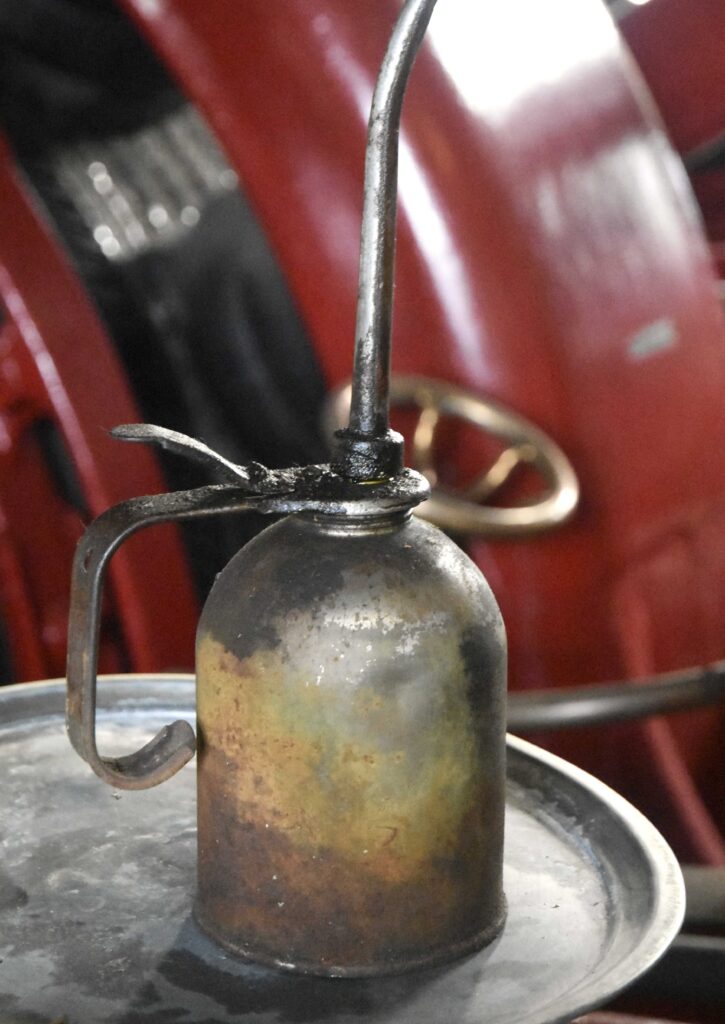
Yoder has worked at Frick for 37 years, and he picked up the preservation torch after Haas’s death. He spent many weeks working at the power plant, cleaning and degreasing equipment and applying fresh paint. “I wanted to be an advocate for the power plant since it’s an important piece of Waynesboro’s industrial heritage.”
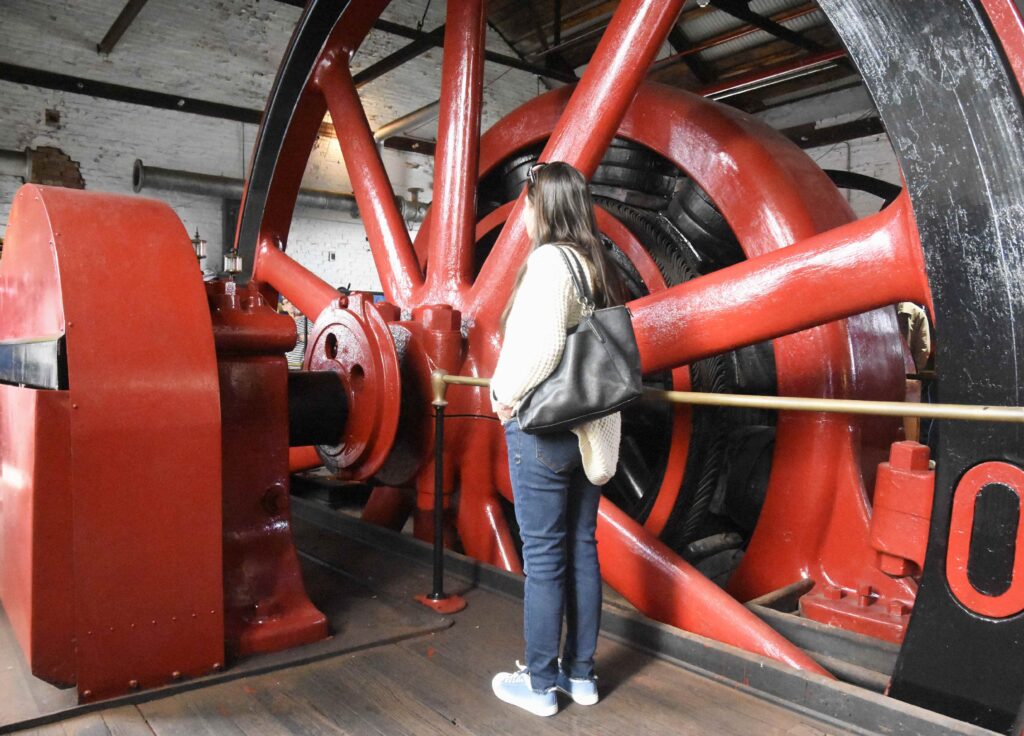
Yoder researched original paint colors, but when that search provided no definitive answer, he picked International Harvester Red as his prime accent color. This choice added contrast and brightness to the interior scene and its prime visual attraction, two giant flywheels (one is 18 feet tall) that dwarf visitors. Yoder was pleased to share this portion of Frick’s history with the public.
York International acquired Frick Company in 1987 and later sold the enterprise to Johnson Controls Inc., which currently owns it. However, the Frick name survives within the company’s well-respected product line. JCI is headquartered in Milwaukee but has become a welcome partner in Waynesboro’s modern industry.
In November 1988, a fire destroyed Frick’s office building on West Main Street. The power plant, located nearby on Lincoln Avenue, survived that disaster. The iconic 100-foot tall Frick water tower, which held 100,000 gallons and was a 1922-built Waynesboro landmark, also endured, but the company removed it in 2008.
Now a prime example of the company’s industrial heritage, the remaining power plant engine room (the building’s section containing the boiler room with its large smokestacks no longer exists) is a testament to Frick’s local impact, serving as a time capsule of Waynesboro history. George Frick and his company’s records are also archived at the Smithsonian Institution.
The power plant is a fine example of local historic preservation that will further the Waynesboro Industrial Museum’s mission and encourage other area building owners to preserve their unique architecture. Many industry icons from the community’s past are now only memories, and once lost, can never be recreated.
Bill Yoder is proud of the power plant’s renovation and his company’s enduring legacy. “Frick showed the initiative to constantly develop new products, from the most basic 1800s steam engines to today’s high-tech systems. This building symbolizes that long evolution, all in one place. Frick’s spirit of innovation never died.”