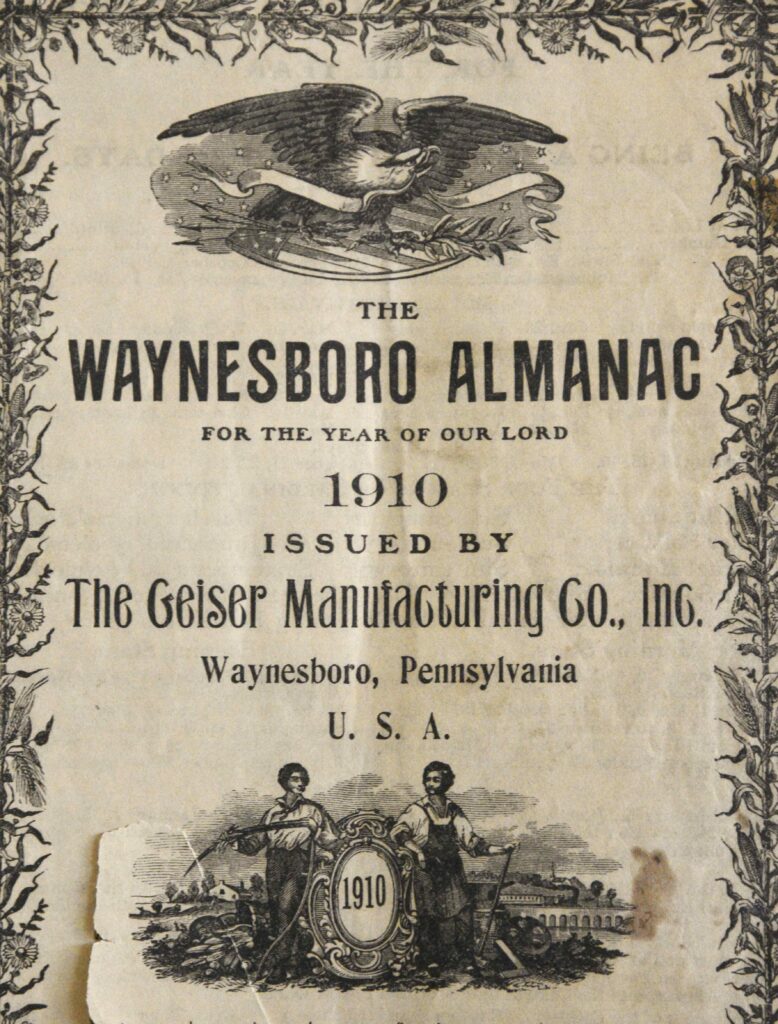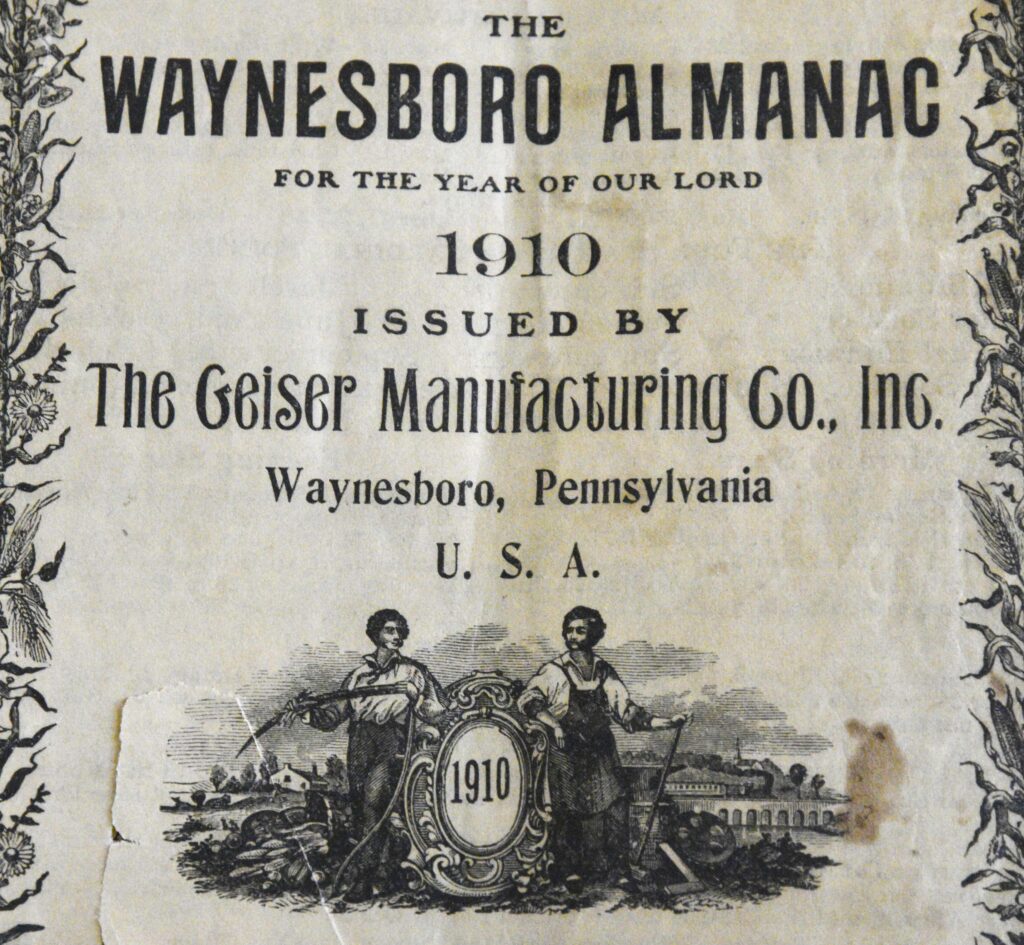
A recent discovery of a 1910 “Waynesboro Almanac,” issued by Geiser Manufacturing Company, offers a glimpse into local industrial history, highlighting one of the town’s earliest powerhouse enterprises. Geiser, which began operations in 1855, built grain separators and threshing equipment powered by steam engines.
Its founder, Peter Geiser, was born in Smithsburg, and he tinkered with inventions that would eventually revolutionize agricultural harvesting. Along with other Waynesboro industry titans, such as George Frick and brothers Abe and Frank Landis, they put the community on the world manufacturing stage.
Almanacs date back to America’s founding era, offering practical and cultural information to farmers and rural citizens. The famous Farmer’s Almanac, first published in 1792, is one of the nation’s longest-running periodicals. Geiser Mfg. tapped into the popular genre with its self-published almanac.
By 1900, Geiser had established a significant presence in Waynesboro, employing over 1,000 workers. The company’s facilities occupied entire city blocks, near modern-day sections of Main, Broad, Second and Walnut Streets. With its prominent link to the agricultural industry, the company designed its almanac to provide information on weather, celestial events and homespun suggestions for clients around the country. However, the ultimate purpose of the Waynesboro Almanac was to advertise and sell Geiser products.
Viewing the year ahead through the eyes of an astrologer, the almanac began by noting the religious Movable Festivals for 1910, which included Shrove Tuesday (now called Fat Tuesday) on Feb. 8, and Whit Sunday on May 15. Morning and evening stars were featured next, and the planet’s brightest days were indicated. Four eclipses would occur that year, two each of the sun and the moon. The sun’s total eclipse on May 9 would be invisible in America, but the moon’s total eclipse on May 24 was locally viewable.
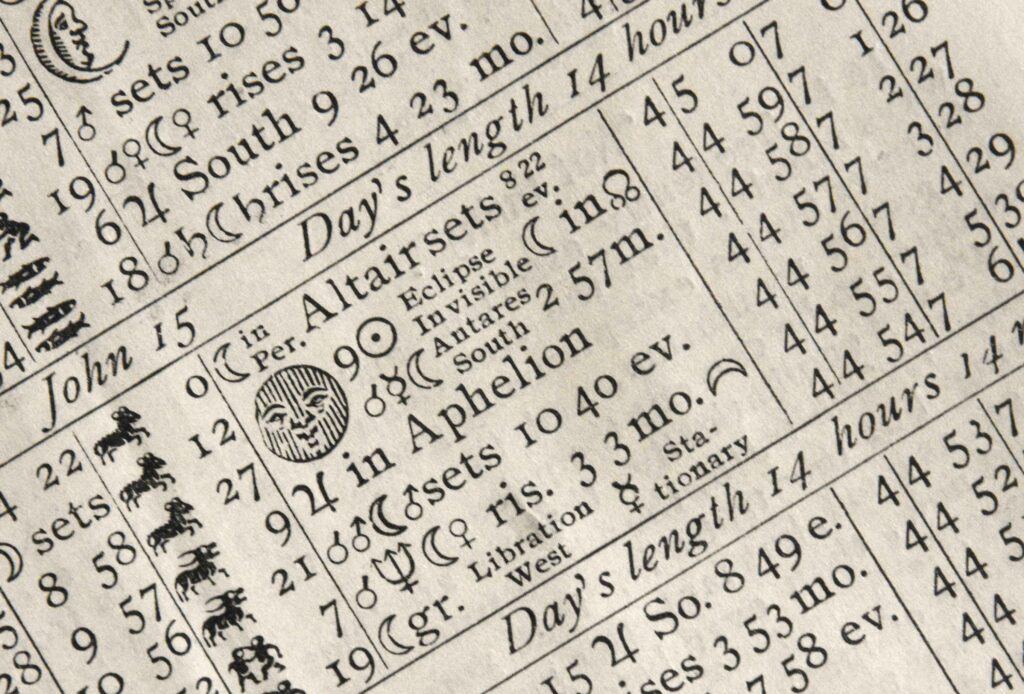

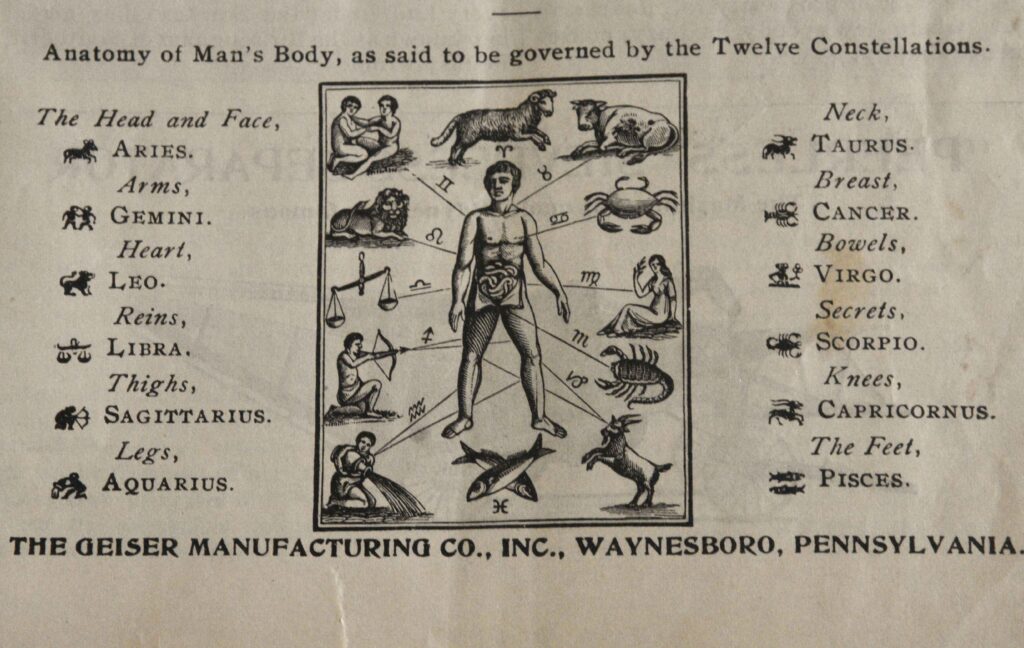
On page three, the almanac continues on a scientific theme, explaining various abbreviations for astronomical characters and planets. This section completes with a description of the “anatomy of a man’s body, as said to be governed by the Twelve Constellations.” According to the almanac, Aries ruled the head, the heart by Leo, secrets by Scorpio and the feet by Pisces.
Geiser’s hometown pride is evident on page four, as it answers its own question: “Where is Waynesboro?” The almanac’s writer (who isn’t credited) sets the scene for Geiser’s host city and promotes the firm’s contribution to it. Waynesboro is situated “on fames eternal campground, midway twixt Gettysburg and Antietam, where Columbia’s sons gave their last full measure of devotion for the preservation of the union, and the glory of the flag.” A portion of this sentence borrows phrasing from Abraham Lincoln’s Gettysburg Address.
Continuing on Waynesboro’s charms, the writer describes its landscape, which is “near the Mason and Dixon’s line, that once divided the North and South, but which is no longer divided. In the Cumberland Valley of Pennsylvania, near Pen-Mar, that overlooks that fair realm of nature, that is the delight of painter and poet. There, in the midst of the hills, is Waynesboro, where more men and more money, in proportion to population, are employed in industrial enterprises than anywhere else in these United States of America. It is beautiful for situation, exceptional and extraordinary for its big manufacturing plants.”
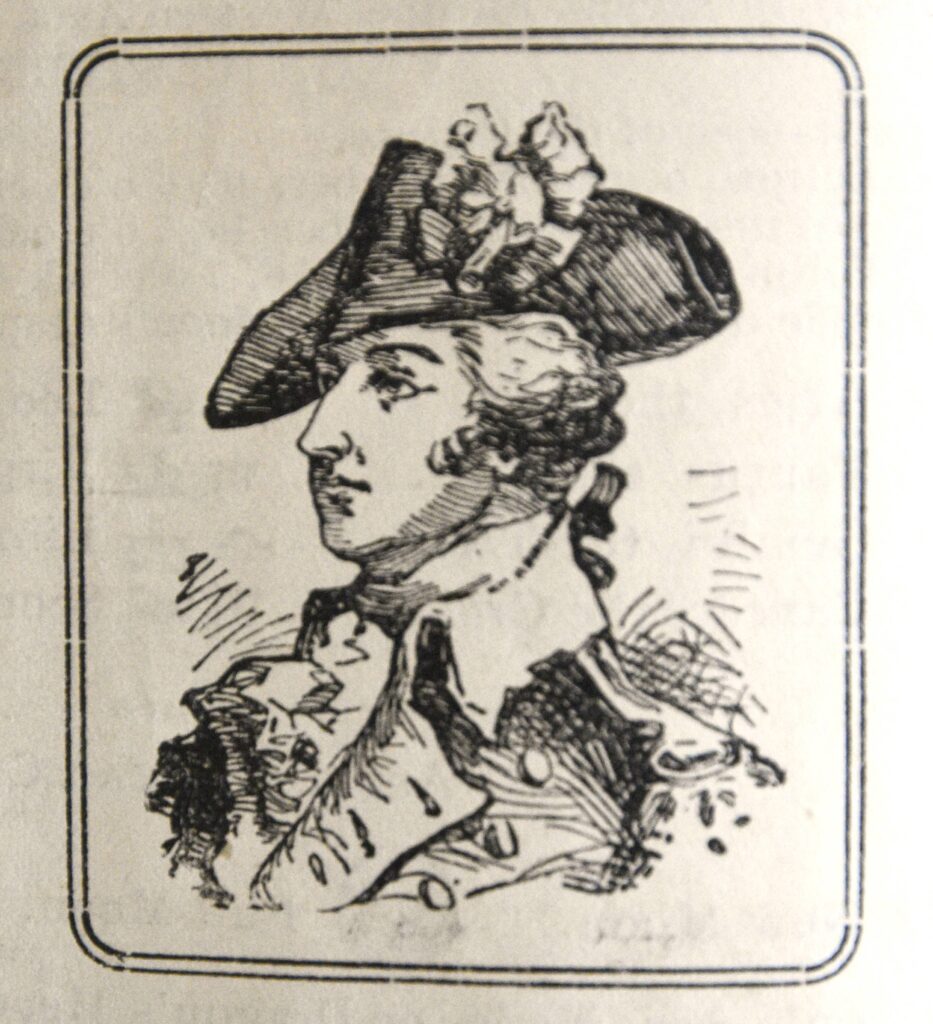
Mentions of Geiser and its products continue throughout the almanac, even tying the firm to Waynesboro namesake Anthony Wayne, the Revolutionary War hero. “It is said that General Wayne, while passing through the then small hamlet, remarked, ‘What a lovely place to build a town.’ That his judgment and foresight were clear is evidenced by the beautiful city that now bears his name. Little perhaps did he think that upon that very spot should be reared the great plant of Geiser Manufacturing Company, whose superior product reaches every land under the sun.”
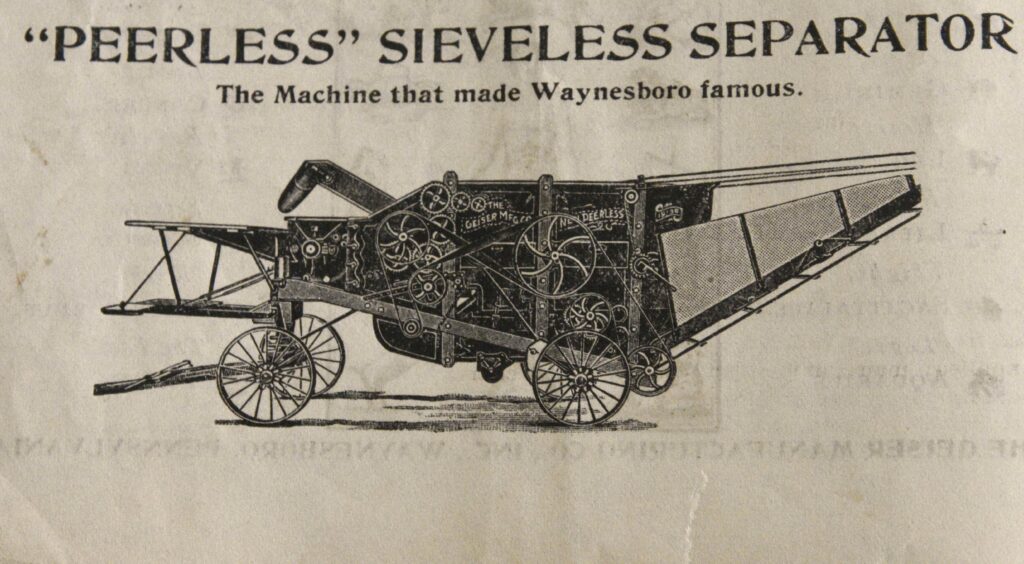
Before monthly almanac features begin, the Geiser-sponsored text introduces itself formally as the creator of the “Peerless” Sieveless Separator, the “machine that made Waynesboro famous.” The narrative explains how the company began in a wagon maker’s shop half a century earlier, then it slowly developed to become one of the “largest and best equipped plants of its kind in the world.”
Geiser explained its business philosophy, next to an intricate drawing of its massive plant. “The chief element of merit in all Peerless machinery is its remarkable simplicity. There is nothing intricate, difficult or complicated about it, and the unwavering purpose to build good and strong and simple has never been deviated from.” The company welcomes almanac readers to the New Year, to a “clientele so large and a patronage so vast, that it cannot be enumerated.” Throughout the monthly almanac, Geiser introduces its clients through testimonials from far-flung states, such as Texas, North Dakota and Kansas.
January begins with a table describing each calendar day, including typical information such as sunrise/sunset times, phases of the moon and individual day’s portion of daylight. The almanac also notes “Remarkable Days”, many of which honor saints’ days such as Isadore, Felix and Virgil. At the bottom of each month’s listing is a Geiser testimonial, which in this first month of 1910 reads: “My new Peerless threshing outfit beats the record in this county,” claimed John Malthy of Piedmont, OK.
To complement each monthly section, Geiser toots its horn with praise for its products. In January, the company claims universal approval, saying, “from the sun-kissed waves of the Pacific to the sandy shores of the Atlantic, you can find the Geiser Company’s Peerless machinery garnering the crops for the benefit of man.” Mentioning that their products were also utilized in Russia, Turkey, Algeria and Spain, Geiser boasted, “It is literally true that the sun never sets on the products of this plant.”
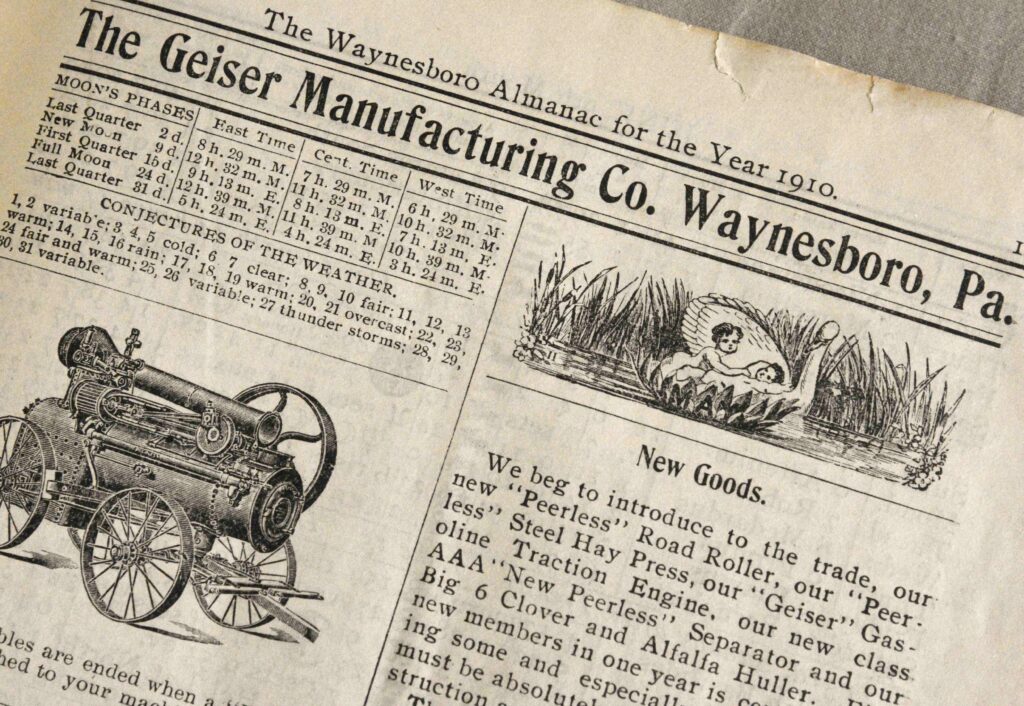
For readers looking for detailed meteorological predictions found in competing publications, the Geiser almanac offers limited “conjectures” about upcoming weather. For various winter days, conditions forecasted included “fair, cold and windy, overcast, rain or snow, mild,” or simply “clear.” Regardless of the generic prognostications, in February the almanac reminds its readers that “the information contained in this book…is very valuable, and makes it a most serviceable Family Almanac. The astronomical pages have been prepared and arranged by men of great ability in their chosen field so they may be accepted as being correct.”
Also included on these pages are suggestions for better living, bits of humor and practical tips for everyday problems. In March, the almanac recommends cleaning a white straw hat by mixing a teaspoon of oxalic acid into a glass of water and then applying the mixture with a clean toothbrush. To keep human hair from falling out, the pulp of a lemon rubbed on the roots worked wonders.
In April, as planting season neared, Geiser’s almanac offered this testimonial from a Kansas farmer. “I made the best run in my life with my new Peerless. Paid my engineer for 40 days and threshed 78,454 bushels of wheat, barley and oats. No machine in this county comes within 300 bushels per day of my average.” Geiser backs up the opinion with a staff-written editorial, saying the process of using antiquated equipment for harvesting was “ridiculous and absurd.”
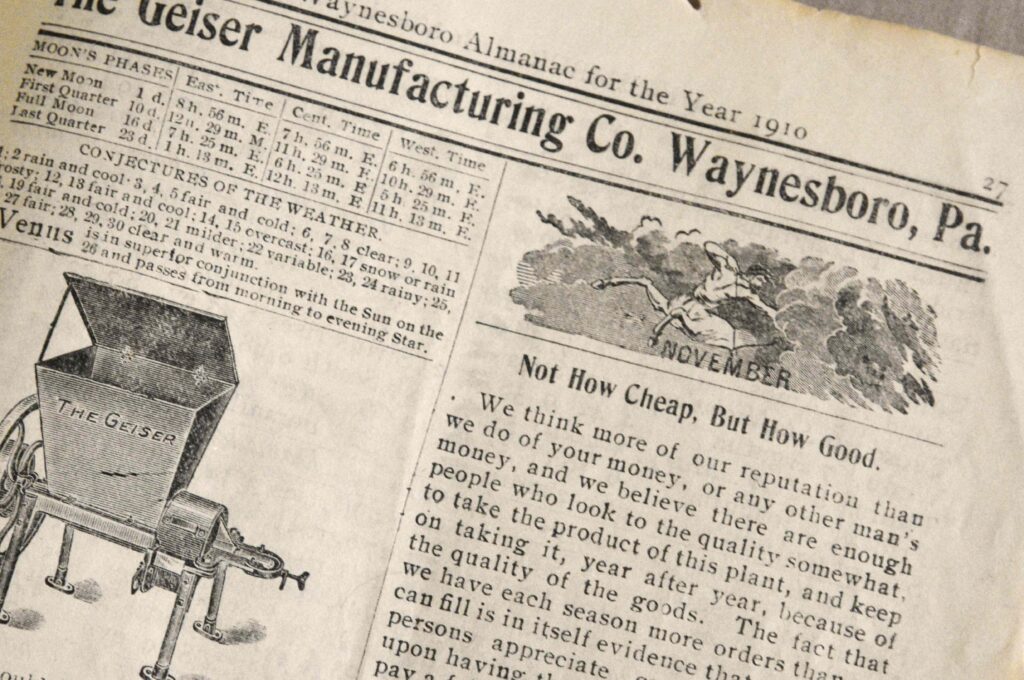
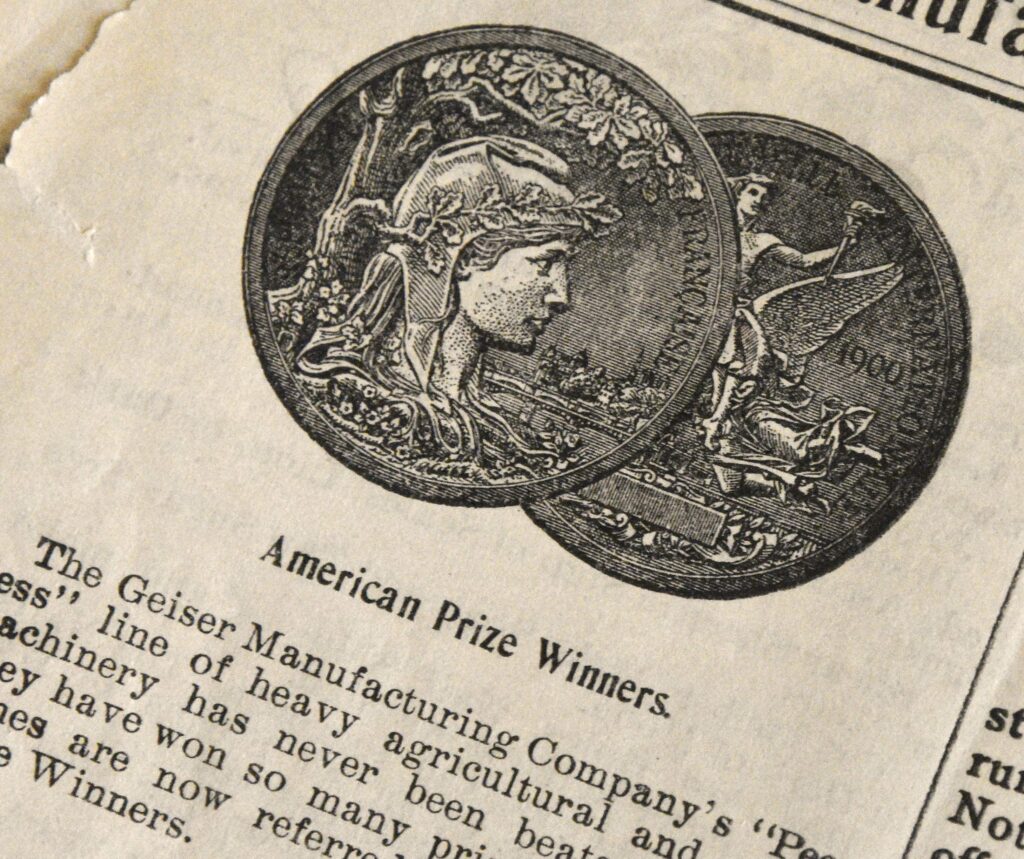
For local farmers and everyday folk, the almanac suggests proper times to plant and perform other chores. For the dark of the moon, plant potatoes, beets, corn and buckwheat. For the increasing moon, plant tomatoes and trees. On St. Patrick’s day, it is advisable to plant cabbage and clean beds, and also to trim toenails to prevent a toothache. Other suggestions included destroying shrubbery on the day that St. John the Baptist was beheaded, letting the cows go dry during a new moon, and cleaning out wells during the sign of Pisces.
When summer arrived, Geiser reminded customers that season was their busiest time. “Year after year, we buy more land, build more shops, install more machinery, use more power and employ more men in an endeavor to supply the constantly increasing demand for Peerless machinery, and we receive more orders than we can fill. Why don’t you order early, giving us the opportunity to prepare and ship your goods? A Peerless machine is as good as gold.”
For anyone hesitating to purchase equipment, Geiser advertised that the style and finish of the Peerless machines were unmatched. “It costs us something extra to make our machinery look handsome. When a man starts out with a Peerless, he has something he can be proud of. This style helps immensely in the quality and quantity of work done, to make business pleasant and profitable.”
Throughout the almanac, Geiser offers tips to potential customers by encouraging a start in agriculture. “There is plenty to do and plenty of opportunities to make money. Only a little money is required to start a business. Our easy payment plan offers an opportunity to a deserving man of limited means to get a start in life.” The almanac suggested that enterprising young men should “say little, think much, and act more. Keep expenses low; always have a balance in your pockets.” For personal habits, “be not mean in anything, avoid the tobacco and drink habits.”
After Peter Geiser died, the company’s fortunes changed. The Emerson-Brantingham Company, an Illinois industrial conglomerate, bought the company in 1912. EBC consolidated its operations in Illinois in 1920, and several years later announced it would sell the Waynesboro Geiser plant. Local investors purchased the company and attempted to rescue Geiser, but their valiant efforts were no match for the Great Depression. Geiser filed for bankruptcy in 1936.
In the final pages of Geiser’s 1910 almanac, the company foreshadowed the potential roots of its demise when it would abandon local control and management two years later. In the November section, it stated: “We think more of our reputation than we do your money or any other man’s money. We believe the best way to avoid competition is to build the best. Then the customers of the past will be the customers of the present and future. In the days and years to come, this belief will ensure the permanent growth of this plant and this business.”