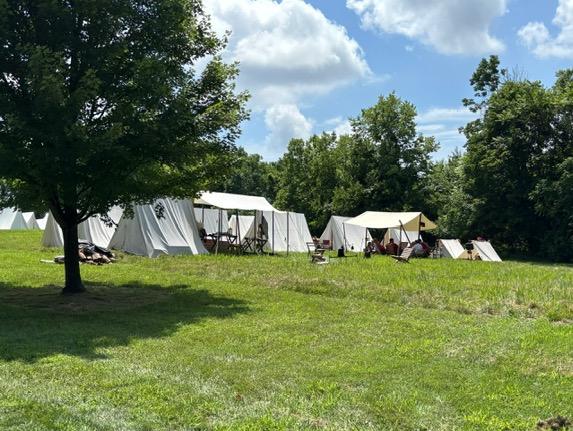
FUNKSTOWN – The townspeople of Funkstown honored their history last weekend with the annual reenactment of the Battle of Funkstown. In Funkstown Memorial park, re-enactors set up camp around the trees and open grass, fully immersing into the experience of the battle.
Re-enactments occurred throughout the days of July 19 and 20, including but not limited to, a tea party, a time period fashion show and battles in the street. Among these events, the Funkstown Fire Department hosted activities, food and music in the lower region of the park.
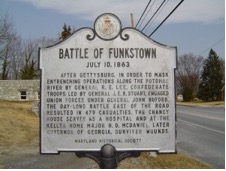
The Battle of Funkstown occurred on July 10, 1863, during the Gettysburg Campaign, the invasion of Pennsylvania by the Confederates. Confederate Maj. Gen. J.E.B. Stuart set up his calvary in a three-mile-long crescent-shaped lineup in Funkstown in order to prevent the Union from reaching Williamsport and the Potomac River and to allow the Confederates to continue their route to Virginia.
By 8 a.m., Thomas C Devin’s cavalry descended in their brigade and initiated an attack. As the battle continued through the day, Union troops eventually began to flee toward Beaver Creek. Though the Confederates successfully held off the Union that day, 479 Confederate soldiers lost their lives on July 10, along with numerous Union casualties. This battle occurred less than one year following the deadliest battle in the Civil War, the battle of Antietam, which took place in Sharpsburg, Maryland, and resulted in around 23,000 casualties.
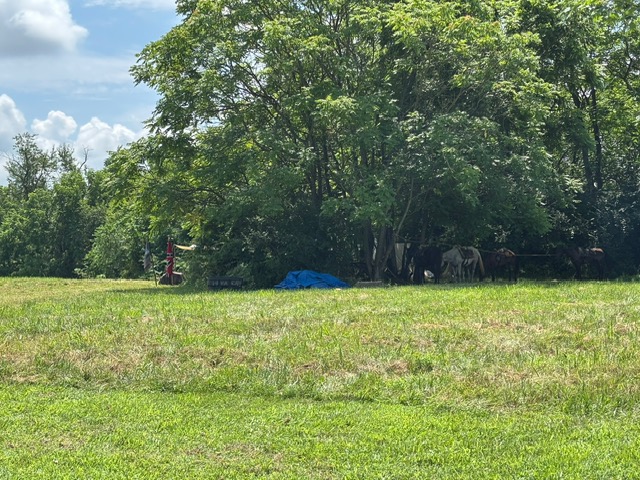
Re-enactors set up camp all around Funkstown Memorial Park, each with their own representation of the times. Many slept in tents and cooked outside with wood and cast iron. Some even brought horses, and many brought children. Along with this, re-enactors participated in historically accurate depictions, such as being woken up early in the morning to drill, Civil War-era church services and even time-period correct food offerings. The outside of the event was also lined with fencing used in the battle of Antietam, borrowed from the Antietam Battlefield, a nod to the previous devastating fight.
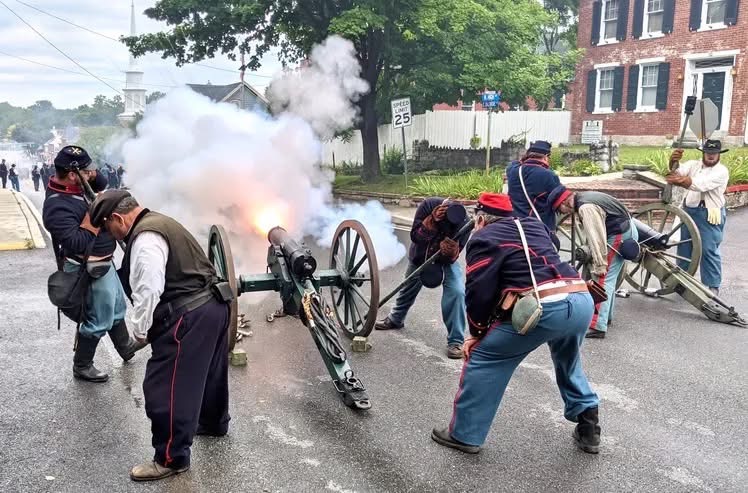
One of the main events, a battle in the street, portrayed real conflicts that occurred near the town in July of 1863. On Baltimore Street, re-enactors could be seen igniting a cannon in the street, marching, carrying out battles as spectators surrounded. While a majority of the battle in 1863 occurred toward the eastern end of Funkstown, homes in the vicinity of Baltimore Street witnessed the clash, first-hand.
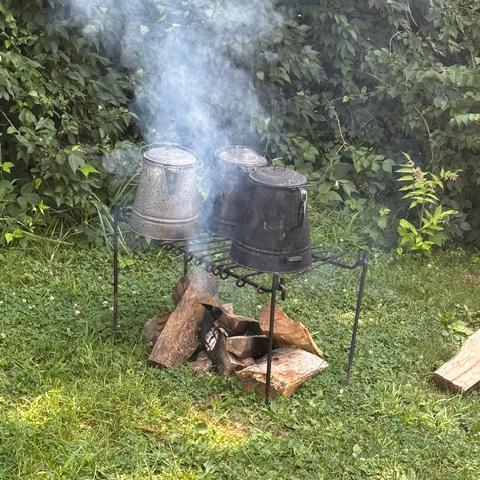
Image From: 4th U.S. Light Artillery of street battle on Baltimore Street on July 19
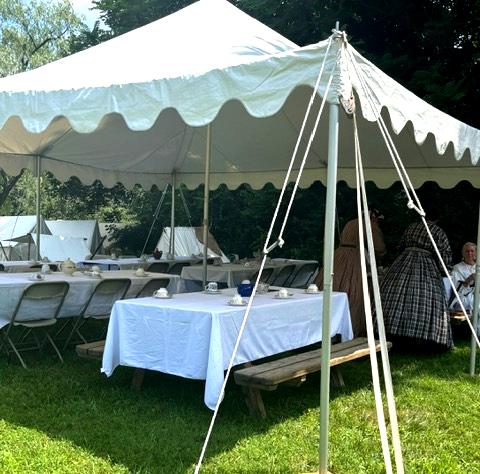
On Saturday, tables were set with antique cups, plates, flatware, along with home prepared, wedding-inspired indulgences like salad sandwiches in preparation for an era-inspired fashion show and tea party. In speaking to the re-enactors setting up the tea party, the passion held for this work is tangible, and many demonstrate their fondness for this lifestyle. With crinoline dresses flowing in the wind, these history lovers shared their passion for representing historical events.
“We stay this way 90 percent of the (time),” one re-enactor shared. “She does this for a living,” She said, pointing at the woman behind her who shared working in a living history museum when she’s not attending reenactments.
“Thirty-four years I’ve been doing this,” the woman went on. “It’s been a lifestyle.”
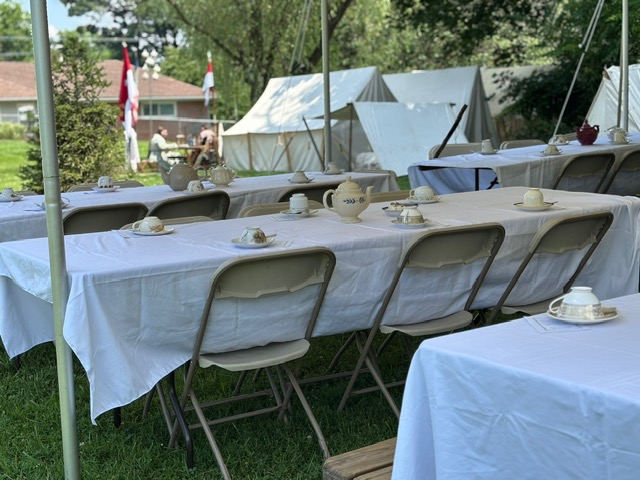
A lady with a long, plaid crinoline-lined skirt shared the importance of events like these to her personally. The groups that attend these events as re-enactors have built a strong community of people with shared passions.
“My family, our unit, is very much our family,” she said.
Furthermore, she shared the importance these events hold in terms of commemoration and lessons learned.
“We can’t change history; it happens,” she noted. “Does that mean we want to repeat the way things were then? No. Do we want to learn from that? Yes! And the best way to learn from it, is this.”
From the Antietam Battlefield to Gettysburg, Civil War history is abundant. Re-enactments and commemorations take place throughout the year at the various historical sites peppered around the area. Maryland and Pennsylvania state websites offer information on the locations of historical destinations and events going on around the area.