MONT ALTO – A Franklin County parent and engineer says her own review of the factors used by the Penn State Board of Trustees reveals a misinterpretation of the data.
Sheila Vieira, a Fayetteville resident who holds a PhD in mechanical engineering and was a research associate at the Yamagata University in Japan, said she feels the numbers used to determine which campuses should close simply do not add up.
In fact, she said, a strong case is made for keeping both the Mont Alto and York campuses open, based on the criteria the university’s advisory committee said it was applying.
She noted her son is starting as a freshman at the Mont Alto campus in the fall, and her daughter is in her fourth year at Penn State. Her primary concern is not her family’s connection to the issue, but that there appears to be data misinterpretation with the information presented to trustees.
Data comparisons
“If you compare (the data) side by side, you cannot arrive to the same conclusion that the University arrived,” Vieira commented. Using her experience in data analytics, she began combing through the 143-page report that was prepared and presented to Penn State President Neeli Bendapudi by members of the Commonwealth Campuses Executive Board. Using a score system to rate each of the 12 Commonwealth Campuses, Vieria drew different conclusions from the same data.

Facts and Figures
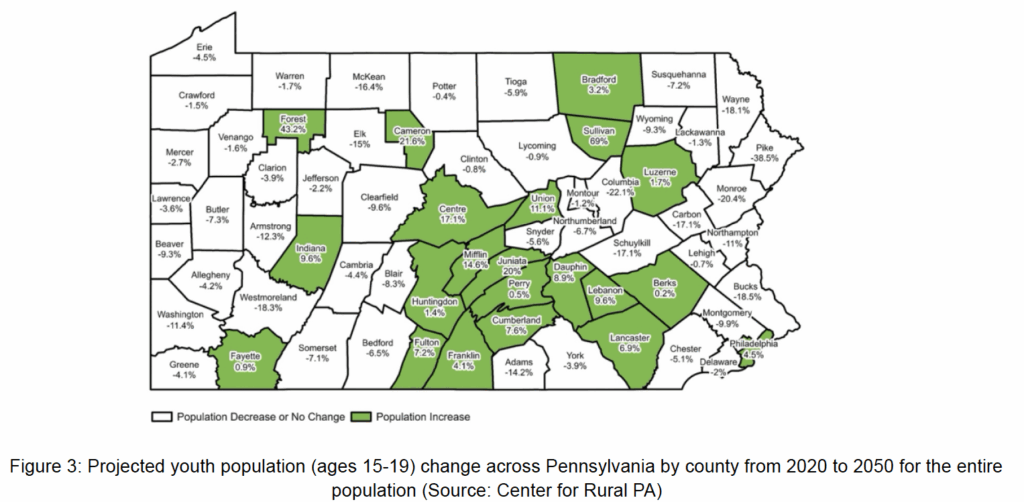
The research in an appendix provided by Vieira kept Mont Alto at the forefront of the satellite campuses, and with good reason; based on just the figures alone, Mont Alto appears to be projected to see an increase rather than face a decrease in area population from which to draw students.
Not only is Franklin County growing by 0.5 percent a year, 4.1 percent of that is in youth population growth ages 15-19, the key market for any university system. In contrast, Beaver, whose campus is to remain open, has had a projected population decrease of 8.9 percent, with a 9.3 percent decline in the youth population.
Additionally, despite a downward trend in enrollment seen in all Commonwealth Campuses, Mont Alto actually has experienced an upward trend in enrollment in the last year. In fact, out of the 12 campuses reviewed, the Franklin County campus is one of only three campuses that is projected to experience both overall population growth and youth population growth (the other two being Hazleton and Wilkes-Barre).
Vieira said she believes the lopsided 25-8 vote to close the local campus was is due to the initial numbers not being properly vetted and analyzed by the Board of Trustees.
“What the board read [in the proposal] does not match the data the university provided,” Vieira said. “I think it’s outrageous that the data was represented in a way that people couldn’t see what was behind it. I love Penn State, but it was really disappointing that politics came before education.”
Alumni petition drive
A petition for saving Mont Alto is sitting at just under 3,000 signatures. Started by the Penn State Mont Alto Alumni Society Board of Directors, the petition appeals to Benapudi and other Penn State University leaders on several fronts.
Among the appeals discussed are Mont Alto’s tie to the University’s land-grant commitment, its impact on the local community and its service as a hub for learning in its region. The history the campus has had regarding programs such as forestry and environmental studies, along with its alignment with the mission to reach every corner of the Pennsylvania Commonwealth, were also highlighted.
“Penn State’s strength has always come from the breadth and diversity of its campus system,” wrote the directors in their petition. Mont Alto is not simply a campus… and we stand united in our desire to see it preserved for future generations of Penn Staters.”
To see the petition and read more about the appeal, readers may visit https://www.change.org/p/support-penn-state-mont-alto?recruited_by_id=a24ff6b0-3003-11f0-808d-3b2ea4c70709&utm_source=share_petition&utm_campaign=share_petition&utm_term=psf_combo_share_message&utm_medium=copylink
All graphics are provided by Sheila Vieira, PhD, and are taken from her analysis of the Penn State data.