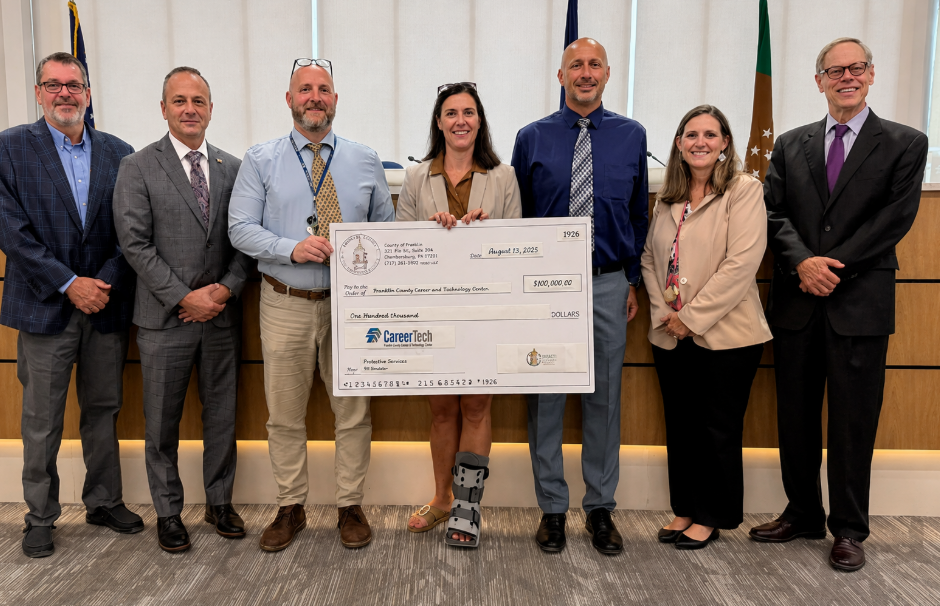
CHAMBERSBURG, Pa. – Franklin County is investing $100,000 in a CareerTech program designed to train high school students for careers in law enforcement, firefighting, emergency medical services and other public safety fields.
Funding for the Franklin County Career and Technology Center’s Protective Services program will primarily be used to create a simulated 911 center and station, giving students hands-on experience with emergency response operations. Money may also be used for training equipment, curriculum development, instructional materials and facility improvements.
Human Resources Director Tiffany Boyer said the county and CareerTech have been working on the partnership for some time as part of an effort to strengthen the local public safety workforce.
CareerTech Administrative Director Dr. Leslie Shuman said the county’s support helped the school create the facility, develop the curriculum and purchase equipment needed to launch the program. The goal, she said, is “to hopefully put these trained individuals back into the Franklin County workforce.”
The Protective Services program introduces students to law enforcement, fire services, emergency medical services, security and disaster response. The first group of cadets completed the program in the spring.
Commissioners said the program could also help address declining participation in volunteer emergency services.
“It’s no secret that volunteerism in our community is dying, and I think just about everywhere else, too,” Commission Chairman Dean Horst said. “So what we can do at the younger level to help increase the idea of volunteerism and to work in our public services in the future is important.”
$1 billion price tag hangs over I-81 widening
A separate presentation on Franklin County’s transportation planning turned into a discussion about the longstanding push to add a third lane to Interstate 81.
Planning Director Quentin Clapper told commissioners that widening I-81 through Franklin County would cost roughly $1 billion, about the same amount Pennsylvania currently sets aside statewide just to meet basic maintenance needs on its interstate highway system.
Clapper said the cost rather than a lack of recognition of I-81’s problems remains the major obstacle.
“I think PennDOT would pave a third lane starting tomorrow if you gave them a billion dollars to do it,” Clapper said.
Parts of I-81 in Franklin County are expected to reach the end of their useful lives between the mid-2030s and 2050s, requiring full-depth reconstruction. Clapper said that work could provide an opportunity to add a third lane if funding can be secured at the same time.
The interstate carries 39 percent of all vehicle travel in Franklin County and accounted for about 88 percent of the county’s estimated 112,000 hours of traffic delay in 2025. However, only 13 percent of the county’s 220 fatal crashes from 2021 through 2025 occurred on I-81, with many fatal crashes occurring on rural roads and involving single vehicles leaving the roadway.
Clapper also provided an update on the planned Exit 12 interchange, which is intended to improve access for freight traffic and provide better geometry for trucks than the existing Exit 16.
The project could go out for bids in late August or early September if remaining permitting and right-of-way work is completed. Clapper said contracting and mobilization could take about a year, followed by two to three construction seasons, putting the new interchange on track to open around 2030.
DA seeks new hiring path amid prosecutor shortage
Franklin County’s Salary Board approved a new junior assistant district attorney classification Thursday as District Attorney Ian Brink said his office is struggling to compete for attorneys.
The position will allow the District Attorney’s Office to hire law school graduates who have taken the Pennsylvania bar examination but are still waiting for their results. Brink said graduates typically take the exam in late July but do not receive their results until October, leaving Franklin County unable under its previous structure to hire otherwise qualified candidates during that period.
Junior assistant district attorneys must qualify as certified legal interns and work under the supervision of licensed attorneys. Once a candidate passes the bar, the employee could move into a regular assistant district attorney position.
Brink said he already has a Franklin County resident who graduated from law school, took the bar examination and is awaiting results. He asked the county to move quickly so she can begin the onboarding process.
The hiring change comes as Brink’s office faces a broader staffing shortage. He said an attorney was leaving the office Thursday after receiving an unsolicited offer to work for a Superior Court judge at a salary $40,000 higher than his county pay.
Brink said the departure leaves his office short three attorneys.
“That’s 120 attorney hours a week at minimum that just can’t, you just don’t make it up with all the existing other attorneys,” Brink said.
Brink said Franklin County is not alone in struggling to recruit prosecutors. He said Cumberland County is down six attorneys despite having Dickinson Law nearby and offering higher salaries than Franklin County.