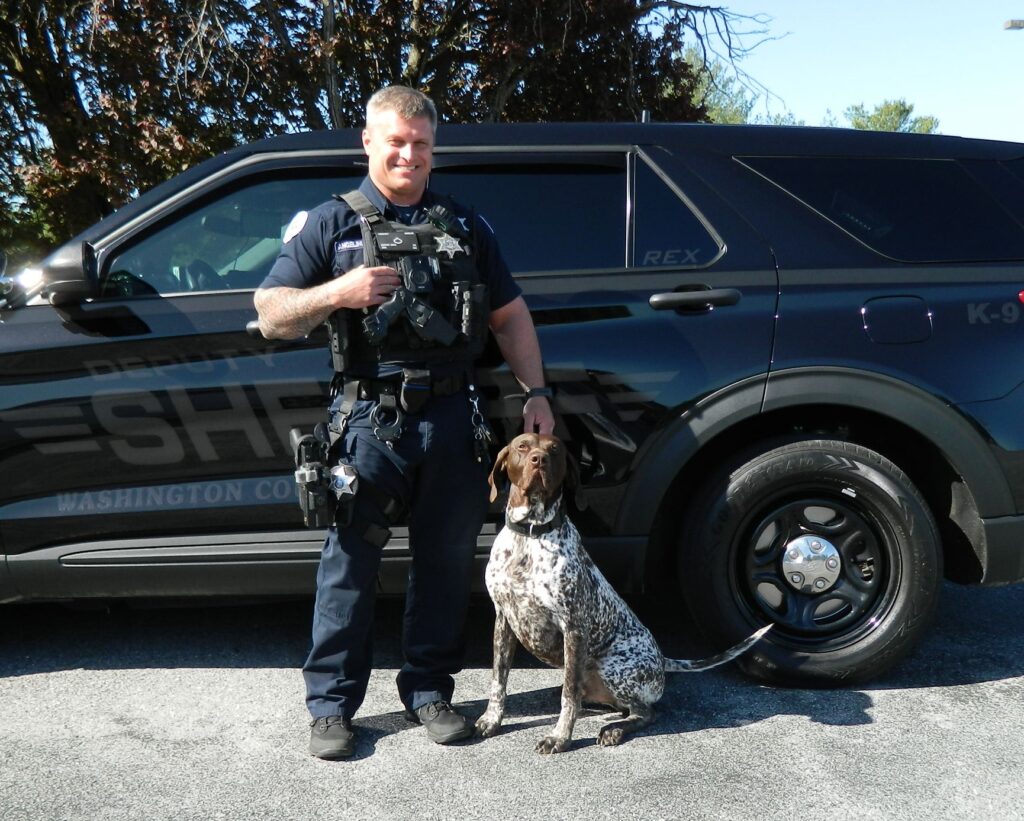
HAGERSTOWN – Washington County Master Deputy Sheriff Mario Angelini may drive the patrol car, but there’s no question – the leader of the team is K-9 Officer Rex.
On patrol, Rex rides shotgun with Angelini, his sleek brown-grey German shorthaired pointer frame coiled with ready energy. His nose occasionally twitches, parsing the air, warming up for when he gets the signal.
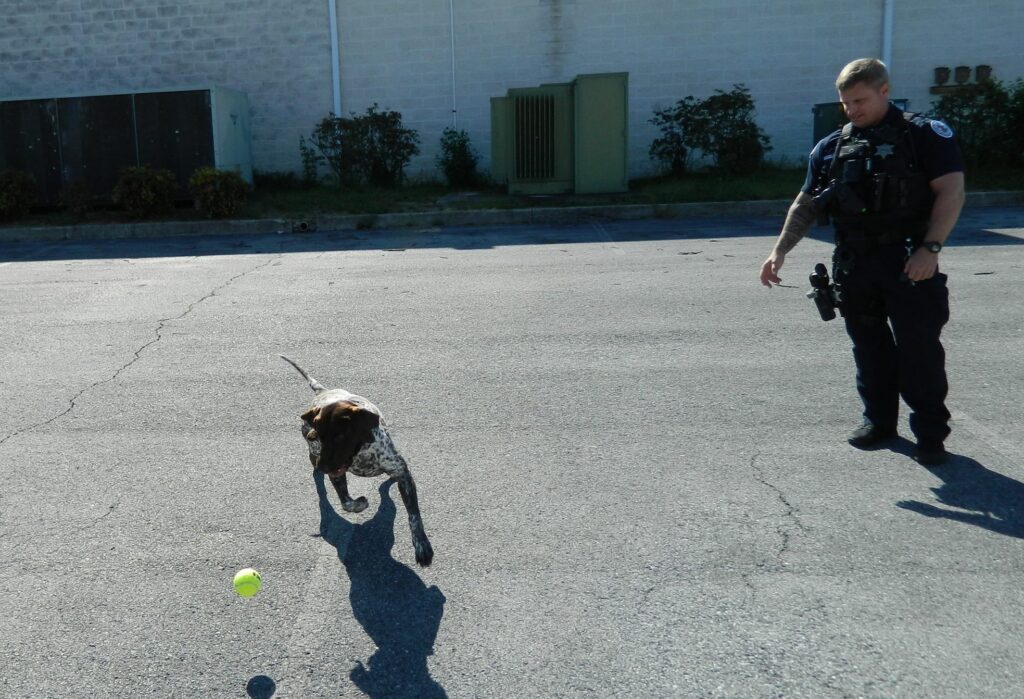
For Rex, this is all a somewhat of a game, the true nature of which he’s not really aware. It’s all about reward – for his work he gets the prize of a bright yellow tennis ball. He just loves tennis balls.
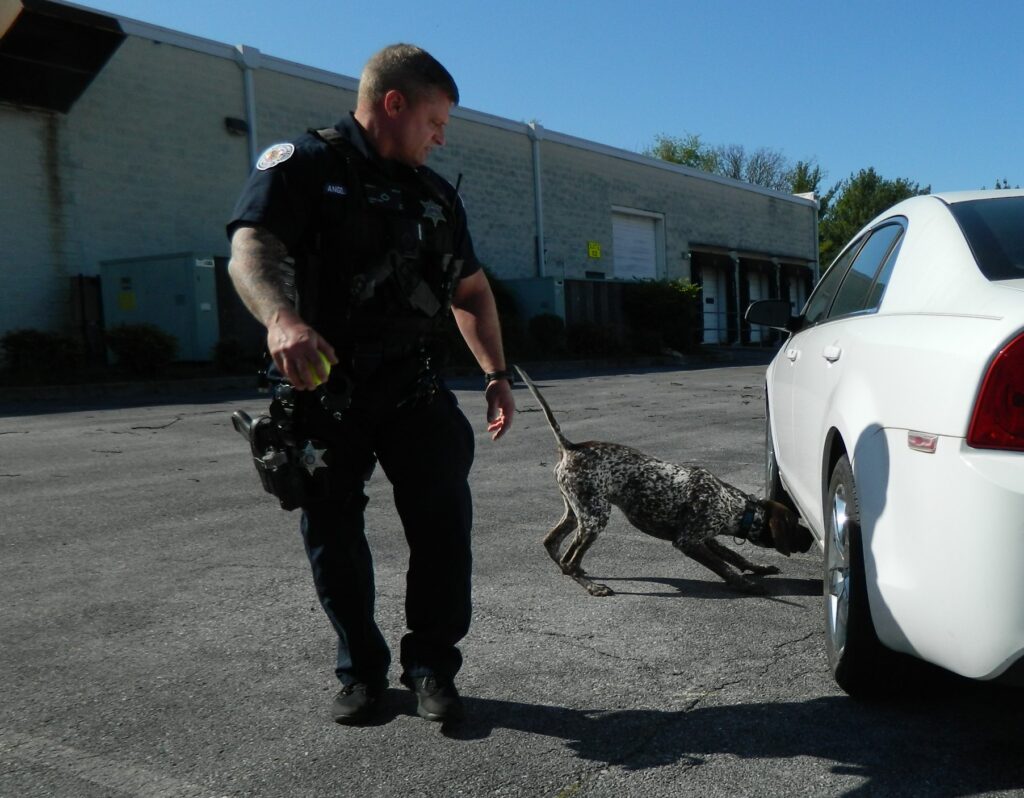
“Rex will do anything and everything he can to get one,” his handler Angelini explained to LocalNews1.org. “When you associate his favorite thing, the ball, with certain odors, and he gets it as a reward for identifying those odors, you can teach him to do anything.”
For Rex, scents like cocaine, heroin, methamphetamine and even the faint tang of a lost human, will get him that beloved ball sooner. (He doesn’t realize he always eventually gets it anyway.)
A few weeks ago, Rex got the signal to search a certain vehicle by the side of the road and sprang into action. After the second lap, his body stiffened, his tail went rigid, and he raised his head in the point for which his breed is famous.
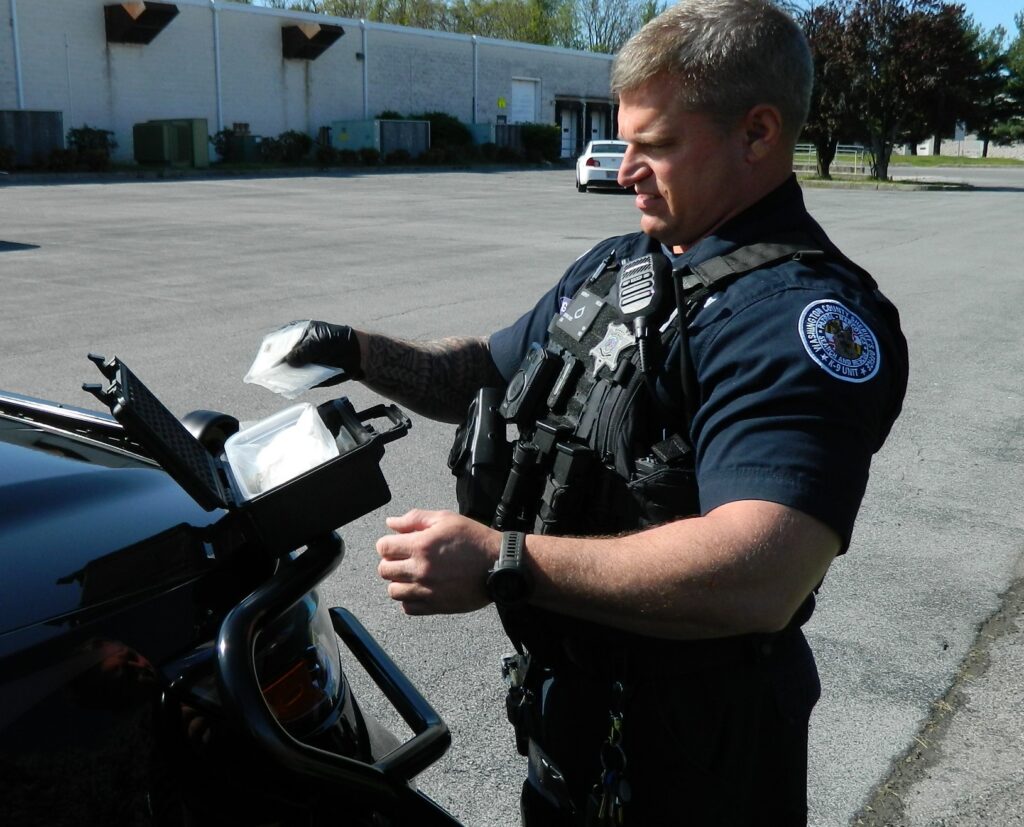
“It was a clear positive,” Angelini said. Inside, deputies uncovered a half-kilo of cocaine, 20 grams of fentanyl, and a weapon, all of which might still be on the street without Rex’s exceptional nose. Out came the ball, and Rex pranced around, happy and victorious. A real win for the sheriff’s office.
Now four years old, Rex has been with the county force for three years. Having successfully applied for assignment to the K-9 unit, Angelini traveled to Tri-State Canine in Warren, Ohio, to join Rex in his training.
For a month, Rex and Angelini worked daily under the breeder’s guidance, forging a strong, durable bond cultivating respect on both sides of the leash. During the training, Rex learned to detect various substances by association of their odors with his beloved ball. “It’s simple,” Angelini said. “Smell the powder, get the toy. He lives for it.”
The science behind Rex’s sense of smell is staggering. Dogs have 125 million to 300 million olfactory receptors, compared to a human’s measly five million, making their sense of smell 10,000 to 100,000 times more acute.
For Rex, a stash of cocaine hidden in a sealed compartment is as obvious as a steak on a grill. “It has a very high vapor pressure,” Angelini explained, “so the odor spreads fast. He picks it up in seconds.” The precision is uncanny. Field tests have shown that scans from trained dogs like Rex achieve more than 90 percent accuracy.
Rex’s duties extend beyond car scans. He’s also a master of article searches, sniffing out items like guns or clothing discarded by fleeing suspects. “He’s looking for human odor,” Angelini said. “Once, we were hunting a gun tossed out of a car window. He found a scrunchie instead. Different object, same human scent.”
In another case, Rex’s nose led to a missing juvenile. Unleashed in a wooded area, Rex circled the areas, sniffing all the while. At one point, his behavior shifted. The sniffing got more rapid; his trot turned into a darting run. Behind a stack of railroad ties, he found a young girl curled in the fetal position. “We’d have missed her,” Angelini said. “Rex didn’t.” The child’s parents were eternally grateful.
Rex is by no means alone in the office’s K-9 unit. He has two colleagues: Rose, a yellow lab who, like Rex, specialize in narcotics and trafficking, and Kevin, a Mali-dutchie mix, who trained for more aggressive work to help physically apprehend suspects.
“Each dog has a niche,” Sgt. Carly Hose, the office’s public information officer, said of the unit’s roster. “Rex is all about the hunt.” The shorthaired pointer breed, with its keen nose and boundless energy, is ideal for this work. “They’re amazing,” she said. “They are among the best [breeds] for scent detection.”
Training is regular. Twice a month, the K-9 unit sets up scenarios, narcotics hides, article searches, tracks across grass or pavement. “Pavement’s tough,” Angelini noted. “Scent doesn’t linger long.” The sessions reinforce his nose for meth, cocaine and heroin, though they don’t train for fentanyl, perhaps the greatest chemical scourge on society, since it’s legally available with a prescription. Legal in Maryland since 2023, marijuana is likewise not a ball-worthy scent for Rex.
Rex is Angelini’s constant companion in his K-9 cruiser. Some days, he’s just along for the ride. Others, he’s called to action: a traffic stop with a whiff of suspicion, a track for a runaway or a scan for a nearby agency.
“Car scans are almost daily,” Angelini said. “Tracks, maybe once a week.” If suspicion justifies a scan, Rex does two laps around the vehicle, urged to slow down the second time. A positive alert grants officers probable cause to search, turning Rex into a legal key that unlocks hidden stashes.
There is a real bond between dog and handler. Angelini takes Rex home at night, sleeping in the house and spoiled with cuddles by his young family. On weekends, he presents as a normal family dog running around the park without a hint of betrayal; he’s a seasoned law enforcement specialist.
“He knows when he’s on duty,” Angelini said. “In the cruiser, he’s all business.” When Rex retires, likely around age eight, he’ll stay with his human family, trading his badge for a life of leisure.
Hose said Rex’s work isn’t just about arrests; it’s about taking care of the community. “Rex gives us a tool to get drugs off the street,” she said. “In a region grappling with addiction, every bit of seized narcotics is one step toward a safer county.”
As his customized cruiser patrols the highways and byways of Washington County every day, Rex’s nose stays ready for the next cue. Somewhere, a tennis ball waits, and with it, the chance to make his humans proud again.