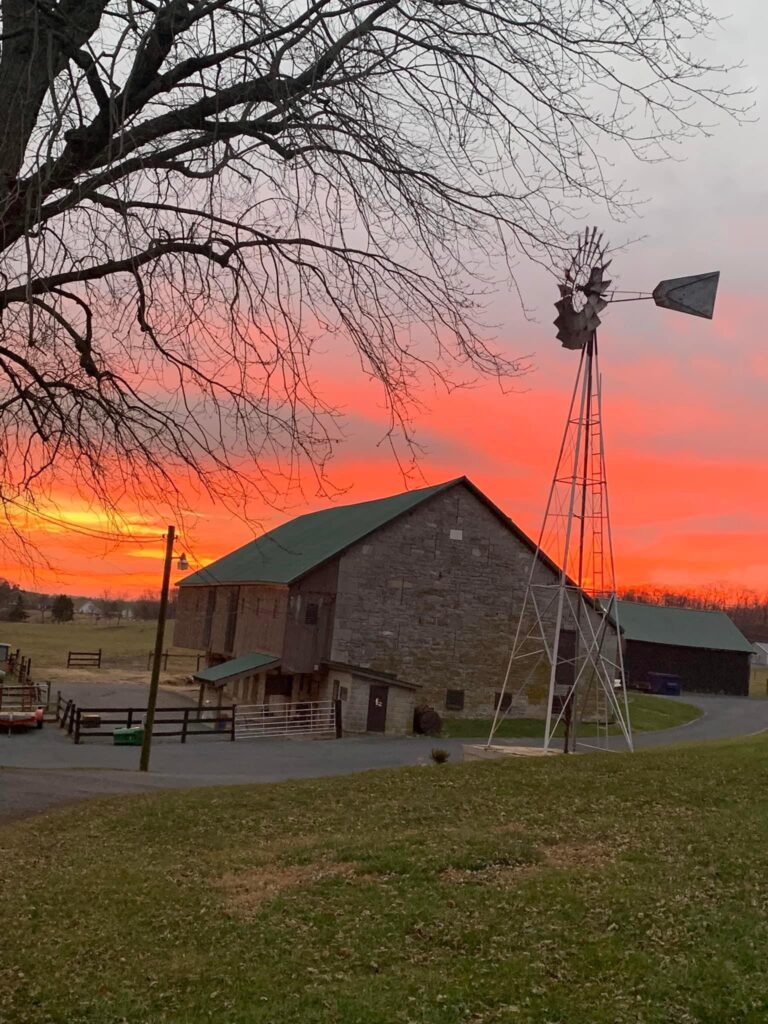
WAYNESBORO – Nestled in the rolling hills of southern Franklin County, a rustic brick farmhouse and stone barn built during the Civil War era stand as enduring symbols of the region’s agricultural heritage much like the surrounding monuments to bygone military battles.
For Benjamin Barnett, the 35-year-old owner of this historic 46-acre homestead, preserving that legacy means confronting 21st-century challenges with innovation, community collaboration and a deep commitment to sustainability.
With a background in animal nutrition and a childhood rooted in dairy farming, Barnett purchased the property in 2018 with a vision to continue running a well-established equine camp program, aiming to connect indoor youth with nature, fostering character and stewardship.
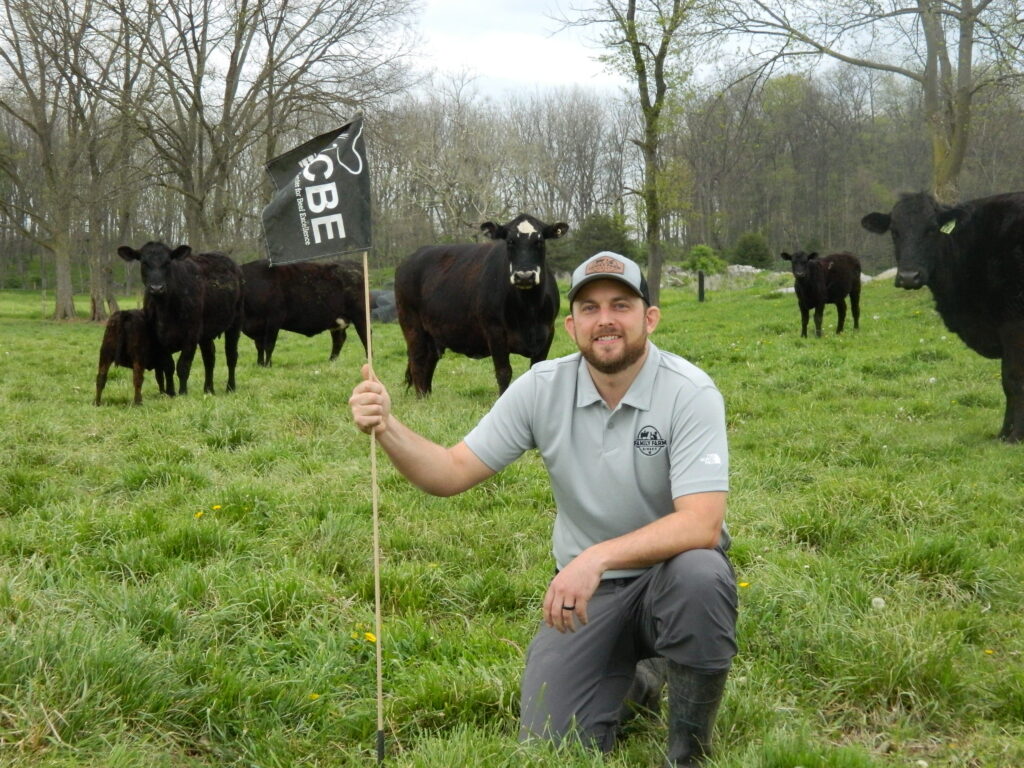
But the COVID-19 pandemic in 2020 derailed those plans, forcing him to pivot on the homestead. He moved his beef production beef from rental land to the homestead to sustain the farm, where today he maintains 120 head of beef cattle, produces 50 feeder calves and 12,000 pounds of beef annually.
Recognizing that small farms struggle to survive independently, Barnett expanded his operational scope by founding Family Farm Direct, an aggregation of 90 producers across Maryland, West Virginia and Pennsylvania. The model he developed allows small farmers to bypass commodity markets, capture a majority share of retail dollars and deliver high-quality products directly to consumers.
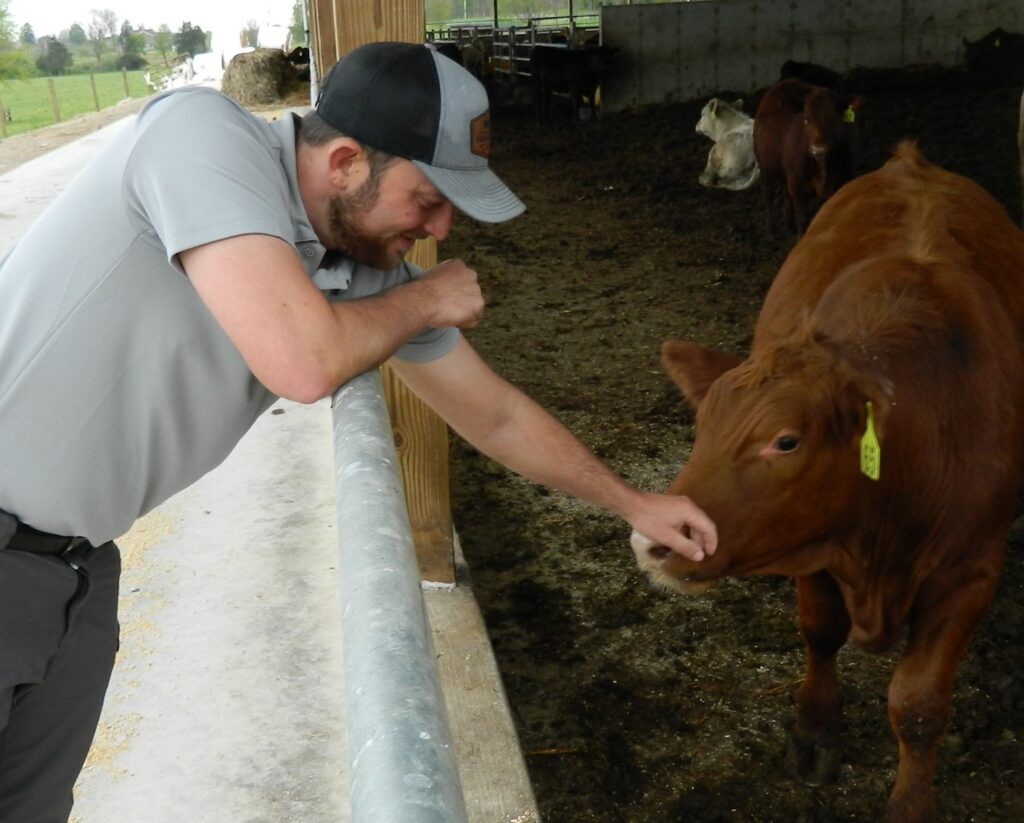
“People will always need food,” said Barnett, scratching the head of curious cow who visited him as he hosted LocalNews1.org. “There will always be a demand for high-volume, high-quality production. This presents a challenge: how do we balance consumer preference for sustainable and locally-produced products with the need to produce enough food?
“Small farms can only compete against economies of scale through technology and innovation.”
At the heart of the farm are its two historic buildings, stone bank barn with hand hued beams still holding the bark dating from 1862, and an 1863 triple brick farmhouse with the classic slate roof built a year later.
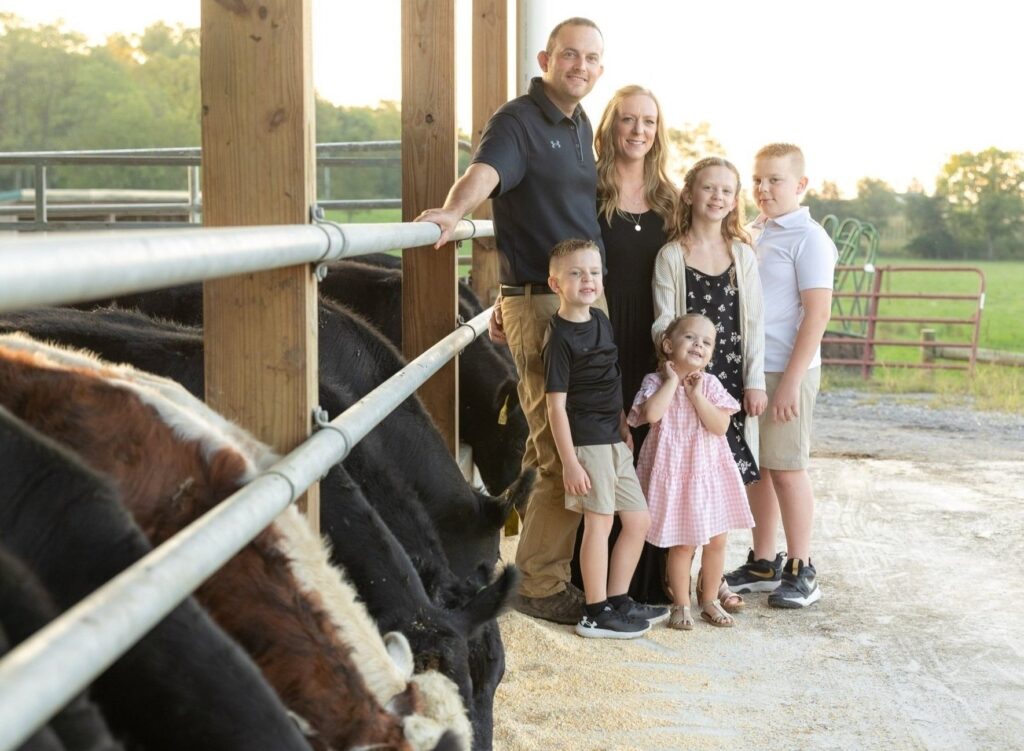
Visitors to the farm will find three generations living and working side by side. Barnett’s parents reside on the homestead along with Barnett, his wife Kelsey, and their four children, aged 3 to 11. The Barnetts actively seek to provide a wholesome childhood for their kids that include nature, daily responsibilities, farm equipment and independence from digital screens.
Older son Drewson already operates tractors (under supervision) to contribute to cattle maintenance chores; daughter Finley, 9, minds the resident pigs and chickens; son Bodie, 7, is a budding mechanic and builder; and younger daughter Oakley works in the garden with her grandparents and loves to ride tractors on Daddy’s lap.
To help build a sustainable model for the 2020s, Barnett originally partnered with the Franklin County Conservation Service through a grant from the Growing Greener Program, which is Pennsylvania’s largest environmental grant initiative, aimed at protecting and restoring natural resources across the state.
He also partnered with the National Resource Conservation Service to participate in the Environmental Quality Incentives Program, a conservation initiative run by the Natural Resources Conservation Service to assist agricultural producers and landowners to implement conservation practices that improve soil health, water quality and wildlife habitat.
To protect soil and water, Barnett rotates cattle across divided pastures to prevent overgrazing, naturally distributing nutrients like manure to maintain fertile soil. A high-use area near the barn contains manure and is set up to manage rainwater, especially during the winter months to prevent nutrient runoff.
On the crop land conservation practices such as no tilling and cover cropping ensure the soil structure stays intact and prevents erosion and nutrient run-off. These practices combine to ensuring air and streams remain pure.
“We follow a nutrient management protocol,” Barnett explained. “It’s about stewardship of the land – feeding the grass and crops without excess.” Rolling pastures act as “green filters,” absorbing nutrients before they leach, unlike bare soil that is vulnerable to erosion.
In addition to soil conservation, Barnett also invested in a renewable solar energy system. This was made possible by two major incentives. The federal renewable tax credit was paired with the Rural Energy Assurance Program. The two programs along with the guidance of Paradice Energy Solutions positioned the farm as energy-neutral, consistently producing the power than it requires.
This allows the farm nutrients to cycle back to allow more production. “We’re proving small farms can lead in sustainability,” Barnett said, noting that Maryland and Pennsylvania increasingly mandate such practices for commercial farms.
Barnett’s academic background and a decade of experience as a Certified Crop Consultant and Professional Animal Nutritionist bring a scientific edge to his to his food and agricultural production.
Yet, some challenges remain timeless as his historic barn. The volatility of farming’s age-old economics challenges feasibility, with the “right” thing to do not always economically. New technology can address that gap along with sustainable markets, helping ensure consistent enough margins of return to continue producing to the highest standards.
“We’re still managing nutrients, battling weather, feeding people and raising our families, just like every farmer since time immemorial,” he said. “But tools like energy generation and artificial intelligence will help us do more with less.”
A devout Christian, Barnett draws from the Book of Genesis to view himself as a steward of creation. This perspective informs his balanced approach to animal welfare. Unlike some organic purists, he uses veterinary-prescribed antibiotics to treat individual sick animals, arguing that withholding care is neither humane nor practical.
“I’ve seen too many losses from organic restrictions,” he said, citing higher death rates and financial struggles on some organic farms.
Family farms face daunting obstacles: soaring land costs, volatile input prices and monopolies of large multinational integrated corporation. Yet small farms have unique strengths, like efficient labor and market flexibility. “Growing family farms of the future will have price control,” according to Barnett.
The efficiency of large-scale operations often comes at the cost of the family-oriented approach that characterizes smaller farms. Redirecting more consumer spending back to farmers is an innovative solution to helping provide the best farm products to local communities and institutions.
This connection will in turn help ensure at the family farms can continue to provide locally produced, exceptional products, which resonates with consumers’ growing interest in supporting local businesses and understanding the origin of their food.
This forward-thinking solution seeks to balance efficiency with the values of faith, family and stewardship that are deeply rooted in the agricultural community.
Through Family Farm Direct, Barnett sells directly to buyers like Meritus Medical Center, which is finalizing a supply agreement for an array of food product from all across the surrounding area. Those products will be purchased from local farms, then processed by local processors, and then will translate higher recovery rates. “It’s a proof-of-concept,” he said. “If we can scale this, it’s a game-changer for small family farmers.”
Under a new initiative with Meritus known as a Food Pharmacy, Barnett’s local farm network will provide “prescribed diets” to patients based on their care needs, whether they be blood pressure, diabetes or other conditions. The agreement will provide not only better health outcomes, but other advantageous such as single source billing, more flexible products and substantial community benefit that is committed to a concentrated 60-mile radius.
Family Farm direct differs significantly from the usual cooperative, prioritizing economically sustainable markets for its member farmers rather than obliging them to move minimum volumes, and catering to directives such as Maryland’s Certified Producer program under its Agricultural and Resource-Based Industry Development Corporation which oversees the state’s 20 percent local procurement directive for all public entities.
“Large farms move lots of product to maintain a margin and survive on a volatile commodity price, but we focus on forming a sustainable and dependable market first for the farmers,” Barnett explained. “If they win, I win.” For consumers, the aggregation offers the best from their neighboring farms with convenience. Family Farm Direct represents a chance to support a transparent, community-based food system that preserves rural heritage.
With only 1 percent of Americans farming, meeting a producer like Barnett is a rare privilege. His story bridges urban consumers and rural roots, proving that small farms, steeped in history, can thrive through innovation and collaboration.
Barnett’s “Meet the Farmer” feature on his website invites wholesalers and even consumers to ask questions via a dedicated link, fostering trust in an era of opaque supply chains. “People want to know where their food comes from, and we are happy to tell them. We’re an open book.”