HAGERSTOWN – The Washington County Museum of Fine Arts invites visitors to experience the beauty and breadth of the American landscape in In Nature’s Studio: Two Centuries of American Landscape Painting, on view from Sept. 13 – Jan. 4.
An early celebration of the upcoming semiquincentennial, the exhibition provides a rich introduction to American landscape painting, featuring key artists and movements, while providing a deeper understanding of the involvement of artists in the crafting of American identity, museum officials noted.
Nearly 90 paintings reveal how artists interpreted the land in ways that reflect both their times and their visions, beginning with the emergence of the first uniquely American artistic movement, the Hudson River School, the exhibition also contains examples of, Impressionism and Tonalism, approaches to painting that emerged later in the 19th and into the 20th century, as well as modern trends in interpreting the landscape as the 20th century progressed.
“This is a gorgeous exhibition that will have broad appeal, and we are excited to use it as a kick-off of our celebration of America’s 250th birthday.” said Sarah Hall, executive director of the Washington County Museum of Fine Arts. “Whether you are interested in American history, art history, environmentalism, or simply love soaking in the beauty of landscape painting, In Nature’s Studio checks all the boxes.
“The exhibition was formed through a collaboration with Reading Public Museum, whose traveling exhibition of 65 paintings, is joined in Hagerstown by our stellar American painting collection with many parallels to the works on loan from Reading. It makes for a dazzling, deep-dive into the art and artists that shape the way we picture America.”
In Nature’s Studio examines majestic and inspirational depictions of bucolic American vistas, intimate forest interiors, sweeping panoramic views of natural wonders and dramatic images of the untamed land and sea. These works are joined by impressive scenes of Europe, the Near East and South America by American artists.
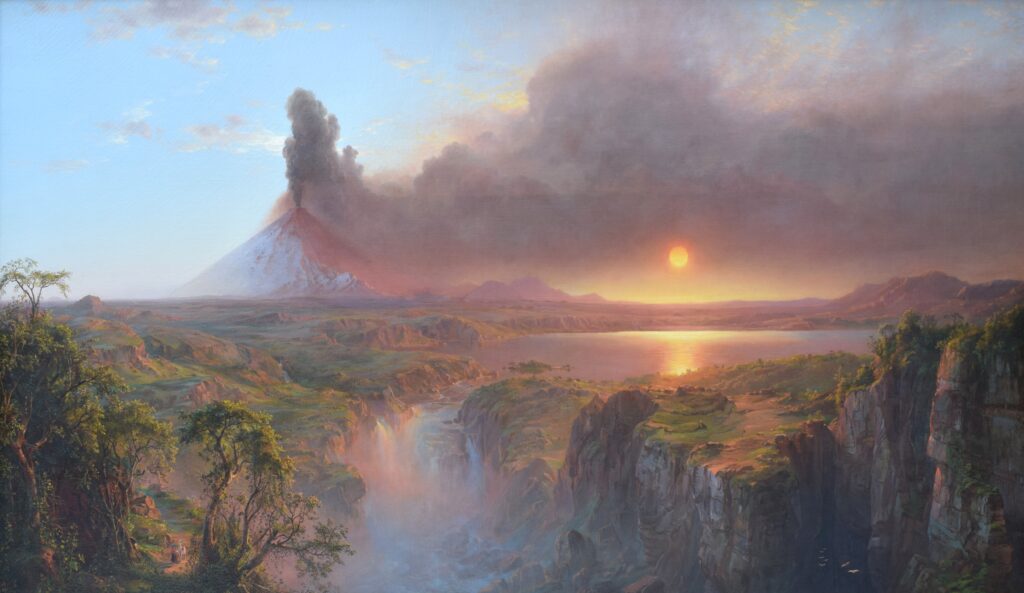
Highlights of the exhibition include Frederic Church’s breathtaking Cotopaxi (1862) along with two other Church works, on the eve of the celebration of his 200th birthday; George Bellows’ The Launching (1913); Childe Hassam’s Beach at East Hampton (1905), and a rare opportunity to see Thomas Cole’s tiny and dazzling study for The Voyage of Life: Childhood (from Washington County Museum of Fine Arts’ collection).
Turn-of-the-century shifts in style are seen in Childe Hassam’s work and Ralph Albert Blakelock’s dreamlike visions. George Bellows’ vibrant The Launching captures the drama of human labor at sea, while Andrew Wyeth’s offers an intimate and sobering view of the Maine coast. Modernist painters such as Arthur Bowen Davies, Benton Spruance and John Fulton Folinsbee carry the story into abstraction and expressionism – reminding us that the inspiration of the landscape has never faded, only transformed.
“These works not only celebrate the beauty of the American landscape, they reveal the changing ways artists have understood and depicted it over two centuries,” said Linda Johnson, Agnita M. Stine Schreiber curator at the Washington County Museum of Fine Arts. “It’s a rare chance to see several of these masterworks, and to reflect on how our relationship to nature has evolved.”
In Nature’s Studio offers visitors a journey across time, place, and style – inviting them to enjoy the beauty of the American landscape while seeing it through fresh lenses. Admission is free, and all are welcome.
About the exhibition
The exhibition is organized thematically, with works grouped to emphasize particular approaches to the landscape, both stylistically and philosophically. Beginning by exploring the spiritual nature of many landscapes that take us into the woods, under the sea, along rivers and waterways and into the poetic land of dreamscapes, The exhibition then explores the impact of man on the landscape through sections like “Pastoral to Pastures,” “Water’s Bounty,” and “Storms a’Comin’.” “East meets West” uses a selection of work to illustrate the complex ideas surrounding the notion of Manifest Destiny and settling the West. “Distant Prospects” explores the work of American artists traveling in other countries, while “Seasonal Vistas” examine depictions of the changing seasons, often showing the impact of Impressionism on the work of artists capturing the varying qualities of light and atmospheric conditions.
These categories highlight the variety of approaches artists have taken, from faithful naturalism to symbolic allegory, while also raising questions about industrialization, expansion, and the costs of progress. Themes provide different “critical lenses” through which viewers today can better understand the work in the context of its time.
The Hudson River School: America’s first landscape tradition
At the core of the exhibition is the Hudson River School, America’s first major artistic movement. Flourishing from the 1830s to the 1870s, these painters were among the earliest to document the nation’s rivers, valleys and mountains, creating images that combined Romantic ideals with distinctly American subjects. Brilliant color, dramatic light and sweeping panoramas conveyed the sublime – nature’s power to evoke awe – while pastoral scenes emphasized the beautiful and the picturesque (human intervention creating order, balance, and beauty).
The exhibition opens with an immersion in the American landscape that provided rich inspiration to these artists – from the woods, where the branches of trees could be read as nature’s own vaulted cathedral, to the water, which could be used as a complex symbol of wisdom, peace or purity, while also evoking its very practical role providing connections between people and places.
Hudson River artists represented include William Louis Sonntag, Paul Weber, Edmund Darch Lewis, Thomas Worthington Whittredge, and Hermann Herzog, whose panoramic canvases recorded majestic vistas in New York, New England, the Mid-Atlantic, and far beyond—to Europe, the Near East, and South America. Some artists, like Thomas Cole, often described as the founder of the Hudson River School, infused their landscapes with allegory, turning natural scenes into meditations on the human journey. A highlight of the exhibition is Cole’s rare study for the Voyage of Life: Childhood, brought out of storage for this occasion. The exquisite little panel features an infant, nestled in a bower of roses, in a golden boat ready to embark on the voyage of life, under the watchful presence of an angel with spectacular iridescent wings.
Also included in this exploration of landscape as spiritual site is work by George Inness (1825-1894). His 1882 work, The Brook, Montclair, displays his compelling transformation of the Hudson River School’s exacting style into a more personal, subjective approach. In this work he paints the area near his family home and studio, with a poetic approach that is heightened by his personal connection to the landscape. Inness’s painterly approach became known as Tonalism.
The exhibition’s section “Distant Prospects” includes work American artists completed while traveling abroad, some for academic reasons and others in search of ever more inspiration from far-flung places. Frederic Church was one of the most well-traveled of the artists. His view of the Ecuadorian volcano Cotopaxi, painted in 1862 is a tour-de-force of landscape painting – with breathtaking color and atmosphere transporting viewers to a seemingly exotic and otherworldly location.
It may be surprising to viewers that this 1862 painting of a South American landscape is often interpreted as an allegory related to the American Civil War – with the volcanic eruption symbolizing the destruction of war, and the glowing sun, with its cross-shaped reflection, hinting at possible peace. Church’s dramatic canvases often created a public sensation, with visitors paying admission to see them displayed theatrically in his studio.
The exhibition, with its connections to Washington County Museum of Fine Arts’ permanent collection, also provided an opportunity to showcase nine works from a recent gift to the museum by David G. Wright. A series of works by Peter Moran, brother of Thomas, and highly-regarded animal painter and printmaker, are included in the exhibition’s section “From Pastoral to Pasture,” examining our connection to the animals we shared the land with and the ways in which artists interpreted our relationship to the landscape as we “tamed” the land.
Tonalism, Impressionism, and Modernism
By the turn of the twentieth century, shifting artistic styles reflected new ways of seeing and experiencing the land. Tonalism was an American art movement, popular from around 1880 to 1920, that emphasized mood and atmosphere through the use of muted colors, soft edges, and poetic, often melancholic landscapes. Tonalists such as Ralph Albert Blakelock and George Inness created canvases that evoked dreamlike contemplation.
In contrast, American Impressionists often flooded their canvases with light, and like their European counterparts, were interested in capturing fleeting weather conditions as well as the leisure activities of a growing middle-class and the rhythms of the modern world through views alive with color. Childe Hassam’s Beach at East Hamptom (1905) presents a coastal view of Long Island with choppy brushstrokes rendering scrubby growth along the dunes, while clouds are captured as they billow across the blue sky, bringing us all along on a summer afternoon’s beach walk.
The exhibition also includes artists primarily associated with the twentieth century, when artists like George Bellows and Andrew Wyeth redefined the American landscape for a new age. Bellows’ The Launching captures the drama of human labor at sea with bold brushstrokes and vibrant color, while Wyeth’s 1944 watercolor, Low Water, presents an intimate view of the rugged Maine coast and the labor involved with seaside life.
Modernist painters such as Arthur Bowen Davies, Benton Spruance, and John Fulton Folinsbee embraced abstraction and expressionism, demonstrating that the landscape remained an enduring source of inspiration even as artistic languages changed.
A rare journey across time and place
In Nature’s Studio offers audiences a sweeping view of how artists have represented the land over 200 years. From Cole’s Romantic allegories to Wyeth’s realist meditations, from the grandeur of the Hudson River School to the shimmering light of Impressionism, the exhibition traces a narrative that is both artistic and cultural.
As the industrial age transformed terrains and contemporary society continues to grapple with environmental challenges, these works remain vital reminders of the power of place in shaping national identity.
In Nature’s Studio: Two Centuries of American Landscape Painting has been organized by the Reading Public Museum, Reading, Pennsylvania.
Support for the Hagerstown presentation has been provided by Raymond James.
Associated programs
To celebrate the opening of In Nature’s Studio: Two Centuries of American Landscape Painting and to encourage deeper connections with the themes of the exhibition, the Washington County Museum of Fine Arts will host a variety of engaging programs throughout the fall. From festive gatherings to contemplative practices, these events invite visitors to experience art, nature, and community in new ways.
All American night at the museum
Friday, Sept. 12, | 5–8 p.m.
September’s Garden Night does double duty as the opening celebration for In Nature’s Studio and the launch of the museum’s semiquincentennial commemorations. Join us for a lively evening in the galleries and gardens, complete with live music by the Silver Tones Swing Band, guided tours of the exhibition (5:30 & 7:30 p.m.), and festive treats including free popcorn, cupcakes, and root beer floats (while supplies last). Wine will be available for purchase from Stone House Urban Winery, and snack boxes may be pre-ordered from Gordon’s Grocery. Bring a lawn chair or picnic blanket and enjoy the relaxed, welcoming atmosphere of our final Garden Night of the season. Admission is free.
Transcendentalists and tea
Thursday, Sept. 18, | 5–7 p.m.
Experience the spirit of the nineteenth-century writers and thinkers who so strongly influenced the Hudson River School painters. Guests are invited to bring favorite passages from transcendentalist authors such as Ralph Waldo Emerson, Henry David Thoreau, and Margaret Fuller to share aloud. Attendees may also write and reflect on their own encounters with nature. Tea will be served. Free admission.
Gentle yoga in nature’s studio
Thursdays, Sept. 25–Nov. 13, | 5:30–6:30 p.m.
Immerse yourself in art and mindfulness with this gentle yoga series held in the museum’s atrium, inspired by the luminous landscapes of the Hudson River School. Instructor-led sessions invite participants to move and breathe amid views of sweeping American vistas, cultivating calm and balance. $25 per session or $20 per session with full 7-week registration. Participants should bring their own yoga mat and water. Register online or by calling 301-739-5727.
About the Washington County Museum of Fine Arts The Washington County Museum of Fine Arts, located on the lakefront in Hagerstown City Park, was established in 1931 by William H. Singer, Jr., and Anna Brugh Singer and has an extensive permanent collection of over 8,000 paintings, drawings, prints, and sculptures from the 15th century (as well as Roman and Egyptian artifacts) to the present, featuring celebrated and diverse artists. Accredited by the American Alliance of Museums since 1976, the museum offers tours, classes, educational programs, and community events. Admission and parking are always free. Readers may learn more at www.wcmfa.org.