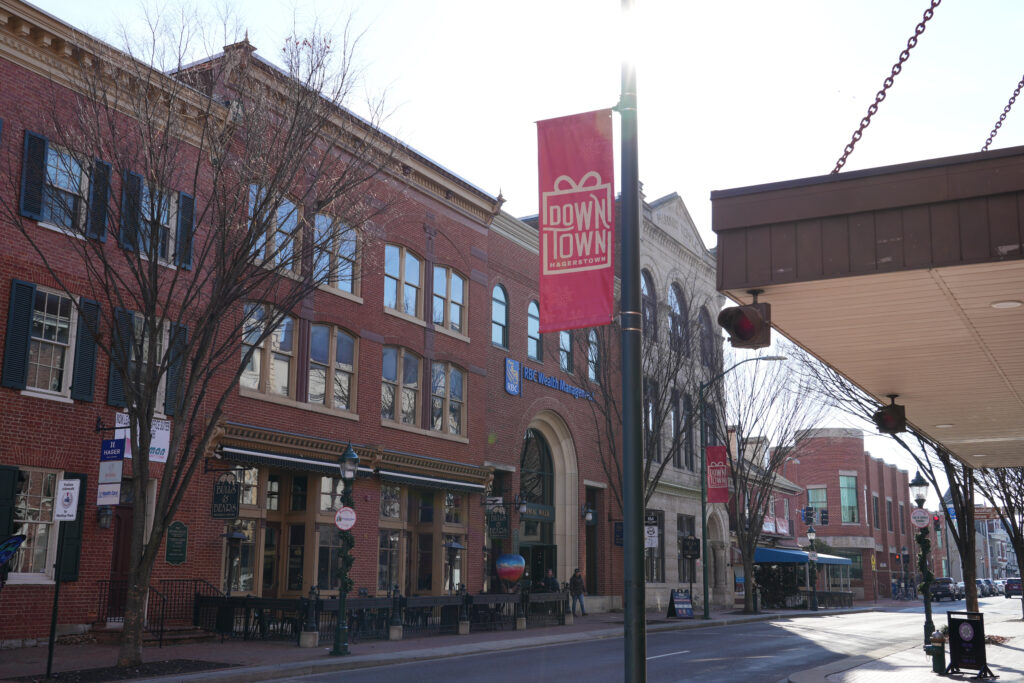
HAGERSTOWN – The Hagerstown City Council is considering new regulations for vending machines on public sidewalks due to concerns regarding pedestrian safety and visual clutter, particularly in residential and historic neighborhoods.
Neighborhood Service Manager Paul Fulk introduced the topic during the May 6 work session, where council members evaluated various regulatory options and expressed support for a permit-based model to ensure public access while accommodating limited vending.
Currently, vending machines in Hagerstown are unregulated in public spaces, and staff members cited recent examples of machines placed directly on sidewalks – some in front of homes – raising questions about sidewalk obstruction, ADA compliance and visual harmony in historic zones.
“We don’t want to ban entrepreneurship, but we do need to make sure people can move safely through public spaces,” Fulk noted during the presentation.
Three Policy Paths Presented
Fulk outlined three regulatory approaches for the council to consider:
- Option 1 – Permit and register:
This approach would require owners to register vending machines and obtain a free permit to place them on sidewalks. The city would use the permit process to enforce placement standards in sensitive areas such as residential blocks and historic districts. Council members discussed the possibility of annual permit renewal and basic safety checks. - Option 2 – Restrict or prohibit (Preferred by the city staff):
This would limit or outright ban vending machines on sidewalks in designated zones, such as downtown, residential streets or near schools and parks. Staff members said this approach offers the most straightforward rules but would limit flexibility for small vendors. - Option 3 – Leave unregulated:
Maintaining the current status would involve no changes, but staff members warned that as vending machine use increases, so will the risks of sidewalk obstruction and inconsistent placement. Machines without oversight may block walkways or create hazards during inclement weather.
Council Leans Toward Balanced Approach
After the discussion, the council seemed to favor Option 1, the free permit model, which would give the city oversight without creating financial barriers for vendors. Council members said a permitting system could help ensure vending machines do not interfere with pedestrian traffic, ADA access or aesthetic standards in historic neighborhoods.
Fulk also emphasized that permitting could help track and manage vending machines, allowing the city to respond to complaints and ensure compliance with health and safety standards.
Next Steps
City staff members will return with a draft ordinance outlining the proposed permit framework, including zoning maps, safety requirements and enforcement procedures. If approved, the ordinance would be introduced later this summer, with a public hearing and final vote to follow.
In the meantime, no new enforcement will be initiated. Residents and business owners with existing vending machines on sidewalks are encouraged to contact the city’s planning department for guidance.
For ongoing updates on this policy and other local decisions, readers may visit the Hagerstown City website.