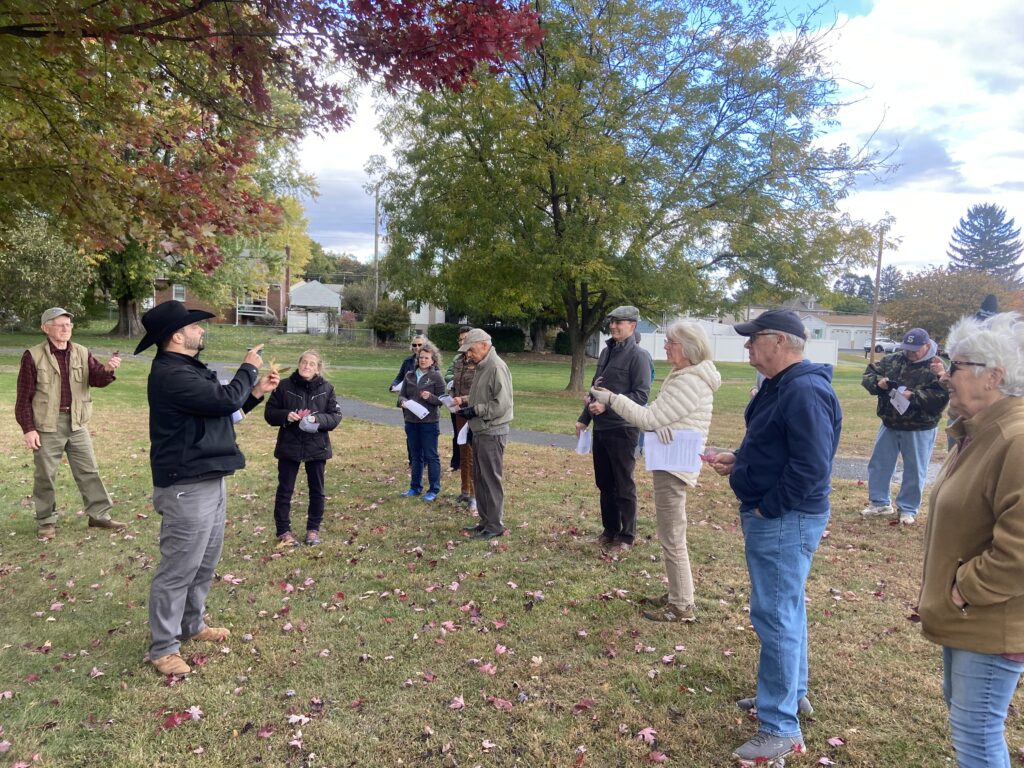
WAYNESBORO – A love of trees drew participants to a walk Oct. 24 in Rotary Park in Waynesboro to learn more about the woody structures.
The Shade Tree Commission of the Borough of Waynesboro hosted the Tree Walk at the park on West Ninth Street to introduce the group’s pursuit of a level one arboretum accreditation for the park through ArbNet, an idea proposed by commission member Austin Lally. The walk will help fulfill criteria for the designation that includes holding an annual public event, and having at least 25 distinct species of trees (Rotary Park has 28), a mission statement and arboretum plan.
If certified, Rotary Park would be only the second arboretum in Franklin County – the other is Penn State Mont Alto, according to Tom McCloud, chairman of the Shade Tree Commission.
Dr. Bob Zimmerman, a member of Rotary Club of Waynesboro, offered remarks about the club’s funding of the project to build the park as part of the preparation for the 2005 Rotary International’s 100th-anniversary celebration. The late Rotarian Ed Hykes, who had perfect attendance at Rotary meetings for 65 years, “really pushed for it,” Zimmerman added. Rotarian Brian Stum designed, selected and planted the trees at the park, which was formally dedicated in June 2008.
“The benefits of trees are copious,” said Derek Furry, a certified master arborist with Bartlett Tree Service and a Rotarian, who led the walk. “In communities with trees, people are healthier and there is less crime,” he added.
“Trees come from the woods and here (at the park) they’re living outside normal conditions. Look at their shapes,” Furry told participants. “They look like hot air balloons. They grow to fill their space … trees have a different form in the woods because they are competing for sunlight.
“How you plant sets a tree up for its lifetime. Don’t put a $200 tree in a 10-cent hole,” added Furry.
“The trees at Rotary Park and all on Main Street have individual identification numbers, an asset the borough uses as a maintenance tool,” McCloud said. “Anyone can report damage to a tree. The trees in Northside, Mount Airy and Memorial parks will be assigned ID numbers next year,” he added.
The group stopped to examine a red maple tree, which Furry called “the most common tree east of the Mississippi. It spreads prolifically. What you see (on trees) in the fall are their true colors. The chlorophyll disappears and the true pigmentation is being revealed.”
As the group walked around the park, they looked at other trees that dot the landscape, including, locust, magnolia, mulberry, evergreen, Norway spruce, dogwood, red oak, white oak, river birch, Japanese tree lilac, serviceberry, red bud, Colorado blue spruce, Bradford pear, weeping cherry and yellow poplar. Furry highlighted information about their history, culture, concerns and management practices.
Lynn Teach and Beth Skroban, instructors at Buttonwood Nature Center in Waynesboro, said they attended the walk “because we love trees and the outdoors.”
“We sponsored the walk for people in Waynesboro to know more about their trees,” added Shade Tree Commission member Dana Poole. “Trees are a thing to share generationally, and we need to know how to care for them.”
For more information, readers may contact the shade tree commission at [email protected].