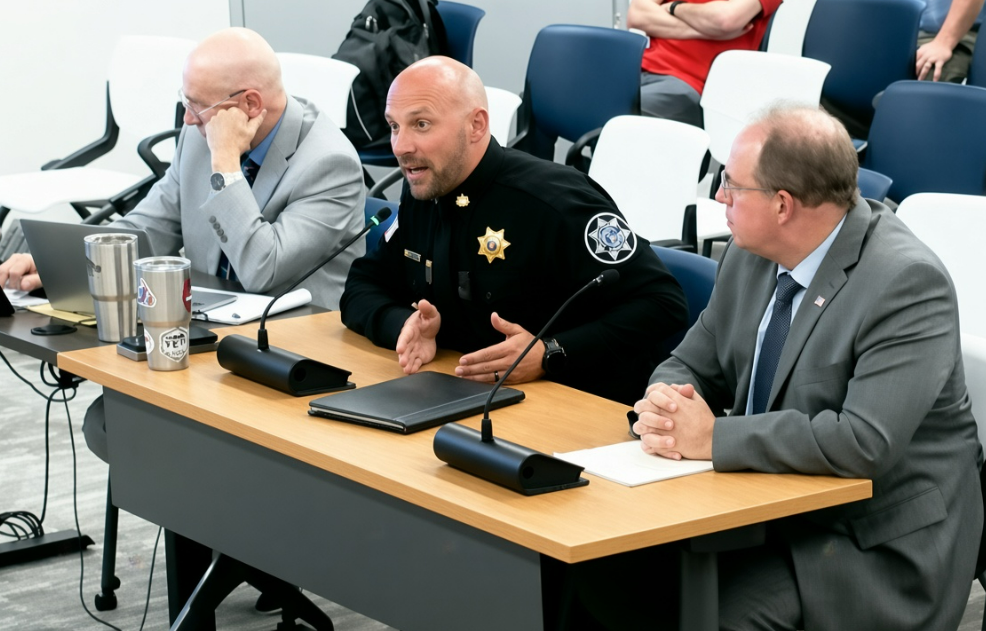
CHAMBERSBURG, Pa. — Franklin County Sheriff Ben Sites defended the county’s use of automated license plate readers Wednesday, pointing to dozens of criminal cases in which the technology helped police locate suspects, stolen vehicles and missing people as residents pressed officials over privacy and government tracking.
About 16 members of the public spoke during a lengthy commission meeting devoted largely to the Flock camera system. The comments were overwhelmingly critical of the cameras or called for tighter restrictions, while support for the system came primarily from law enforcement officials.
Sites said he had identified 37 cases in which automated license plate reader information produced useful results for law enforcement. He described about 17 of them during the meeting, ranging from apprehension of wanted suspects to missing-person and violent-crime investigations.
In one case, Sites said the system located a stolen vehicle whose driver was wanted for robbery. Police arrested the driver and found a juvenile reported missing from another state in the passenger seat.
A camera in Greene Township also captured an image of a homicide suspect’s vehicle that was distributed to police before the suspect was taken into custody. Sites said Flock cameras assisted this month in the investigation and apprehension of a juvenile rape suspect.
Sites described Flock as an investigative tool rather than a general traffic-enforcement system. The cameras photograph license plates and vehicle characteristics and can alert police when a plate matches information involving stolen vehicles, wanted or missing persons, Amber and Silver alerts or law enforcement hot lists.
He said Flock does not automatically alert officers about minor traffic violations such as expired registration, and searches require a law enforcement purpose and case number. An officer must corroborate an alert before taking enforcement action.
The county-controlled cameras currently store static vehicle images for 30 days, Sites said. That retention period will be reduced to seven days as Flock changes its standard.
Sites said searches are auditable, and suspicious use can trigger automatic audit notifications. Misuse can be reported to state and federal authorities and the district attorney’s office and could result in administrative or criminal consequences.
“I will always consider that tug between privacy and public safety,” Sites said. “Always.”
DA says current use meets law
District Attorney Ian Brink told commissioners that existing court decisions support law enforcement’s use of automated license plate readers on public roads.
Brink cited Pennsylvania and federal cases holding that motorists generally do not have a reasonable expectation of privacy in license plates and vehicle movements visible on public thoroughfares.
He said Pennsylvania case law has found that use of an automated license plate reader database does not violate a driver’s reasonable expectation of privacy under those circumstances.
Brink said the license plate reader cases reaching his office have been tied to criminal investigations rather than general monitoring of drivers. He cited murder and sexual assault investigations as examples of cases in which police were trying to locate a specific vehicle or person.
His office previously rejected a request to use Flock information to track someone when the request was not connected to a legitimate criminal investigation, Brink said.
“It was not a legitimate purpose,” he said. “It wasn’t assigned to a case that was being investigated.”
Residents focus on searchable database
The sharpest disagreement centered not on whether police can photograph a license plate on a public road, but on what happens when large numbers of those observations are stored and made searchable.
Robert Clayton, who told commissioners he works in data and information systems, said individual scans reveal little by themselves. A database containing millions of scans, he said, can show patterns involving where people work, worship, shop and go to school.
“The issue isn’t whether police can see my plate on a public road,” Clayton said. “[It’s] whether government should be able to assemble a detailed searchable history of a person’s movements without first convincing a judge there’s a legitimate reason to do so.”
Clayton acknowledged the system’s value in finding stolen vehicles, missing people and suspects in serious crimes. He asked officials to reduce data retention to seven days, establish independent auditing and require stronger controls when outside agencies seek access.
“Trust is not a control. Verification is,” Clayton said.
John Patterson drew the same distinction between a roadside observation and the accumulation of those observations over time.
“It’s not the camera; it’s the database,” Patterson said. “It’s the database that reveals who we are, what we do, who our friends are, who our associates are, and how we choose to conduct and live our lives.”
Other speakers questioned how the technology could be used years from now, whether information could be shared across jurisdictions and whether current safeguards would survive changes in sheriffs, commissioners or technology.
Sites says private cameras can aid police
The Flock network includes cameras purchased by private businesses, as well as those operated by law enforcement.
Sites said businesses such as Lowe’s, banks and convenience stores maintain their own separate data but can choose to share camera captures with law enforcement. Private businesses cannot access police hot lists or the National Crime Information Center database, he said.
Sites also pushed back against criticism that the system amounts to constant surveillance and said other automated license plate reader systems already operate in Franklin County.
“Law enforcement need these things,” Sites said. “There’s not enough staff, there’s not enough time, there’s not enough money.”
Commissioners take no action
Commissioners said at the outset that they had not taken a collective position on Flock and stressed that Sites is an independently elected sheriff. The board approved spending for the system through the sheriff’s office budget but does not directly manage law enforcement operations.
Vice Chairman John Flannery said after the public comments that he agreed with some of the concerns raised and expected commissioners to continue discussing the issue. He also said the potential to locate a kidnapped child illustrated the public-safety value that makes the decision difficult.
“If somebody kidnaps and steals one of my grandkids, there’s gonna be problems,” Flannery said. “That’s the one time I hope he has Flock, and I hope it’s working.”
Commissioners took no vote on the cameras before adjourning.