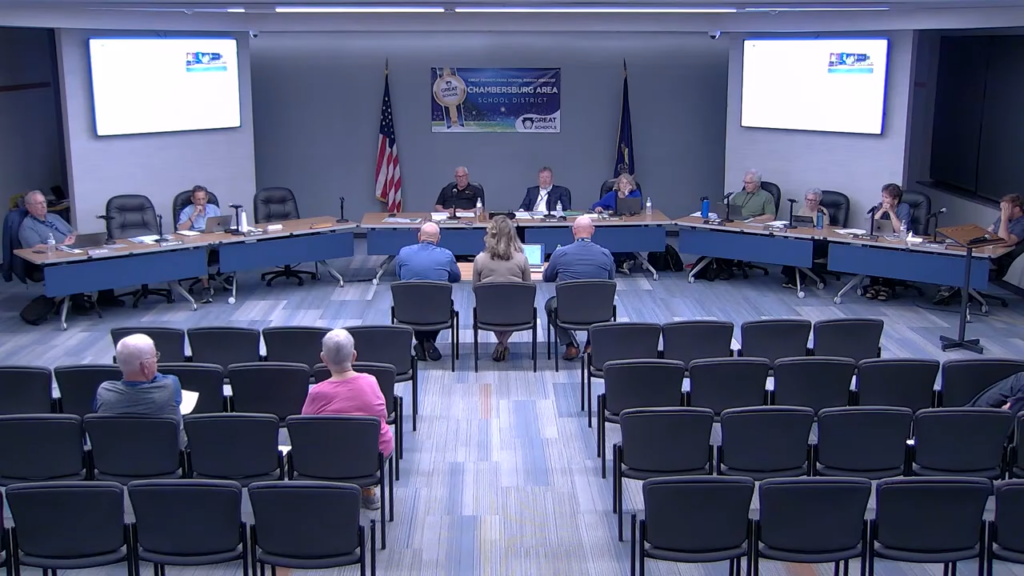
CHAMBERSBURG, Pa. — Staffing concerns emerged at Tuesday’s school board meeting as members questioned the length and location of the high school’s study hall and how many students are assigned to it instead of classes.
Deborah Luffy, director of grades 9-12, led a presentation on the need for change at the high school level. One concern raised afterward was that, due to the transition to block schedules, students sit in the school’s auditorium for an hour and 20 minutes, and in some cases two hours, during study hall.
Block schedules use fewer, longer class periods (typically 75 to 120 minutes) each day, while traditional schedules use more classes (usually 6 to 8) that are shorter (typically 35 to 55 minutes) and meet every single day.
Chambersburg Area Senior High School Principal Rodney Brenize stated that the auditorium is the best location because it can hold the most students while keeping staffing needs low.
“The ideal situation is to have them in classrooms with the fewest number of students in study hall as possible. That’s the goal,” Brenize said.
The exact number of students in study hall was not provided, but Luffy theorized that most students are freshmen. She noted that seniors begin internships and other outside experiences during the spring semester, which opens classroom seats and leaves fewer underclassmen in study hall.
The shift to a block schedule also reduced the number of classes teachers have. Under a traditional schedule, a teacher could teach seven classes a day. With the block schedule, that number dropped to six, giving teachers less class time.
Maintaining the same student capacity after switching to block schedules often requires additional staff to cover the gap. However, the district did not adjust staffing levels.
Superintendent Christopher Bigger said he decided to hold off on adding staff during the last budget season because of uncertainties in state funding and healthcare costs.
“We’re in a better spot now to even be in front of you for that ask,” he said. “So, part of the delay from [the admin team] asking was me saying we can’t afford the staff yet.”
School Board President Edward Norcross voiced concerns about focusing on the wrong goals during budget season, such as building the new middle school instead of prioritizing staffing and education, when discussing schools of distinction.
“I don’t think we lost focus,” Bigger said, “I think from the budgetary standpoint, the board standpoint: perhaps. But not internally.”
He pointed out that they didn’t have Luffy or Brenize over a year ago, who had collected and analyzed data to support and recommend changes at the high school level.
“From my view, it’s coming to you at the right strategic times,” Bigger said, “and asking at the right time when we know what we’re asking for versus running to just ask for more.”
Although the need for teachers was recognized, Bigger advised against reopening the budget mid-year to hire additional staff. The existing budget could still be adjusted to reallocate funds for the necessary resources, but limits remain on how many staff can be added for the spring semester.
Board members acknowledged staffing constraints and requested a solution for the upcoming spring semester, agreeing to support the high school’s need for additional teachers.
The administrative team’s most immediate solution was to add a co-op teacher for the spring semester. Luffy also suggested offering electives exclusively for freshmen to reduce the number of students in study hall.
Luffy presents changes for grades 9-12
Next year, all ninth-grade students will attend Chambersburg Area Senior High School, as the Career Magnet School will transition to grades 10-12 only. This year, the two schools will hold a single senior graduation, rather than separate graduation ceremonies.
Luffy revealed that overall Keystone proficiency rates were low. These end-of-course exams cover literature, biology, and algebra.
Currently, ninth graders take algebra and biology, while tenth graders take biology and literature. Beginning next year, the district will administer all these exams at the ninth-grade level, as all ninth graders will be at one high school.
This year, students will take one Keystone exam per day rather than two. Luffy also wanted students to test with teachers they know and trust, believing those relationships will help motivate them during the exams.
Previously, literature and biology scores have been average compared with state scores; Luffy would like to improve on that. “Not where we want them to be, but right around the state average. And so, we would like a more rigorous result.”
One recommendation from the state is to retest students with nonproficient scores after additional instruction, called remediation. Remediation is required for retesting, and the district does not currently offer it.
The administrative team proposed a tiered Keystone retesting plan that would incorporate remediation into the next course in a student’s sequence. Luffy stated that, for example, a student who tested after Algebra 1 could receive remediation in Algebra 2 and retest subsequently.
A nonproficient retest score would be accepted if it improved upon the student’s initial result. Students whose nonproficient scores do not improve would be enrolled in an online elective until they demonstrate progress.
“So, we, as a team, feel very strongly that this is something that we want to pursue and that we want to make this as part of our graduation recommendation requirements for our students…” Luffy said.
As part of another change to graduation requirements, the administrative staff calculated that students could earn up to 32 credits, at eight per year. The current graduation requirement is only 23, leaving a substantial gap between available and required credits.
“What we’re looking at is, you know, how to increase the rigor of all of our courses…” Luffy said. “Our goal is that we are a very competitive district.”
The administrative staff recommended increasing the number of credits to 25 by adding one credit for internships and one additional credit for electives, bringing the total number of electives to eight.
Additional staff would be required: about six for internships and about 10 for electives, with hiring staggered over a few years. Students could complete internships over the summer or during their senior year.
Career centers will launch in the 2028-29 school year for both the high school and Career Magnet School, with the curriculum, admissions processes and marketing strategies currently under development.