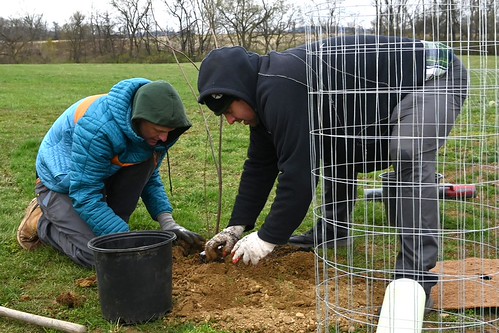
Since 2021, Maryland’s 5 Million Trees program partners and supporters have planted more than 1.5 million native trees across the state. While significant, 3.5 million more trees must be planted to reach the state’s ambitious goal of planting 5 million trees by 2031. Marylanders can play a direct role in closing that gap.
Marylanders can join the effort by planting and registering trees. Interested individuals can participate through available programs for landowners and communities, partner with a local tree planting specialist to initiate a project or work with a forester for technical assistance.
“Trees help fight climate change, absorb carbon, provide clean oxygen and improve air quality in urban and rural areas,” said Isaac Whitmore, 5 Million Trees program coordinator for the Maryland Forest Service. “They also reduce urban heat, support wildlife habitat, and improve water quality in local waterways and the Chesapeake Bay.”
When to Plant
Spring is a great time to plant trees as it gives young trees a strong start during the growing season. As temperatures warm and daylight increases, trees begin actively growing roots and leaves, which helps them establish quickly. Spring typically brings more consistent rainfall, reducing the need for frequent watering. Fall can also be a good time as cooler temperatures reduce stress on the tree while still allowing roots to grow in warm soil.

What Trees Count
To count toward the 5 Million Trees goal, plantings must meet the following criteria:
- Have been planted after July 1, 2021. Past plantings may be registered. For large-scale plantings, Marylanders can contact Isaac Whitmore at [email protected] for assistance to register trees.
- Support afforestation, which means in areas where tree cover has historically been absent.
- Be native to Maryland. This includes more than 60 species, most of which are included on the recommended tree list.
At least 10% of the trees must be planted in urban underserved areas as defined by Maryland’s Tree Solutions Now Act of 2021. The program prioritizes planting in urban underserved areas, including neighborhoods that:
- Were redlined or graded as hazardous by the Home Owner’s Loan Corporation.
- Have an unemployment rate higher than the state average.
- Have a median household income at or below 75% of the state’s average.
- Are located within a housing project.
Marylanders can access an interactive map to see the qualifying urban underserved areas.
When in doubt, Marylanders can contact their local tree planting specialist to see if their project qualifies for the 5 Million Trees count. The Maryland Forest Service is available to assist both public and private landowners interested in tree planting.
Numerous programs exist for anyone looking to join the initiative:
Ways to Get Involved in Urban Areas
- Everyone can take advantage of the Marylanders Plant Trees coupons, which give $25 off a purchase of a tree valued at $50 or more from participating nurseries.
- The Maryland Forest Service Tree-Mendous Maryland program is aimed at helping citizens restore tree cover on public land and community open space in Maryland.
- The Chesapeake Bay Trust’s Urban Trees Award Program provides grants to fund tree planting projects in urban, underserved areas.
- The Maryland Urban and Community Forestry Council provides grants for community groups to fund tree planting and education projects in Maryland’s urban forests. The committee also provides funding for MDOT Transportation Reforestation Grants that support tree replanting in areas where canopy was lost due to transportation infrastructure projects.
- The Backyard Buffer Program provides free seedlings for homeowners to grow native tree and shrub buffers to protect streams and waterways.
Support Available for Rural Landowners
- Healthy Forest, Healthy Waters is a partnership between the Maryland Forest Service and the Alliance for the Chesapeake Bay, which provides technical assistance to public and private landowners. Afforestation projects of one acre or more include three years of maintenance and are free to the landowner.
- Forest Stewardship Assistance offers technical and financial support for landowners to manage and care for their forests. Forest stewards will assist landowners to take advantage of programs such as
- Woodland Incentive Program, which provides financial assistance for private, non-industrial woodland owners with 5 to 1,000 acres.
- Environmental Quality Incentives Program, a multi-agency program assisting landowners in improving agricultural and woodland practices.
- Conservation Reserve Enhancement Program (CREP), which supports forest buffers and wetlands on farmland to protect wildlife and improve water quality.
- Maryland Agricultural Water Quality Cost-Share Program offers farmers grants covering up to 100% of the cost to install best management practices that prevent erosion, manage nutrients, and protect water quality.
- Maryland’s Conservation Buffer Initiative provides farmers with incentive payments to plant streamside buffers on farmland to improve the health of local streams and the Chesapeake Bay.
- The Western Maryland Resource Conservation and Development Council builds and sustains resource conservation programs that raise the quality of social, economic, and environmental development in Garrett, Allegany, Washington, and Frederick counties.
To track progress of the 5 Million Trees initiative, citizens can visit the program website or follow DNR on Facebook.