HAGERSTOWN, Md. — For nearly four decades, Georgene Charles has helped turn 23,110 small points of light across Antietam National Battlefield into one of Washington County’s most recognizable traditions.
Now, after organizing 35 Memorial Illuminations over 38 years, Charles is stepping away from the event she helped create, leaving behind a volunteer operation that has grown to involve about 1,500 people each year.
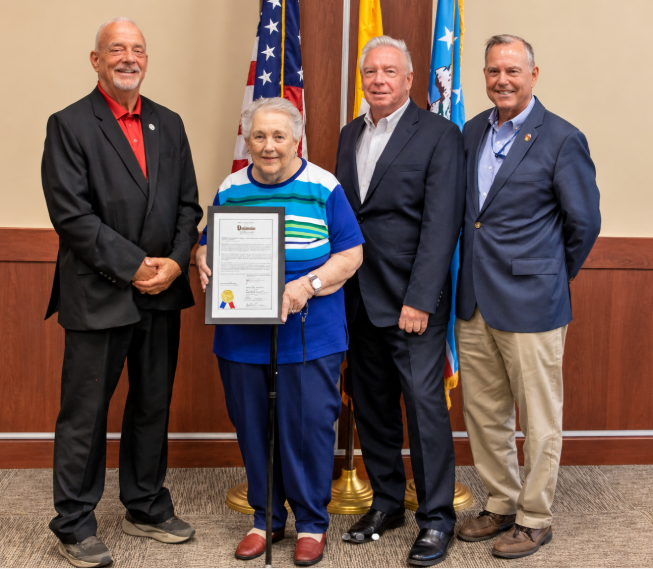
Washington County commissioners recognized Charles Tuesday for her longtime leadership of the annual illumination, which places one luminary for each soldier killed, wounded or missing during the Battle of Antietam.
The National Park Service recognized Charles with its Enduring Service Award in 2017, crediting her with coordinating the volunteers, supplies and logistics required to place and light the thousands of luminaries across the battlefield. NPS said the event draws more than 10,000 visitors in a typical year.
Charles told commissioners the event has become a multigenerational tradition for many of its volunteers.
She has watched children and scouts who once helped place the luminaries grow up, go to college, marry and eventually return with children of their own.
“They bring the next generation back,” Charles said.
That attachment to the illumination has sometimes continued even after death. Charles recalled one longtime volunteer whose remains were spread near the Clara Barton monument at the battlefield during a ceremony attended by about 80 people and accompanied by bagpipers.
But one of the stories that has stayed with Charles most happened only recently.
She said organizers learned of a woman with stage-four cancer who had placed participating in the Memorial Illumination on her bucket list. Charles contacted volunteers with the Knights of Columbus stationed near Dunker Church and arranged for the woman to join them.
“She came, and she helped lay out luminaries and light luminaries,” Charles told commissioners.
Charles said she recently checked on the woman and learned that she is still battling the disease. “She said, ‘I’ll be back next year,’” Charles recalled.
The Memorial Illumination traces its beginnings to 1988, when Charles spearheaded the first event. The National Park Service later described her role as extending far beyond recruiting volunteers, including assigning groups to fields, coordinating the placement of luminaries, ordering materials and organizing the volunteer ceremony.
Charles has said the idea grew from an earlier project she organized in 1986 in which thousands of Maryland schoolchildren released 23,110 balloons to commemorate the battle’s casualties. When the idea of using candles was proposed later, the illumination began taking shape.
Tom Riford, a member of the Antietam National Battlefield Committee, told commissioners that Charles has overseen 35 illuminations during a 38-year span, with interruptions including the COVID-19 pandemic.
He said the event can draw more than 20,000 people when weather conditions are favorable.
Charles has done all the work without pay. She estimated that the value of the volunteer labor contributed to the illumination over the years exceeds $10 million.
Although Charles is retiring from her leadership role, she told commissioners the illumination itself will continue.
Tuesday’s recognition happened to fall on another milestone for Charles. She and her husband, Ron, were celebrating their 47th wedding anniversary.
After decades spent coordinating thousands of volunteers and tens of thousands of lights, Charles said she is ready to turn the work over to others.
The tradition, she made clear, is not retiring with her.