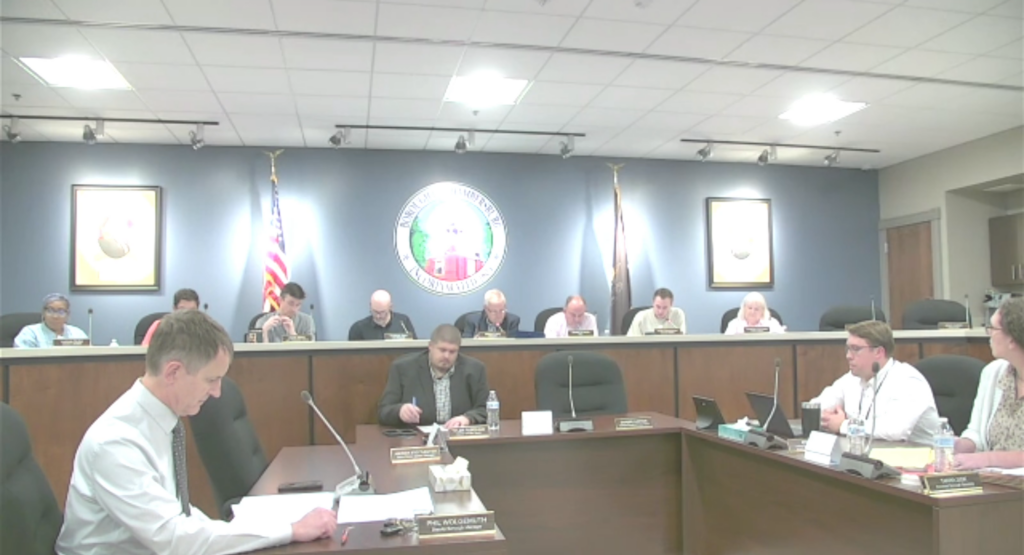
CHAMBERSBURG, Pa.- A fee increase in the storm sewer utility was recommended to the Chambersburg Borough Council during its budget presentation at Monday’s meeting.
The borough plans to lease the storm sewer utility to the Chambersburg Area Municipal Authority, subject to council approval. The agreement would allow the borough to continue operating and maintaining the system, Deputy Borough Manager Phil Wolgemuth said.
The change follows the Pennsylvania Supreme Court’s decision in the West Chester stormwater fee case earlier this year, which deemed the stormwater maintenance fees a tax and exempted government-owned properties from paying them.
The current $6 per equivalent residential unit monthly rate, where one unit equals 2,920 square feet of impervious area, will likely rise to $9 per equivalent residential unit. The municipal authority will ultimately be responsible for setting the rates.
This increase will generate an estimated $2.4 million in revenue for 2027, with the borough receiving about $1.5 million to maintain and operate the utility. The municipal authority will retain $900,000 to cover additional overhead operating expenses and contribute to the capital reserve account.
“Quite a list of capital improvements that are coming, multi-million-dollar projects completed this year,” Wolgemuth said. “They’ve, for the most part, depleted our bond and our capital budget. So, that does need replenished.”
Storm Sewer Utility Budget Presentation Continued
The Storm Sewer Pollution Control Fee and Credit Program is expected to bring in $1,627,272 by the end of the year. The fee has two classifications: single-family residential, accounting for 32% of revenue, and non-single-family residential, accounting for the remaining 68%.
Bond-financed projects include the Southgate Shopping Center, North Fourth Street, South Fifth Street and Industrial Drive.
Southgate Shopping Center is projected to cost about $3.3 million for the first and second phases, with the U.S. Army Corps of Engineers providing about $2.5 million and the storm sewer bond covering the remainder.
North Fourth Street has an estimated project cost of around $2 million to install 1500 feet of new concrete box culverts. The street will be returned to two-way traffic from Nelson Street to King Street.
The South Fifth Street project costs about $1.8 million to provide 2,500 feet of new pipes and inlets, while the Industrial Drive project will cost around $1 million for new pipes from South Main Street to Hollywell Avenue. Next year will likely include work at the Progress Road intersection.
The borough also has many capital reserve and grant-funded projects. East Catherine Street storm sewer improvements are estimated at $1.3 million, with work expected to be completed before next year’s street reconstruction.
The 195 West Loudon Street building will be demolished at an estimated cost of $254,255, funded by a FEMA grant, and the Conococheague Creek floodplain will be restored at an estimated cost of $541,647.
The South Franklin Street retaining wall will be replaced at an estimated cost of $1.4 million, and Chambers Fort Park will receive a retaining wall for $2.5 million, with design still needed and funding sources to be obtained for both projects.
The Falling Spring Presbyterian Church floodplain restoration is estimated at $383,626, with grants still pending to cover construction costs.
A CCTV improvement project, which brought in a contractor to clean and televise the current system, was projected to cost around $2 million, but the department has saved money by working together to find more cost-effective solutions.
“These projects that we are doing are only going to enhance how stormwater moves around our community and alleviate flooding,” Council President Bill Everly Jr. said.
Land Use and Community Development Department Budget Presentation
Wolgemuth stated that the code budget was on track, with the total budget set at $974,477. As of Sept. 30, the department spent around $567,437.
The Retail Food Facility License Program, an in-house inspection program for food service establishments, implemented a simplified fee schedule this year to reduce Borough subsidization from 80% to 60%. No changes were recommended for next year.
The Residential Rental Unit Inspection Program is currently administered by a third party, the Pennsylvania Municipal Code Alliance, which conducts code enforcement inspections
for $75,000 per year, plus a $25 program fee per unit inspected. There will be no changes to these amounts next year.
Wolgemuth highlighted changes recommended to the program itself:
· Extend the 36-month inspection period to 48 months
· Include a free review where property owners can request borough code enforcement to review cited violations by the third party.
· Waive the $35 reinspection fee for the first reinspection only
· Allow photographs as proof of compliance for reinspection
· Add language to clarify “substantial areas” of peeling, chipping, flaking paint that result in a violation
· Provide an inspection outline to property owners prior to inspections
The Planning and Zoning Office is also on track with its budget. As of Sept. 30, planning has spent about $93,000 of its $145,465 annual budget, while zoning has spent about $37,000 of its $49,055 allocated budget.