HARRISBURG, Pa. — Pennsylvania voters delivered significant gains for Democrats in Tuesday’s general election, reelecting Gov. Josh Shapiro, shifting four Republican-held congressional seats to Democrats and moving the party closer to controlling both chambers of the state Legislature for the first time in more than three decades.
The results marked a substantial change in Pennsylvania’s political landscape, particularly in competitive suburban and eastern Pennsylvania districts, where Democrats defeated several Republican incumbents.
While many races had been called by early Wednesday, some legislative contests remained unresolved, leaving the final balance of power in Harrisburg subject to additional vote counting.
Shapiro wins second term
Democratic Gov. Josh Shapiro defeated Republican state Treasurer Stacy Garrity to secure another four-year term.
Unofficial statewide results showed Shapiro receiving 2,988,002 votes, or 60.28%, compared with Garrity’s 1,904,484 votes, or 38.42%, with 98% reporting.
Libertarian Kenneth Krawchuk received 64,234 votes, or 1.30%.
Shapiro’s statewide victory contrasted with results in several Republican-leaning counties, including Franklin County, where Garrity received approximately 61% of the vote.
Democrats flip four congressional seats
Democrats also made significant gains in Pennsylvania’s congressional delegation, flipping four U.S. House seats previously held by Republicans.
The Democratic victories included competitive races in Bucks County, the Lehigh Valley, northeastern Pennsylvania and south-central Pennsylvania.
Among the changes, Democrat Bob Harvie defeated longtime Republican U.S. Rep. Brian Fitzpatrick in the 1st Congressional District.
The congressional gains were part of a broader national shift toward Democrats in the midterm elections.
Republican U.S. Rep. John Joyce, however, retained his seat in Pennsylvania’s 13th Congressional District, which includes Franklin County.
Democrats claim control of state Senate
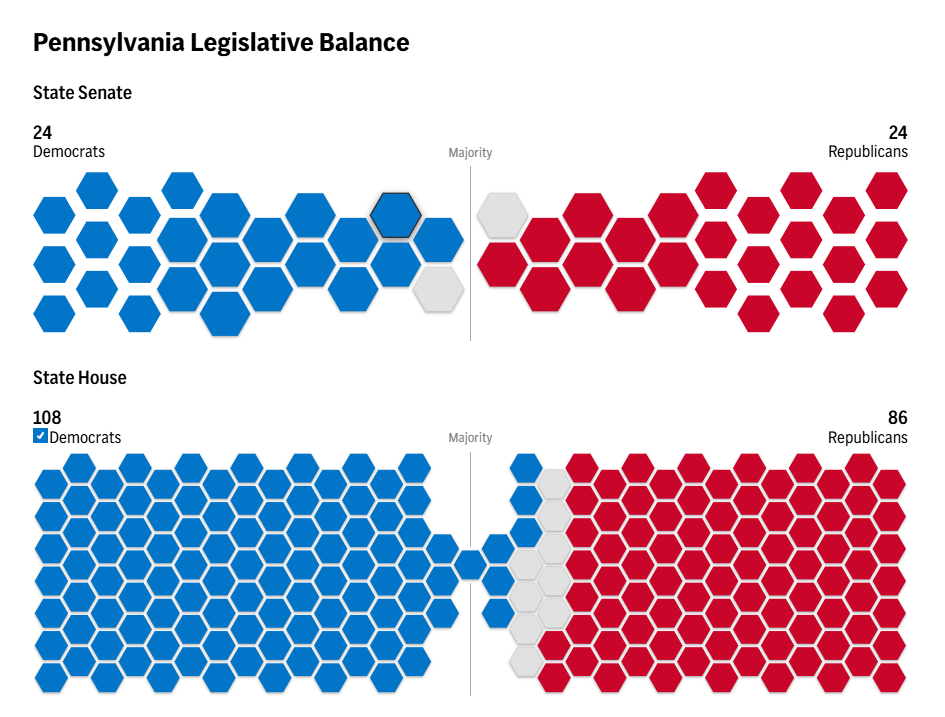
One of the election’s most consequential developments came in the Pennsylvania General Assembly, where Democrats claimed they had secured enough victories to take control of the state Senate.
Republicans entered Election Day holding a 27-23 majority in the 50-member chamber.
Democrats reported victories in several Republican-held districts, including contests in Bucks, Berks, Montgomery, Lehigh and northeastern Pennsylvania counties.
Among the Democratic candidates claiming victories were Eileen Hartnett Albillar, Mark Pinsley, Chris Thomas and Brian Wrightson.
Republicans also gained a seat in Lancaster County, where Tom Jones defeated Democratic incumbent James Malone.
Democrats said the combined results would give them a narrow Senate majority.
However, the Associated Press had not called every outstanding Senate contest early Wednesday. At one point, its election projections showed the chamber divided 24-24, with two races unresolved.
If Democrats secure the majority while maintaining control of the state House, the party would hold the governor’s office and both legislative chambers for the first time since 1993.
Democrats expand state House majority
Democrats also strengthened their position in the Pennsylvania House of Representatives.
The party entered Election Day with a narrow majority and secured victories in several competitive districts previously represented by Republicans.
By early Wednesday, the Associated Press had projected Democrats to win at least 108 seats in the 203-member chamber, enough to maintain control.
The party’s expanded majority could give House Democratic leaders additional flexibility when advancing legislation.
Republican incumbents Rich Irvin, Rob Kauffman and Chad Reichard retained their state House seats in districts affecting Franklin County.
What a Democratic trifecta could mean
Control of the governor’s office and both legislative chambers would give Democrats greater opportunity to advance proposals that have faced obstacles in the Republican-controlled Senate.
Shapiro and Democratic legislative leaders have identified several priorities, including increasing Pennsylvania’s minimum wage to $15 an hour, expanding housing development, protecting abortion rights and changing the statute of limitations for survivors of childhood sexual abuse.
Other issues that could receive renewed consideration include legalizing recreational marijuana and establishing a regulatory and tax structure for skill game machines.
A Democratic majority would not guarantee passage of those measures. Lawmakers would still need to negotiate legislation and secure sufficient votes in both chambers.
Results remain unofficial
Pennsylvania election officials reported relatively few major disruptions during Tuesday’s voting, although isolated polling place delays and equipment issues occurred in several counties.
Secretary of the Commonwealth Al Schmidt credited county election officials and approximately 45,000 poll workers for administering the election across more than 9,000 polling locations.
Counties will continue processing outstanding ballots before results are certified.
The final composition of Pennsylvania’s General Assembly will become clearer as remaining legislative contests are called and vote totals are finalized.