BOONSBORO, Md. — Boonsboro has suspended plans to install a new system of license plate-reading cameras and arranged to postpone approximately $93,000 in payments until July 2028, following weeks of public opposition over privacy and government transparency.
At the Oct. 12 Town Council meeting, Police Chief Dave Rizer said the town’s existing Flock cameras had been deactivated and would be removed. The replacement cameras, supplied by Axon, will not be installed while town officials reconsider the program.
The decision represents a significant retreat from the town’s earlier plans, but it is not a cancellation. Boonsboro remains under contract with Axon, and the council has not decided whether residents will be allowed to vote on the cameras’ future.
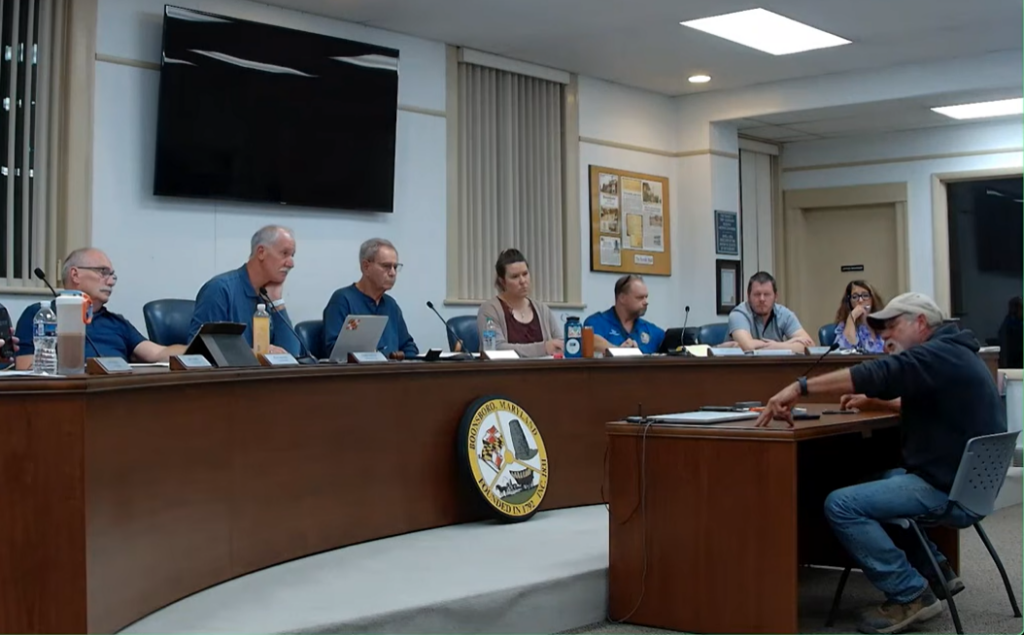
The announcement followed an Oct. 5 public meeting at which dozens of residents questioned the surveillance program. Opposition continued at the Oct. 12 meeting, where resident David Bell presented a petition that had grown from 109 to 172 signatures in one week.
Contract payments postponed
Rizer told the council that Axon had offered to delay the license plate reader portion of its contract, with no additional payments for that equipment due until July 2028.
The approximately $92,802 commitment would be paid in three annual installments if the town ultimately proceeds with the program.
Separately, the town would pay approximately $57,434 for police body cameras and Tasers, using existing departmental funds and a newly awarded grant.
Rizer said Axon had expressed willingness to work with the town if officials decide against the cameras, potentially allowing the money to be applied to other police equipment. But no alternative agreement has been reached, and the company has not agreed to release the town from its financial obligations.
The chief cautioned that canceling the cameras might still leave Boonsboro responsible for the money under the existing contract.
He said the July 2028 deadline would give the council time to consider its options, including a possible referendum. The next regular town election is scheduled for May 2028.
Residents demand a voice
Much of the Oct. 12 discussion centered on whether the council should make the final decision or put the question directly to voters.
Bell and other residents argued that the town should not proceed with the surveillance program without broader public consent. Speakers raised concerns about data security, outside vendors’ access to information and the potential for tracking vehicles traveling through town.
The dispute has also become a test of public trust.
Maryland’s Open Meetings Compliance Board previously found that Boonsboro violated state law by failing to identify the camera proposal on its July 2025 meeting agenda, despite knowing the subject would be discussed. That finding has become a recurring point of contention as residents question how the program was approved.
At the Oct. 12 meeting, Bell challenged Rizer over communications with Axon obtained through public information requests. He questioned whether the police department had been working with the vendor to preserve the camera program despite public opposition.
Rizer rejected that characterization, saying his discussions with Axon were intended to find a way forward that would protect the town from unnecessary financial losses.
Other speakers called for independent technical advice and greater public involvement before any decision to restore the cameras.
The opposition was not unanimous. Some residents defended the value of license plate readers in police investigations, while others argued that elected officials must be able to make public safety decisions without putting every equipment purchase to a vote.
Chief acknowledges controversy
Rizer, who has defended the cameras as a crime-fighting tool, acknowledged that the public debate had become increasingly contentious.
He recalled his experience working on the investigation of the 2002 Beltway sniper attacks, explaining that it helped shape his belief in the value of technology that could assist police in identifying suspect vehicles.
But he also acknowledged becoming defensive during the dispute.
“I’m going to stop being defensive because it’s wrong,” Rizer said.
The chief indicated that he was willing to give residents and council members time to consider the issue rather than press ahead with installation.
He also suggested that a public safety committee or other community forum could help the town evaluate the technology and determine whether residents support its use.
No final decision
Council members discussed a possible workshop, citizen committee and referendum, but took no final action on those proposals.
Officials also considered whether the Axon contract could be revised to provide other police equipment if the town abandons license plate readers permanently.
For now, the immediate rollout has stopped, but the larger questions remain unresolved: whether Boonsboro will ever reactivate a license plate camera program, how it will settle its contract with Axon and whether residents will have a direct vote on the decision.
The town has bought time to answer those questions. It has not yet settled them.