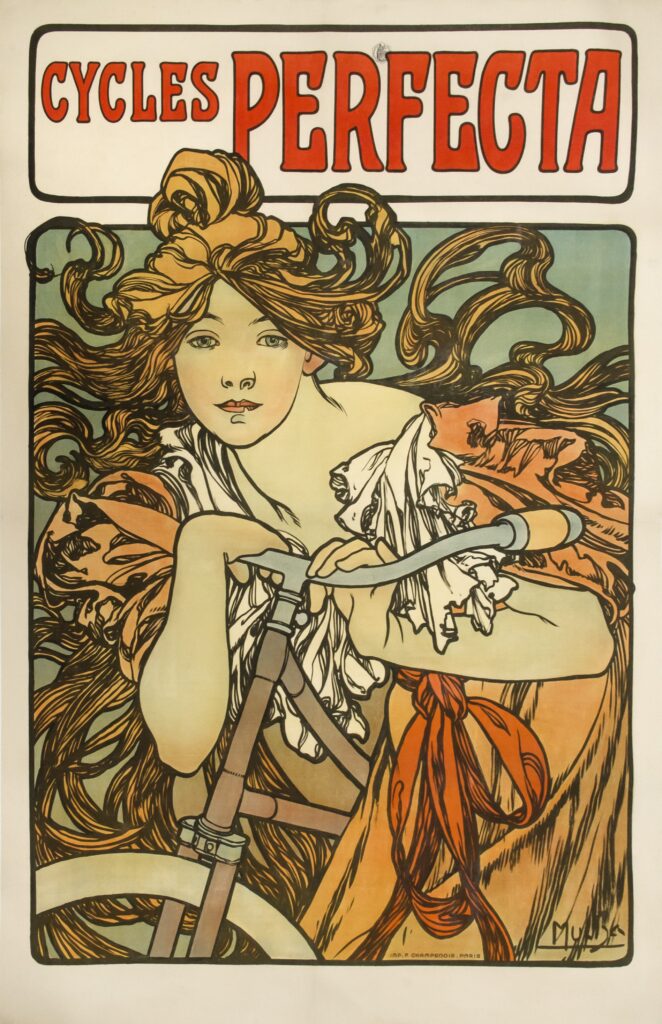
HAGERSTOWN, Md. — The Washington County Museum of Fine Arts invites visitors to step into the world of Alphonse Mucha (1860-1939) with “Alphonse Mucha: Master of Art Nouveau,” a major exhibition, featuring more than 70 works by the celebrated Czech artist.
The exhibition examines the career, influence, and enduring legacy of the artist whose elegant figures and decorative designs became synonymous with Art Nouveau and transformed the visual culture of the modern world.
More than a century after his images first appeared on the streets of Paris, Mucha’s work remains instantly recognizable. His flowing lines, floral motifs, luminous colors and idealized female figures helped define the aesthetic of the Belle Époque, influencing generations of artists, designers, illustrators, advertisers and filmmakers.
Yet beyond their decorative beauty, his works offer a fascinating window into a period of dramatic cultural change and raise enduring questions about the representation of women in art and commerce.
“Visitors may come expecting beauty—and there is certainly beauty everywhere in Mucha’s work,” said Executive Director Sarah Hall. “But they will also discover an artist whose career intersected with major social, political and cultural movements of his time.
“This exhibition explores not only how Mucha created one of the most influential visual styles in history, but also how his images continue to shape conversations about gender, celebrity, consumer culture, and national identity.”
Born in 1860 in Ivančice, Moravia (now part of the Czech Republic), Mucha rose from modest beginnings to become one of the most famous artists in Europe.
After studying in Munich and Paris, he achieved international fame almost overnight in 1894 when he designed a theatrical poster for the legendary actress Sarah Bernhardt’s production of “Gismonda.” The poster’s revolutionary design stunned Parisians and launched a partnership that would transform both rtists’ careers.
A centerpiece of the exhibition is Mucha’s celebrated “Gismonda” poster, represented by a rare trial proof that reveals the technical sophistication behind late 19th-century color lithography. Standing more than seven feet tall in its final form, the poster broke dramatically with contemporary advertising conventions.
Rather than relying on crowded text and bold graphics, Mucha presented Bernhardt as an almost sacred figure, framed by Byzantine-inspired ornament and rendered with extraordinary elegance. The poster became an overnight sensation, with admirers reportedly cutting examples from Parisian walls to keep.
The exhibition also explores Mucha’s close relationship with Bernhardt, one of the world’s first international celebrities. Known as “The Divine Sarah,” Bernhardt captivated audiences across Europe and America with her commanding stage presence and unconventional performances.
Mucha’s six-year contract with the actress extended beyond posters to include costume, jewelry and set designs, establishing a creative partnership that helped define the visual identity of modern theater.
Among the exhibition’s most recognizable works is “Job” (1896), perhaps the most famous image of Mucha’s career. Created to advertise cigarette papers, the poster features a woman lost in ecstatic reverie as her flowing hair spirals around her in elaborate decorative forms.
The image perfectly demonstrates Mucha’s ability to elevate commercial advertising into fine art. Simultaneously seductive and spiritual, the composition reveals one of the exhibition’s central themes: the tension between celebrating feminine beauty and using it as a tool of commercial persuasion.
Visitors will also encounter “Rêverie” (1898), a contemplative image of a young woman absorbed in reading. Widely distributed as a decorative print, the composition became one of Mucha’s most successful commercial images. Unlike many contemporary advertisements, “Rêverie” sold no product at all. Instead, it offered beauty itself as a commodity, reflecting the Art Nouveau belief that art should enrich daily life and surround viewers with elegance.
The exhibition highlights Mucha’s versatility through works such as “Têtes Byzantines: Blonde” and “Têtes Byzantines: Brunette” (1897). These profile portraits combine references to Byzantine mosaics, medieval iconography and contemporary fashion. Their decorative sophistication exemplifies Mucha’s mastery of composition and ornament while illustrating his fascination with historical artistic traditions.
In addition to posters, the exhibition examines Mucha’s work as an illustrator, designer, photographer and printmaker. Visitors will discover how advances in color lithography made his artistic achievements possible and learn about the collaborative process that transformed his drawings into thousands of vividly colored prints distributed across Europe and America.
A dedicated section explores Mucha’s fascination with photography and demonstrates how he used the camera as a creative tool long before photographic references became commonplace in artistic practice. Photographs of models, costumes and landscapes reveal the meticulous preparation behind his finished works and provide insight into his creative process.
The exhibition also examines the philosophical and spiritual dimensions of Mucha’s art. Influenced by symbolism, mysticism and esoteric traditions, Mucha infused many of his images with references to religion, mythology and universal ideals. While modern audiences often focus on the decorative appeal of Art Nouveau, these works reveal a deeper intellectual and spiritual ambition that animated Mucha’s career.
The final section introduces visitors to a lesser-known chapter of Mucha’s life: his commitment to Czech nationalism and Slavic cultural identity. Although he achieved international fame through commercial art, Mucha increasingly devoted himself to projects celebrating the history and traditions of his homeland. His monumental cycle “The Slav Epic” became the culmination of these efforts and reflected his belief that art could serve both aesthetic and national purposes.
Exhibition special events
In conjunction with the exhibit, the museum will offer a variety of educational programs, lectures and hands-on workshops that invite visitors to engage more deeply with Mucha’s artistic practice, the Art Nouveau movement, and the culture of the Belle Époque.
Let’s Talk Art: Art in Costume
Thursday, Aug. 20, 6–7 p.m.
Join Agnita M. Stine Schreiber Curator Linda Johnson, Ph.D., for an engaging discussion of fashion, theatrical costuming and visual culture during the late 19th and early 20th centuries. The lecture will examine how period dress informed Mucha’s artistic vision and contributed to the distinctive elegance of Art Nouveau imagery.
Free to tune in.
Drawing the portrait in charcoal with added gold leaf
Three sessions
- Thursday, Sept. 10, 5:30–7:30 p.m.
- Thursday, Sept. 17, 5:30–7:30 p.m.
- Thursday, Sept. 24, 5:30–7:30 p.m.
Inspired by Mucha’s work, this three-session studio course, led by instructor Nicole Troup, introduces participants to portrait drawing in charcoal while exploring the decorative possibilities of gold leaf. Students will learn portrait proportions, shading, value relationships and edge control through demonstrations and guided practice. Participants will also visit the exhibition for inspiration as they develop their own works.
Registration Deadline: Aug. 27
Cost: $200 members | $210 nonmembers
Please Note: Art supplies are not included. A materials list is available on the museum website.
Together, these programs offer opportunities to experience Mucha’s world through making, looking, and learning—bringing the elegance, craftsmanship, and artistic innovation of Art Nouveau to life for contemporary audiences.
ABOUT THE WASHINGTON COUNTY MUSEUM OF FINE ARTS Located in beautiful City Park, Hagerstown, Maryland, the Washington County Museum of Fine Arts was founded in 1931, the legacy of Hagerstown native Anna Brugh Singer and her husband, Pittsburgh-born artist William Henry Singer, Jr. Featuring a collection of more than 8,000 objects, the museum has important holdings of American painting, Old Masters, decorative arts, and sculpture. The museum schedules an ambitious program of exhibitions, lectures, concerts, tours, and talks featuring national and international artists, as well as a yearly showcase of the art of students in Washington County Public Schools. Its free youth art education programs have served seven generations.